
How Fat Loss Supplements For Faster Results Stack Up When You Read The Actual Trials
Dick Durbin
American lawyer & senator
Millions of Americans take vitamins safely every day, including me. Vitamins and mineral supplements taken in recommended doses are safe. It's the designer supplements that are worrisome.
Summary (TL;DR)
You’ve read the labels. “Clinically proven.” “Boosts metabolism.” “Targets stubborn belly fat.” Then you read one more article, and suddenly the same ingredient is linked to liver damage. Everything sounds amazing, and five minutes later it sounds scary. If you feel overwhelmed, that’s a reasonable response to a market built on confusion.
And maybe you’re not looking for a quick fix at all. You’re eating reasonably, moving a few times a week, losing slowly, and hitting an afternoon slump by 3 p.m. That’s exactly the point in a weight loss journey when fat loss supplements for faster results start to look sensible.
You wouldn’t be alone in reaching for it: according to the NIH Office of Dietary Supplements, about 15% of U.S. adults have used a weight loss supplement, and women report using them about twice as often as men (21% vs 10%).
This guide does what the labels won’t. It takes the most common fat loss supplements one by one, shows how much extra weight each helped people lose in controlled trials, flags the safety issues, and gives you a five-point test for any product. No brands, no affiliate links, nothing to sell.
Medical & Referral Disclaimer
This article is for informational and educational purposes only. It is not a substitute for professional medical advice, diagnosis, or treatment. Always consult your physician or qualified health provider before starting any new diet, exercise program or supplement, especially if you are pregnant or breastfeeding, take any prescription medication, have a liver, heart, thyroid or kidney condition, or have a history of disordered eating.
Key Takeaways
- Expect small numbers. Even the best-studied ingredients add about 1 to 2 kg for most, and up to about 4 kg (9 lb) for psyllium, over several months compared with a placebo.
- Fiber and protein beat “fat burners.” Their benefits come from appetite control and muscle protection, not from revving your metabolism.
- Mechanism isn’t outcome. “Increases fat oxidation” in a lab doesn’t mean visible fat loss in women.
- Dose matters for safety. Caffeine above 400 mg a day and green tea catechins at 800 mg a day or more are where the warnings start.
- Prescription GLP-1 medications are a different category. They produce 15% to 21% weight loss in trials and need a doctor’s supervision.
- Your calorie deficit still does the heavy lifting.
Do Fat Loss Supplements Actually Work?
Some do, a little, and most don’t do enough to notice. The largest review of the research found that only about 1 in 20 trials of weight loss supplements was both well designed and showed a real difference from a placebo.
That 2021 review in Obesity analyzed 315 randomized controlled trials covering 14 supplements and alternative therapies. Only 52 were low risk of bias with enough data, and just 16 of those found a significant difference in weight, from 0.3 to 4.93 kg. The authors’ conclusion is blunt: supplements for weight loss “have a limited high-quality evidence base of efficacy.”
A larger 2023 network meta-analysis of 111 trials with 6,171 adults reached a similar place. Several ingredients produced “a small weight loss,” often with low-certainty evidence. The NIH fact sheet quotes the U.S. Government Accountability Office on the whole category: “little is known about whether weight loss supplements are effective.”
How Fat Loss Supplements Claim To Work
Fat loss supplements make one of four promises: burn more calories, eat less, use more fat for fuel, or keep more muscle. Only the second and fourth have consistent human evidence behind them.
Here’s how the marketing categories map to the biology:
- Thermogenic fat burners and metabolism boosters: Caffeine and green tea extract are sold to raise the calories you burn. In trials, any extra weight loss has been small and inconsistent.
- Appetite suppressants: Gel-forming fibers such as psyllium and glucomannan swell in your stomach and slow digestion, which can help you feel full on less food.
- Fat oxidation helpers: L-carnitine moves fatty acids into your cells’ mitochondria to be burned. Taking more doesn’t automatically mean burning more body fat.
- Muscle protectors: Protein powder and creatine help you keep or build lean muscle during a calorie deficit, which is the core of body recomposition.
None of these create fat loss on their own. At best, they nudge the one thing that does, your calorie deficit.

The Evidence, Ingredient By Ingredient
The table below shows the average extra weight loss each ingredient produced compared with a placebo in pooled trials.
| Ingredient | Extra Loss vs Placebo | What Was Studied | WLBF Verdict | Safety Flag |
|---|---|---|---|---|
| Psyllium fiber | About 2.1 to 3.7 kg (4.6 to 8.2 lb) | About 10 g a day before meals, roughly 5 months | Worth trying | Bloating; take with plenty of water |
| L-carnitine | 1.21 kg (2.7 lb); fat mass 2.08 kg | 37 trials; benefit leveled off near 2,000 mg a day | Modest | Generally well tolerated up to about 4 g a day |
| Whey protein | 0.56 kg (1.2 lb); fat mass 1.12 kg lower | 9 trials in adults with overweight or obesity | Worth trying | Check labels for added sugar |
| Creatine | Fat-free mass up 0.82 kg; body fat down 0.28 percentage points | 143 studies; stronger with resistance training | Worth trying for body recomposition | Scale weight may rise slightly from water and muscle |
| Berberine | 2.07 kg (4.6 lb) | 12 trials, many in people with metabolic conditions | Promising, not proven | Ask your doctor if you take any medication |
| Green tea extract | 0.04 kg outside Japan; up to 3.5 kg in Japanese studies | 12 to 13 weeks | Weak | Liver injury risk at high doses |
| Caffeine | Small, dose-dependent, highly variable | 13 trials, 606 people | Weak | Keep total caffeine under 400 mg a day |
| CLA | 0.70 kg (1.5 lb) | 7 trials, 6 months or longer | Skip | Digestive upset |
| Garcinia cambogia | 0.88 kg (1.9 lb), short-term only | 9 pooled trials | Skip | Linked to liver injury reports |
| Glucomannan | 0.22 kg (0.5 lb), not significant | 8 trials | Skip | Digestive upset |

Green Tea Extract: A Small Effect With A Real Liver Warning
Green tea extract does almost nothing for weight loss in most studies, and concentrated doses carry a liver risk. Drinking green tea is a different story: it’s generally considered safe.
A Cochrane review of green tea for weight loss split the research in two. Six studies outside Japan found an average difference of just 0.04 kg after 12 to 13 weeks. Japanese studies showed 0.2 to 3.5 kg, but were too varied to pool. The NIH fact sheet sums it up: “any effect it has is small and not likely to be clinically relevant.”
The safety side is clearer. The European Food Safety Authority found that EGCG doses of 800 mg a day from supplements may be associated with initial signs of liver damage, and its experts could not identify a safe supplement dose.
A 2025 review in Liver International lists green tea extract among the main supplements implicated in herbal-induced liver injury, which now accounts for 20% of drug-induced liver injury cases in the U.S. Drug-Induced Liver Injury Network (DILIN) registry. If you like green tea, brew it, and see our guide to natural fat burners and fat burning foods.
Caffeine Supplements: Mild Help That’s Easy To Overdo
Caffeine slightly increases weight loss, and the effect grows with the dose, but so do the side effects. Many thermogenic fat burners rely mainly on caffeine.
A dose-response meta-analysis of 13 randomized trials with 606 people found that doubling caffeine intake was linked to a 22% greater reduction in weight and 28% in fat mass. But results varied enormously between studies, so your own response is hard to predict.
The FDA cites 400 milligrams a day, about two to three 12-ounce cups of coffee, as an amount not generally associated with negative effects for most adults. A fat burner on top of your morning coffee can push you past that, and if you’re already tired every afternoon, more stimulant can cost you sleep.

L-Carnitine: A Modest Effect On The Scale, None On Your Waist
L-carnitine helps a little with weight and fat mass, but it didn’t shrink waistlines in the research.
A meta-analysis of 37 randomized trials with 2,292 participants found L-carnitine reduced body weight by an average of 1.21 kg and fat mass by 2.08 kg compared with placebo. It had no significant effect on waist circumference or body fat percentage, and the benefit leveled off at about 2,000 mg a day.
The authors call it “a modest reducing effect.” If belly fat is your main concern, our guide to supplements for a flat stomach covers what the waistline research shows.
Fiber And Appetite Control
Psyllium fiber has some of the strongest weight loss evidence of any supplement, while glucomannan has failed to beat placebo in pooled trials.
The 2023 network meta-analysis rated psyllium’s effect, an average of 3.70 kg more weight loss, as moderate certainty. A separate review of six trials found that about 10.8 g a day taken just before meals for roughly five months led to 2.1 kg more weight loss and a 2.2 cm smaller waist.
In fairness, that second review was written by employees of the company that makes Metamucil, which is why the independent analysis matters.
Glucomannan is the cautionary tale. An analysis of eight trials found a difference of just 0.22 kg, which wasn’t statistically significant, plus digestive side effects. Food fiber first, psyllium to fill the gap.
Protein Powder And Creatine: The Body Recomposition Pair
Protein powder and creatine won’t burn fat directly, but they help you keep muscle while you lose fat. That can be the difference between looking leaner and just weighing less.
In a meta-analysis of nine trials in adults with overweight or obesity, whey protein supplementation lowered body weight by 0.56 kg and fat mass by 1.12 kg, while increasing lean mass by 0.77 kg. Choose one with little added sugar.
Creatine is the overlooked option. A 2024 meta-analysis of 143 studies found it increased fat-free mass by 0.82 kg and reduced body fat percentage by 0.28 points, with stronger results when combined with resistance training.
Don’t panic if the scale goes up slightly at first; that’s water and muscle, not fat. This is what body recomposition really means, and it pairs best with strength training.

Berberine, CLA, Garcinia, And Apple Cider Vinegar: The Hype Shelf
These four get the most social media attention and have the thinnest or messiest evidence. Berberine is the only one with a meaningful pooled result, and even that comes with caveats.
- Berberine: Often called “nature’s Ozempic,” it reduced weight by 2.07 kg on average in a meta-analysis of 12 trials. Many trials involved people with metabolic conditions, and it is not a GLP-1 medication.
- CLA (conjugated linoleic acid): A review of long-term trials found 0.70 kg more weight loss, and the authors concluded the evidence doesn’t show “clinically relevant effects.”
- Garcinia cambogia: Short-term trials showed 0.88 kg of extra loss, a borderline result, and digestive side effects were twice as common in one included trial. It’s also on the liver-injury watch list.
- Apple cider vinegar: The 2024 trial behind many viral ACV headlines has since been retracted by its journal. That trial can no longer be relied on, so treat ACV weight loss claims with caution.
The P.R.O.O.F. Test: How To Judge Any Fat Burner
The P.R.O.O.F. Test is a five-question check that tells you whether a fat loss supplement deserves your money. If a product fails two or more, put it back on the shelf.
- P is for Proven in women: Was the ingredient tested in randomized trials that included women like you, or only in men, animals or a test tube?
- R is for Real studied dose: Does the label give the exact amount of each ingredient, and does it match the dose used in the research? “Proprietary blends” hide this.
- O is for Outcome, not mechanism: Is the claim about actual weight or fat loss, or only about “boosting metabolism” or “fat oxidation”?
- O is for Off the FDA tainted list: Search the product name in the FDA’s tainted weight loss products notices before you buy.
- F is for Fits your deficit: Will it realistically help you eat a little less or protect your muscle while you’re in a calorie deficit? If not, it’s not a fat loss tool.
For quality checks like third-party testing and bioavailability, use our 4-filter guide to finding the best dietary supplement alongside the P.R.O.O.F. Test.
Want The Habits Behind Lasting Weight Loss? Supplements are the small part. Our free guide covers the big part: 10 research-backed habits that help women lose body fat and keep it off, without extreme diets or mystery pills. Send Me The Free Guide.
Understanding Fat Loss Supplements vs. Prescription Medication
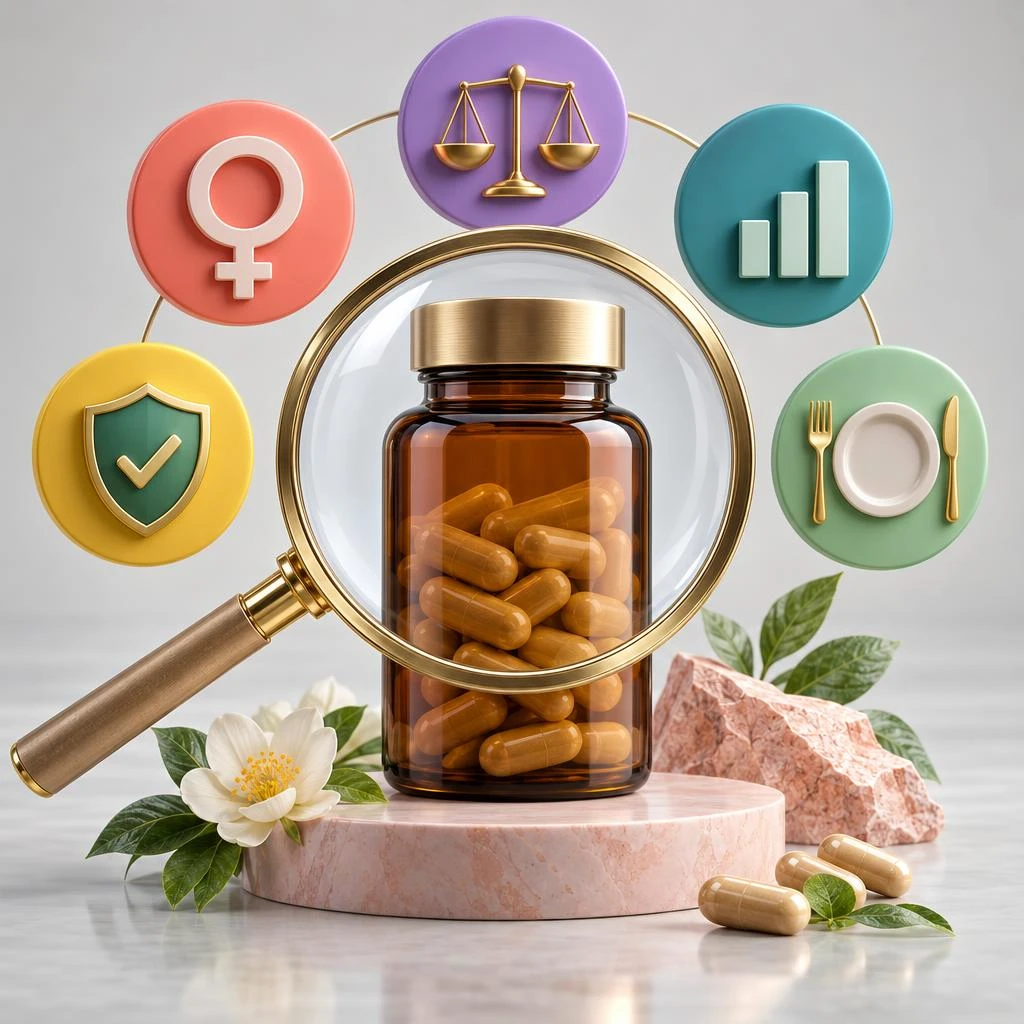
Supplements and prescription weight loss drugs sit in different categories, with different rules and very different results.
Regulation And Efficacy Of Over-The-Counter Options
The FDA regulates dietary supplements, but it does not approve them before they go on sale. Under the law that governs supplements, FDA “does not have the authority to approve dietary supplements before they are marketed” and is largely limited to acting after problems appear.
In a national survey, many people, users and non-users alike, believed weight loss supplements are evaluated by the FDA for safety and efficacy before marketing. They aren’t, so the checking falls to you.
Role Of Prescription Weight Loss Drugs In Fat Management
Prescription GLP-1 medications produce weight loss many times larger than any supplement, because they were tested and approved as drugs. They also come with side effects and need ongoing medical supervision.
In the STEP 1 trial, adults taking semaglutide lost 14.9% of their body weight over 68 weeks, compared with 2.4% on placebo. In SURMOUNT-1, the highest dose of tirzepatide led to 20.9% weight loss over 72 weeks, versus 3.1% on placebo. Nausea and other digestive effects were common.
The trials enrolled adults with obesity, or with overweight plus a weight-related health condition. These drugs are a conversation for your doctor, not a social media group.
| Feature | Over-The-Counter Fat Loss Supplements | Prescription Weight Loss Drugs (e.g. GLP-1s) |
|---|---|---|
| Regulation | Regulated by the FDA as food products; no approval needed before sale | Must be proven safe and effective in trials and approved by the FDA |
| Typical efficacy | Usually under 5 kg extra over several months | About 15% to 21% of body weight over 68 to 72 weeks in major trials |
| Availability | Sold freely in stores and online | Prescription only |
| Supervision | Self-directed | Regular medical monitoring |
| Main risk | Unlisted ingredients, liver injury, stimulant overload | Digestive side effects; requires ongoing treatment |

Are Fat Burners Safe? The Risks Nobody Puts On The Label
Many fat burners aren’t safe, mostly because you can’t be sure what’s inside them. The FDA warns that weight loss products often contain hidden drug ingredients.
In its own words, products such as diet pills and fat-burning pills “are likely to be contaminated with dangerous hidden ingredients,” and they “often have multiple positive reviews and/or are being shared through social media.”
When we checked two of the busiest Reddit threads asking which fat burner works, both original posts had been edited to plug the same product through an affiliate link. Skip fat burners and stimulant-based supplements entirely, or talk to your doctor first, if any of these apply to you:
- You’re pregnant, breastfeeding or trying to conceive.
- You take prescription medication, including for blood pressure, diabetes, thyroid, mood or birth control.
- You have a liver, heart or kidney condition, high blood pressure or an anxiety disorder.
- You have a history of disordered eating, where “faster results” can become a harmful goal.
Tired all the time? Rule out a simpler cause first. Our guide to the benefits of taking supplements covers which nutrient gaps are worth testing for.
Pros And Cons Of Popular Weight Loss Aids
Each weight loss aid trades convenience for something, usually cost, safety or staying power.
| Weight Loss Aid | Pros | Cons |
|---|---|---|
| Thermogenic fat burners | Easy to take; caffeine can lift energy for a workout | Small effect; stimulant side effects; highest risk of hidden ingredients |
| Fiber supplements | Better appetite-control evidence; affordable | Bloating at first; must be taken before meals with water |
| Protein powder | Helps you reach protein targets and protect muscle | Some are high in sugar; doesn’t replace whole meals long-term |
| Meal replacement shakes | Portion control without planning | Hard to sustain; can be costly over time |
Expert Commentary: What The Research Actually Shows
Across the reviews, the effect of most supplements is measured in kilograms over months, not pounds per week.
Three findings stand out. First, hundreds of trials exist, yet only a small fraction are strong enough to trust. Second, the ingredients with the best evidence, psyllium, protein and creatine, work through appetite and muscle, the same levers that good food and regular exercise pull. Third, the safety signals cluster around the most heavily marketed products.
There’s also a gap worth naming. None of the reviews cited here focused on women specifically, let alone perimenopause. If that’s your stage of life, our breakdown of perimenopause supplements that actually work covers the options studied for sleep, mood and metabolism.
The Contrarian Take: “Faster” Is The Trap
The word “faster” is the most expensive part of any fat loss supplement. Most of the better-studied ingredients add about 1 to 2 kg over several months, and that’s the promise the label quietly turns into “rapid results.”
An extra 1.2 kg from L-carnitine, spread over a few months, works out to about 10 to 15 grams a day, easily hidden by normal day-to-day water swings. You’d never see it, but you would feel the cost.
The women who lose fat and keep it off usually aren’t the ones who found the right pill. They’re the ones who stopped chasing speed and built a routine they could repeat for a year. Slow progress usually means the plan needs to be easier to stick to.
A stronger product won’t fix that. Our guide to sustainable fat loss is a good place to start, and if the scale has truly stalled, read about weight loss resistance before you blame your metabolism.
A Daily Supplement Routine That Supports Fat Loss
A sensible daily supplement routine for fat loss is short: it supports your diet, protein and training rather than trying to replace them. Build the foundation first, then add only what passes the P.R.O.O.F. Test.
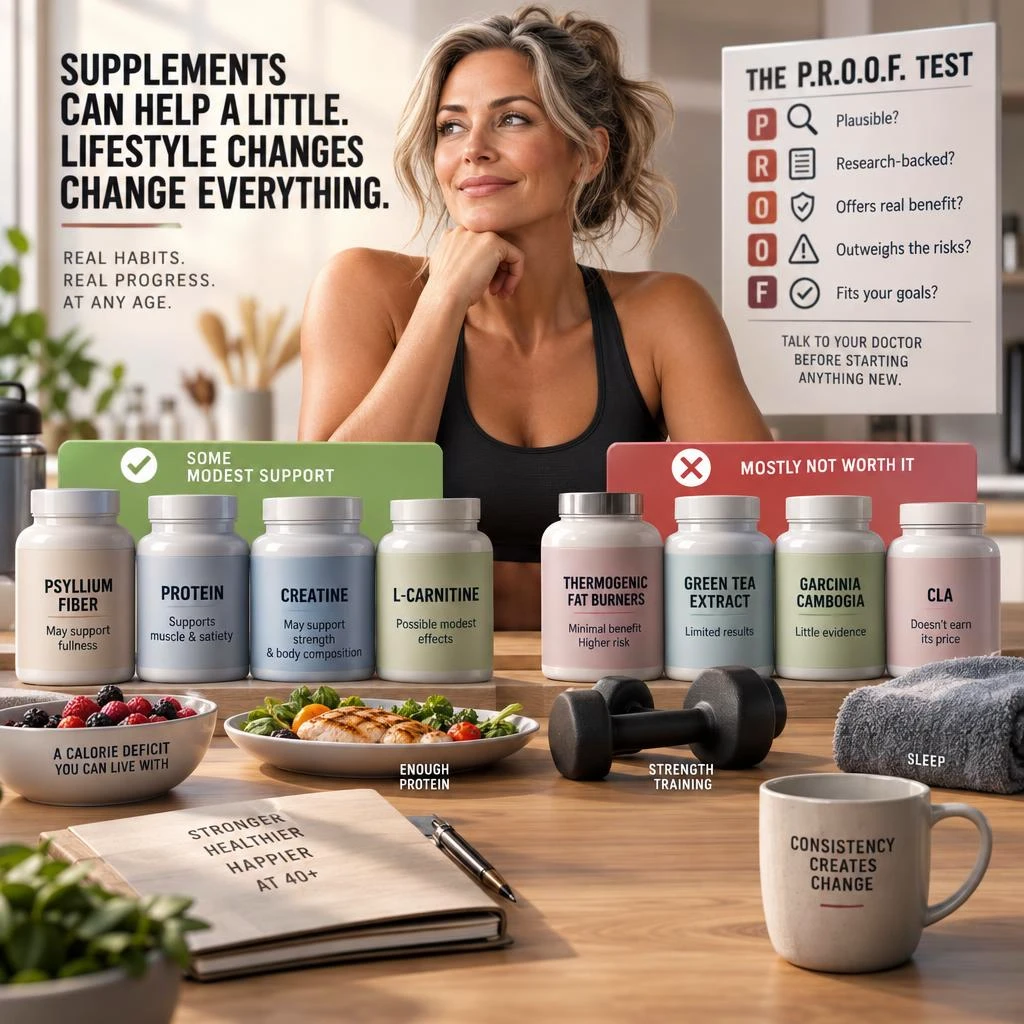
Start with the basics:
- A moderate calorie deficit: Use our weight management calculators to find a realistic target.
- Protein at every meal: It keeps you full and protects muscle, whether it comes from food or a shake.
- Two to three strength sessions a week: This is what makes protein and creatine pay off.
- Seven or more hours of sleep: So you have the energy to train and cook, not just to get through the afternoon.
If you want a supplement, the evidence points to a short list: psyllium before your two largest meals, a protein powder on days when meals fall short, and creatine if you lift weights. Skip anything sold as a “belly fat blaster” or “metabolism reset.” For belly fat loss, see our guide to cortisol belly vs hormonal belly.
The Bottom Line
Fat loss supplements can help a little, but none will give you dramatically faster results. Psyllium, protein, creatine and possibly L-carnitine have modest evidence. Thermogenic fat burners, green tea extract, garcinia and CLA mostly don’t earn their price or their risk.
Use them as a small add-on to a healthy lifestyle and the work that changes your body: a calorie deficit you can live with, enough protein, strength training and sleep. Run every product through the P.R.O.O.F. Test and talk to your doctor before starting anything new.
Ready To Stop Second-Guessing Every Label? Get the free Women’s Lean Body Formula guide with 10 research-backed habits that help women lose body fat and keep it off. It’s the foundation every supplement depends on. Get The Free Guide.
Glossary Of Key Terms
- Body Recomposition: Losing fat while keeping or gaining muscle.
- Calorie Deficit: Taking in fewer calories than your body uses, which is required for fat loss.
- Catechins (EGCG): Compounds in green tea, concentrated in extract supplements.
- DSHEA: The Dietary Supplement Health and Education Act, the U.S. law under which supplements are sold without FDA pre-approval.
- Fat Oxidation: The process of breaking down fat for energy.
- GLP-1 Medication: A class of prescription drugs, such as semaglutide and tirzepatide, that reduce appetite and slow digestion.
- Meta-Analysis: A study pooling many trials to estimate an overall effect.
- Placebo: An inactive pill used in trials to show whether a supplement works better than nothing.
- Proprietary Blend: A label term that lists ingredients without their individual doses.
- Thermogenic Fat Burner: A supplement, usually stimulant-based, marketed to raise the calories you burn.
FAQ
What Is The Most Effective Fat Loss Supplement For Women?
No single supplement is clearly best, but psyllium fiber has some of the strongest evidence, with about 2 to 4 kg of extra weight loss over several months. Protein powder and creatine help most alongside strength training.
Do Thermogenic Fat Burners Work?
Only slightly. Most rely on caffeine or green tea extract, which produce small and inconsistent effects in trials. They also carry the highest risk of side effects and hidden ingredients.
Is Green Tea Extract Safe For Weight Loss?
Brewed green tea is generally safe. Concentrated green tea extract is riskier: EFSA found that EGCG doses of 800 mg a day from supplements may be associated with early signs of liver damage, and it could not set a safe supplement dose.
Does L-Carnitine Help You Lose Belly Fat?
Not specifically. In a review of 37 trials, L-carnitine reduced body weight by about 1.2 kg and fat mass by about 2 kg, but it had no significant effect on waist circumference.
Are Fat Loss Supplements Approved By The FDA?
No. The FDA regulates supplements, but it does not approve them before they are sold. It mainly acts after a product causes problems, which is why checking labels and FDA warnings matters.
Can Fat Loss Supplements Replace Diet And Exercise?
No. Supplement effects in these reviews are small, and fat loss still depends on a calorie deficit.
How Long Do Fat Loss Supplements Take To Work?
The trials cited here mostly ran from about 12 weeks to six months, and the effects were small. If you try one, give it about three months alongside a steady routine, and stop if you get side effects.