

Your Body Just Did Something Extraordinary. Here Is How To Build A Postpartum Fitness Routine From That
Rajneesh
Author & philosopher
The moment a child is born, the mother is also born. She never existed before. The woman existed, but the mother never.
Summary (TL;DR)
Getting back to fitness after having a baby is genuinely hard, and science explains exactly why. Postpartum hormonal shifts, sleep deprivation, and the cultural pressure to "bounce back" all undermine your motivation before you even lace up a shoe.
The 2025 Canadian postpartum guidelines confirm that consistent movement reduces postpartum depression risk by 45%. You don't need motivation to start. You need a gentle, phase-by-phase plan that meets you where you actually are. This post gives you exactly that, including an original three-phase framework built around current ACOG and CSEP evidence.
Someone asked you when you're getting back to the gym. Maybe it was at the hospital. Maybe it was your own inner voice at 3 am during a feed that just would not end. You smiled and said "soon" while privately wondering if your body would ever feel like yours again.
Here's what most fitness content skips: your postpartum fitness routine needs to look completely different for a while. Not because you have lost something, but because your body is still completing one of the most demanding physiological processes in human biology.
You did not run a marathon. You built a person. The return to movement after that is not a sprint back to where you were. It is a deliberate, stage-by-stage reconnection with a body that has genuinely changed.
This guide gives you a research-backed roadmap, an original three-phase framework called the RESTORE Method, and an honest conversation about motivation that most fitness sites will not have. No bounce-back pressure. No before-and-after framing. Just practical strategies that actually account for what is happening in your body right now.
Medical & Referral Disclaimer
The content in this article is for educational and informational purposes only and is not a substitute for professional medical or fitness advice. Postpartum recovery is highly individual. Please consult your doctor, midwife, or women's health physiotherapist before beginning or resuming any exercise program after giving birth, particularly following a C-section or complicated delivery.
Key Takeaways
- Fatigue, lack of childcare, and time constraints are documented structural barriers to postpartum exercise, not personal failings.
- The 2025 Canadian CSEP postpartum guidelines confirm regular movement reduces postpartum depression risk by 45% and urinary incontinence risk by 37%.
- Research shows 75% of women only reach pre-pregnancy fitness levels by 36 months postpartum, not six weeks.
- The "6-week clearance" is a medical milestone for uterine healing, not a fitness green light; pelvic floor work should begin before it and progress beyond it.
- Motivation follows action postpartum; it does not precede it. Systems designed to bypass the need for motivation outperform inspiration-chasing every time.
- Exercise driven by body appreciation produces more consistent long-term habits than exercise driven by body dissatisfaction.
- The RESTORE Method introduced in this article gives you a clear three-phase roadmap from week one to month six.
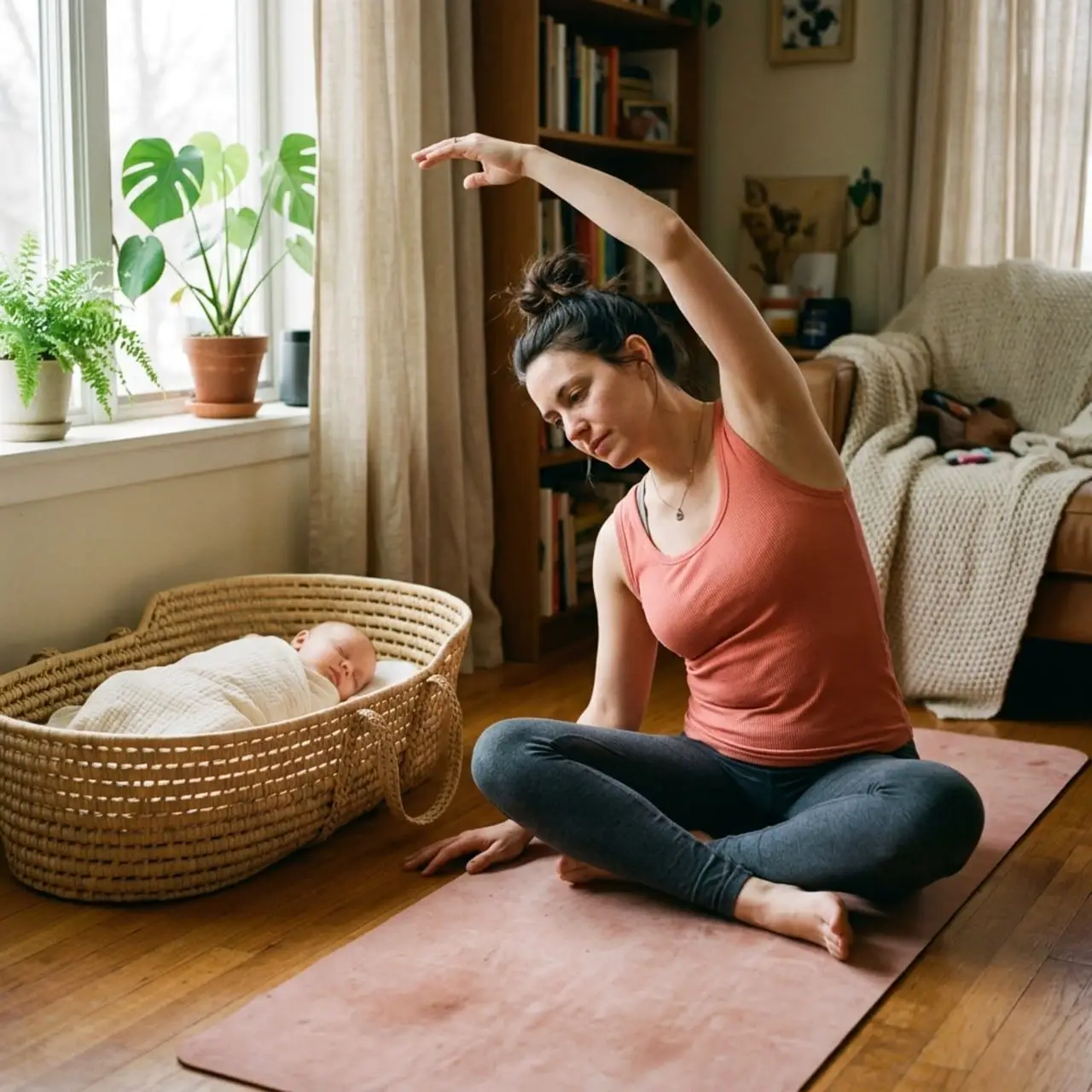
Why Is It So Hard To Exercise After Having A Baby?
Here is the short answer: your body is hormonally, physically, and neurologically different postpartum. Elevated cortisol from disrupted sleep, falling estrogen, and high prolactin (in breastfeeding mothers) all suppress energy and motivation at a biological level. Research on postpartum barriers confirms that fatigue, lack of childcare, and time constraints are structural barriers, not character flaws. This is not a willpower problem. It is a physiological problem, and treating it like a willpower problem makes it worse.
After birth, estrogen and progesterone drop sharply within hours. This crash affects serotonin and dopamine, the neurotransmitters that generate motivation and reward. If you are breastfeeding, prolactin stays elevated to support milk production, but this suppresses estrogen further and can contribute to fatigue, mood sensitivity, and reduced drive. At the same time, cortisol (your primary stress hormone) remains elevated due to sleep deprivation and the round-the-clock demands of newborn care.
A 2024 study in Scientific Reports found direct links between maternal stress and elevated cortisol concentrations, creating a cycle where high stress slows recovery, which elevates stress further. And as you may already know from cortisol's documented role in weight and energy, chronically elevated cortisol signals your body to conserve energy rather than expend it.
Add in the physical realities: a healing pelvic floor, possible diastasis recti, posture changes from feeding, and a body that just spent nine months in a state of major structural renovation. Expecting strong motivation in this context is not realistic. The first step is not finding motivation. It is understanding why motivation is biologically harder right now, then building a system that does not depend on it.
What The "Bounce Back" Myth Is Actually Doing To Your Motivation
The fitness industry has a story to sell: six weeks after giving birth, a woman should be bouncing back. Social media amplifies it daily. Celebrity transformations are presented as templates. Diet plans are marketed as the key to getting your body back.
Here is the problem. It is built on a complete distortion of what postpartum recovery actually looks like.
Research cited by Psychology Today in 2025 found that 75% of women only reach their pre-pregnancy fitness levels at 36 months postpartum. Not six weeks. Not three months. Three years. And that is the successful majority, not the outliers who struggled.
This is not failure data. This is normal data. The bounce-back myth has redefined normal as failure, and the cost is measurable. A 2025 study found that new mothers who viewed fitspiration content reported increased anxiety, more upward social comparisons, and lower body satisfaction. Mothers who viewed body-positive content reported higher body satisfaction and less distress.
Here is the contrarian take the fitness world needs to hear more often: bounce-back culture is not just unrealistic. It is actively counterproductive as a motivational strategy.

Shame-based motivation collapses quickly under pressure, and new motherhood is all pressure. What actually creates lasting postpartum fitness habits is a goal that feels genuinely worth having: more energy to keep up with a growing baby, better quality sleep, reduced anxiety, and a stronger and more functional body. None of those requires a six-week transformation. All of them start with permission to begin slowly.
Reframe the question entirely. Stop asking "how do I get my body back?" and start asking "what does my body need right now to support the life I'm actually living?" That question has answers that feel achievable. The first question usually doesn't.
When Is It Actually Safe To Start Exercising After Birth?
Sooner than most women think for gentle movement, and later than six weeks for high-impact exercise. ACOG guidelines state that women with uncomplicated vaginal deliveries can begin gentle movement, including walking, pelvic floor exercises, and diaphragmatic breathing, within days of birth when they feel ready. The six-week rule is a medical check milestone, not a starting line for fitness, and it was never designed to be one.
This is the contrarian position that pelvic health physiotherapists are increasingly vocal about: the 6-week clearance was never designed for fitness readiness.
The 6-week postnatal check exists to assess uterine involution (the return of the uterus to its pre-pregnancy size), cervical healing, and blood pressure. A GP clearing you at six weeks is confirming that your medical recovery is progressing normally. It is not a biomechanical assessment of your pelvic floor, diastasis recti status, or readiness for impact exercise. Yet most women hear "you're cleared" and interpret it as permission to resume everything they did before.
The NHS recommends getting specific advice at the 6-week check before any high-impact exercise. Note the framing: advice before impact at 6 weeks, not a blanket release to resume all training. The difference matters enormously.
Many women are safely walking and doing pelvic floor rehabilitation well before their six-week appointment. Others, particularly following C-sections, significant vaginal repair, or pelvic floor dysfunction, should not be running or doing jumping exercises at six weeks, even with a general medical clearance. The six-week rule is too blunt an instrument for a recovery as individual as postpartum.
| Delivery Type | Gentle Movement | Progressive Strength | High-Impact Clearance |
|---|---|---|---|
| Uncomplicated vaginal | Days 1 to 3 (pelvic floor, walking) | 6 weeks with medical clearance | 12 weeks minimum, ideally with physio |
| Vaginal with stitches or repair | Week 1 to 2 (breathing, pelvic floor) | 8 to 10 weeks | 12 to 16 weeks |
| C-section | Week 2 to 3 (short gentle walks) | 10 to 12 weeks | 16 weeks or beyond, clearance required |
| Complications or prolapse | Under physiotherapist guidance only | Individual assessment | Individual, physio-led |
If you are unsure which category applies to you, a single session with a women's health physiotherapist in the first six weeks is one of the highest-value investments you can make in your long-term fitness and pelvic health.

The RESTORE Method: A Three-Phase Postpartum Fitness Framework
Most postpartum fitness plans start with workouts. This one starts with healing.
The RESTORE Method is an original three-phase framework for postpartum movement developed from current ACOG and CSEP clinical guidelines, women's health physiotherapy best practices, and the behavioral science of habit formation in high-fatigue environments. Its core principle: you cannot out-train an under-recovered body. Each phase builds the foundation that the next one requires.
Phase 1: Recover (Weeks 1 To 6)
Focus: Heal, breathe, and reconnect.
This phase is not about fitness. It is about restoring the structural foundation that all future movement depends on. Your pelvic floor, deep core, and breathing mechanics need deliberate attention before any external load is added. NASM's postpartum progression guidelines are explicit: diaphragmatic breathing is the non-negotiable starting point. It is not a warm-up. It is the workout.
Recommended in Phase 1: pelvic floor contractions, diaphragmatic breathing, gentle walking (building from 5 to 20 minutes), pelvic tilts, heel slides, supine glute bridges. No crunches, no spinal flexion, no impact of any kind.
Phase 2: Rebuild (Weeks 6 To 16)
Focus: Strengthen from the inside out.
Once medical clearance is confirmed and pelvic floor function is improving, progressive loading begins. Bodyweight squats, modified deadlifts, bird dogs, and wall push-ups form the core of this phase. Walking duration and pace increase. Light resistance is introduced carefully.
Beginner fat loss workouts designed for home use are well-suited to this phase. The target from the 2025 Canadian guidelines, building toward 150 minutes of moderate aerobic activity per week plus two strength sessions, is the goal for the end of Phase 2, not the beginning.
Phase 3: Reclaim (Month 4 Onward)
Focus: Return to full movement on your terms.
This is where you return to activities you enjoyed before pregnancy, if and when your body is ready. Running, HIIT, heavier lifting, classes, and sports. Some women return to high-impact activity at four months. Others at eight or ten months. Both are normal. Neither is a failure. The milestone to trust is not the calendar. It is your pelvic floor, your energy levels, and your absence of symptoms.
| Phase | Timeline | Primary Focus | Sample Exercises | What To Avoid |
|---|---|---|---|---|
| Recover | Weeks 1 to 6 | Heal and reconnect | Pelvic floor, breathing, walking, pelvic tilts | Impact, crunches, heavy load |
| Rebuild | Weeks 6 to 16 | Progressive strength | Bodyweight squats, glute bridges, resistance bands | Loaded spinal flexion, breath-holding |
| Reclaim | Month 4 onward | Return to full activity | Running, lifting, classes, sport | Anything causing leaking, pain, or prolapse pressure |

How Do You Find Motivation When You're Running On No Sleep?
You do not wait for motivation. You design a system that requires almost nothing. Behavioral science is clear on this: motivation follows action in the postpartum period. It does not precede it. The neurological reward of completing even a 10-minute walk creates dopamine that makes you more likely to move again tomorrow. Waiting to feel motivated when you are sleep-deprived and hormonally depleted is a strategy built to fail almost every time.
A study on group-based postpartum exercise found that social support was the strongest enabler of exercise participation in new mothers. Women in group programs showed increased competence and motivation over time. The "just do it alone by willpower" model does not map well onto a depleted postpartum nervous system, and social accountability provides a scaffold where internal motivation cannot yet hold the weight.
Three practical systems that bypass the need for motivation
- Start with the minimum viable workout. Ten minutes of movement is not "not enough." On the days when that is all you have, it is a complete session. Consistent short sessions produce better long-term outcomes than sporadic long ones. A 10-minute walk every day outperforms a 45-minute session every ten days, every single time.
- Assign one fixed trigger, not a flexible intention. Don't decide when to exercise each day. Decide once: "I move during the first nap slot that is longer than 20 minutes." That eliminates decision fatigue from an already overloaded brain and turns the exercise into a condition that runs automatically.
- Habit-stack with what is already happening. Walking with the pram is an exercise. A set of glute bridges during tummy time is a workout. The workout motivation strategies built specifically for moms on this site go deeper into how to build movement into a baby's schedule rather than against it.
Keep the bar deliberately low for the first four weeks. Low enough that you genuinely cannot fail. Raise it by a small increment. Then again. That is not laziness. That is behavioral architecture, and it works far better than inspiration.
Join Our Mailing List
Join thousands of women inside our community and receive our free guide, 10 Actions That Support Permanent Weight Loss — the exact behavioural shifts that make the difference between a two-week attempt and a lasting transformation.
No restriction plans. No guilt. Just what actually works — for real women with real lives.

The Mindset Shift That Makes Postpartum Fitness Sustainable
The single most powerful shift you can make: moving from "getting your body back" to "building a body for the life you have now." Research confirms that exercise motivated by body appreciation rather than body dissatisfaction produces more consistent long-term habits, better adherence, and better mental health outcomes. The "before" body is not the goal. A body that keeps up with a toddler, lifts a car seat without wincing, and still has energy at 7 pm — that is the goal.
Here is the mental health case for movement that goes far beyond aesthetics: the 2025 Canadian postpartum guidelines found that regular physical activity reduces postpartum depression odds by 45%, urinary incontinence risk by 37%, and type 2 diabetes risk by 28%.
A meta-analysis in PLOS One confirmed that aerobic exercise is effective in both preventing postpartum depression and reducing its severity in women already experiencing it. Those are outcomes that matter far beyond anything a mirror reflects.
Expert commentary worth holding onto: Women's health physiotherapists and postpartum fitness specialists are increasingly aligned on one point. The women who sustain postpartum fitness long-term do not have more discipline. They have a better story about why they are doing it. "I move so I have energy for my baby" sustains itself. "I exercise to lose the baby weight" does not, because the second goal is always partially outside your control, and the first one delivers results within the first two weeks.
Write down your postpartum "why" before you start. Return to it on the weeks when nothing goes as planned. The goal is not a body transformation. It is a life upgrade. And that goal is available to you starting this week, regardless of where you are in recovery.
For staying consistent through the harder weeks, the guide to finishing workouts pairs directly with what you are building here. When you are ready to add a nutrition strategy alongside your movement, the postpartum meal prep guide shows you how to fuel recovery without adding another source of overwhelm.
Ready to go further? Join the Women's Lean Body Formula newsletter for weekly strategies on nutrition, movement, and mindset built specifically for women who want results that actually last. Your first issue lands this week.
Related Articles
The Bottom Line
Your body just did the most demanding thing it will ever do. You do not owe it a transformation timeline. You owe it patience, gradual rebuilding, and movement that actually fits the life you are living right now.
Start with pelvic floor breathing this week. Walk for 10 minutes when the first nap allows. Replace "I need to get my body back" with "I am building a body for this life." Work through the three phases of the RESTORE Method at whatever pace your body supports.
The research is consistent: movement improves your mood, your energy, your pelvic floor, and your mental health at a level no six-week transformation could match. You do not need to feel motivated to begin. You need to begin, so the motivation can follow.
Glossary Of Key Terms
FAQ
C-section recovery requires more patience than vaginal delivery because it involves healing from major abdominal surgery. Gentle walking can typically begin within two to three weeks once you are mobile and your wound is progressing well. Resistance training or anything that stresses the abdominal wall should wait until at least 10 to 12 weeks, always following explicit medical clearance. A woman's health physiotherapist can assess scar tissue mobility and core readiness before you progress, which is strongly recommended after any C-section delivery.
Not all core exercises are appropriate postpartum. Pelvic floor contractions, diaphragmatic breathing, and gentle pelvic tilts are safe from the earliest days and should be prioritised. Crunches, sit-ups, and loaded spinal flexion should be avoided for at least the first six months and longer if diastasis recti is present. NASM specifically cautions against erratic or excessive spinal flexion exercises in the first six months postpartum. Always assess for diastasis recti with a physiotherapist before returning to traditional abdominal training.
Moderate exercise does not reduce breast milk supply for most women. Research indicates that concerns about lactic acid in breast milk affecting taste are largely overstated at moderate intensity levels. Staying well hydrated and timing workouts shortly after a feed (rather than immediately before) reduces any mild taste change that some babies notice. If you are already experiencing supply issues, speak with a lactation consultant before adjusting your exercise intensity, as individual factors matter more than general guidelines here.
The best postpartum exercises for weight loss are the ones you can sustain consistently at your current recovery stage. In the first six weeks, walking and pelvic floor work support metabolism and recovery without additional physiological stress. From six weeks onward, adding bodyweight strength training helps preserve lean muscle and support fat metabolism. The 2025 Canadian guidelines recommend working toward 150 minutes of moderate activity per week plus two strength sessions as the long-term target. Pairing movement with a practical nutrition strategy produces the best results. The guide to losing pregnancy weight covers the nutrition side in detail.
Consistency with a baby at home requires designing for reality, not the ideal. Choose one reliable movement trigger each day (the first nap, a morning walk during the fussy window, a 10-minute session during tummy time). Keep workout clothes and equipment within arm's reach so starting requires zero friction. Tell your partner or a friend your plan for light social accountability. Accept that three sessions one week and two the next is still a successful fortnight. The postpartum workout motivation guide has a complete system for building these habits around a baby's unpredictable schedule.
Yes, and the evidence is strong. The 2025 Canadian postpartum guidelines found that regular physical activity reduces the odds of postpartum depression by 45%. A meta-analysis in PLOS One confirmed that aerobic exercise is effective in both preventing postpartum depression and reducing its severity in women who are already experiencing symptoms. Walking counts. Short sessions count. Even gentle movement in the early weeks produces measurable mood benefits through endorphin release and cortisol reduction. If you are experiencing PPD symptoms, please speak with your GP or midwife alongside any movement plan, not instead of one.
Research suggests that 75% of women reach their pre-pregnancy fitness level by 36 months postpartum. This is not a disappointing number. It is the actual normal timeline for most women, not an outlier result. High-performance athletes typically return to competitive sport between 6 and 18 months, depending on sport and delivery type. For everyday fitness, meaningful improvements in strength, endurance, and energy are typical from about 3 to 4 months onward, with steady progress continuing through the first two years. Comparing your progress to a six-week window is comparing yourself to a statistical myth, not a realistic benchmark.
You Know Why. Now Learn Exactly How
Join thousands of women inside our community and receive our free guide: 10 Actions That Support Permanent Weight Loss — the practical, sustainable habits that translate everything you just read into real, lasting results.
No fad diets. No extreme plans. Just what the research actually supports — written for real women.