


Fitness Motivation For Beginners: 7 Tips To Get You Moving
How To Get Started: A Practical Guide To Creating Lasting Fitness Motivation For Beginners
Zig Ziglar
Author, salesman, & motivational speaker
You don't have to be great to start, but you have to start to be great.
Summary (TL;DR)
Fitness motivation for beginners isn't something you find — it's something you engineer. The 7 tips in this guide are built on behavioral science and women-specific physiology to help you move past the motivation dip that stops most beginners in weeks 3–5. Stop relying on willpower.
Start building systems: anchor your workouts to identity, use the 10-Minute Rule to bypass resistance, design your environment to remove friction, and track progress metrics that actually show results. The dopamine habit loop takes 6–12 weeks to form. These strategies carry you through that window.
Sound familiar? You sign up for a gym class with full enthusiasm, go twice that week, skip Thursday "just this once" — and six weeks later the gym bag is still by the door, untouched.
If that's you, I want to say something clearly: you don't have a discipline problem. You have a system problem.
I've been writing about women's fitness for years, and the single biggest mistake I see beginners make isn't choosing the wrong exercise program. It's treating motivation like a fuel source when it's designed, neurologically, to be temporary. The women who build lasting fitness habits aren't more motivated than you. They've built their lives so that showing up is easier than not showing up.
That's what this guide is actually about. Not a 30-day challenge with an expiry date. Not a list of platitudes about believing in yourself. Seven evidence-based strategies, built specifically for women starting, are designed to work whether you feel like it or not.
Medical & Referral Disclaimer
The information in this article is provided for educational purposes only and does not constitute medical or clinical advice. Before beginning any new exercise program — particularly if you have pre-existing health conditions, recent injuries, or are postpartum — consult your healthcare provider. Results vary between individuals. This article references research findings in general terms; for clinical guidance, consult qualified health professionals and primary sources.
Key Takeaways
- Motivation is neurologically unreliable — especially in the first 6–8 weeks. Stop using it as your primary strategy.
- The dopamine habit loop takes 6–12 weeks to form. The dip around weeks 3–5 is biology, not failure.
- Environment design beats willpower every single time. Lay out your clothes. Remove friction. Pre-schedule everything.
- The 10-Minute Rule is not cheating — it exploits the neurological gap between how bad you predict exercise will feel and how good it actually feels once you start.
- Track frequency, energy, and strength — not just body weight. The scale is a poor motivator for beginners.
- Rest days are mandatory, not optional — recovery is when your body actually gets fitter.
- Tell someone your plan. Social accountability activates a more reliable neural circuit than self-discipline.
- Your "why" must go three levels deep. Surface goals evaporate. Values-based drivers persist.
- Hormonal fluctuations affect motivation — this is biology, not weakness. Cycle-syncing your training reduces friction significantly.
- The workout you do beats the perfect workout you plan but never start. Every time.
Why Does Fitness Motivation For Beginners Feel So Hard?
Fitness motivation feels hard for beginners because the brain hasn't yet linked exercise to reward. Until consistent physical activity triggers reliable dopamine responses, your nervous system treats it as effort with no payoff — making every session feel like a fight against yourself.
Here's what's actually going on in your brain. When you repeat a behavior and experience a reward, your brain releases dopamine — not just during the reward, but in anticipation of it. Over time, that anticipation becomes a habit. Experienced exercisers feel a pull toward the gym before they even arrive. For beginners, that neural pathway doesn't exist yet.
A review published in Frontiers in Psychology found that exercise adherence drops sharply in the first four to six weeks for beginners — not because the workouts are too hard, but because the reward signal hasn't been established. Your brain is running a real-time cost-benefit analysis and coming up short.
Willpower-based strategies almost always fail here, and not because you're weak. You're being asked to sustain effortful behavior before the reward system has been trained. The solution isn't to try harder. It's to work with your brain's architecture instead of against it.
This also affects women in a specific way. During the luteal phase of the menstrual cycle (roughly days 15–28), serotonin drops and fatigue increases. What feels unmotivating during that window isn't a character flaw — it's biology. Factor that in before deciding you "can't stick to anything."
What Is The Motivation Momentum Framework?
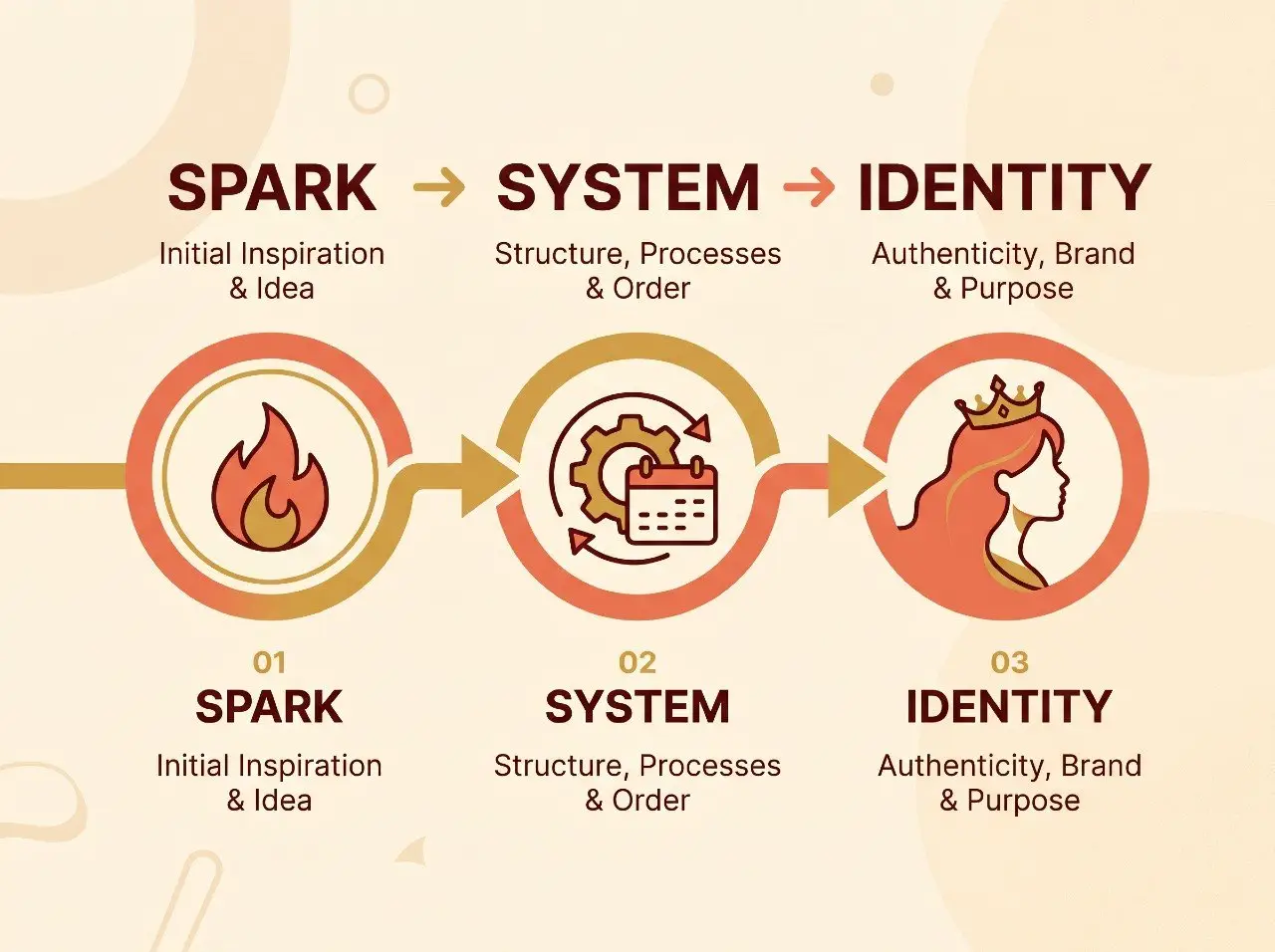
The Motivation Momentum Framework is a three-phase model for building exercise habits from scratch. It maps the predictable psychological stages beginners move through — from forced effort to built momentum to identity-level habit — and prescribes the right strategy for each stage.
Most beginner advice skips straight to workout plans. But without knowing where you are in the motivation cycle, you'll keep applying the wrong solutions at the wrong time.
Phase 1: Spark (Weeks 1–4)
The goal here is not consistency — it's neural conditioning. You're teaching your brain that exercise is something other than punishment. Ten minutes count. A walk counts. The objective is signal, not volume. Novelty dopamine is your friend right now; use it.
Phase 2: System (Weeks 5–12)
The dopamine pathway is forming. This is when structure helps — regular schedule, accountability, progressive challenge. Motivation will still fluctuate wildly. That's expected. Your systems carry you past the dips, not your feelings.
Phase 3: Identity (Week 12+)
You've stopped asking "Am I motivated today?" and started thinking "I'm someone who works out." Identity-level habits don't require willpower because they're anchored to who you are, not how you feel on a Tuesday morning.
Most beginners quit somewhere in Phase 1 because they don't know Phase 2 is coming. Every strategy in this article is designed to bridge that gap.

What Are The 7 Best Fitness Motivation Tips For Beginners?
The 7 most effective fitness motivation tips for beginners are: anchoring your "why," designing your environment, using the 10-Minute Rule, finding accountability, tracking the right metrics, building in rest, and creating a motivation library. Each addresses a specific point of failure in the beginner habit cycle.
Tip 1: Start With Your "Why" — Not Your Goal
A values-based reason for exercising — feeling energized, managing anxiety, being present for your family — sustains motivation far longer than outcome-based goals like losing weight or fitting into old jeans. Get to your real "why" before you plan a single workout.
There's a meaningful difference between "I want to lose 20 pounds" and "I want to feel strong enough to keep up with my kids without getting winded." The first is an outcome goal — it works until you hit a plateau, then it evaporates. The second is a values-based driver that stays relevant no matter what the scale says.
Research from the American Psychological Association consistently shows that intrinsic motivation — doing something because it aligns with your personal values — outperforms external motivation in long-term exercise adherence. The difference isn't slight. It's substantial.
Try this: write down your fitness goal, then ask "why does that matter to me?" three times. Each iteration pulls you closer to the real driver. That's what you write on a sticky note and put somewhere you see it daily.
Your Action Step
Before your next workout, spend five minutes writing your three-layer "why." Keep it somewhere visible — your phone lock screen, a sticky note on the bathroom mirror, anywhere that creates a daily touchpoint.
Tip 2: Design Your Environment Before You Need Willpower
Remove all friction between you and your workout before motivation runs low. Lay out your gym clothes the night before, keep your workout shoes at the door, pre-schedule sessions like non-negotiable appointments, and eliminate any decision-making that has to happen in the moment.
BJ Fogg, behavioral scientist at Stanford and author of Tiny Habits, calls this "environment design" — and his research shows it consistently outperforms motivation as a strategy. The fewer micro-decisions you need to make when tired or busy, the more likely you are to follow through.
This applies to obstacle removal as well as habit support. If driving to a gym never actually happens for you, have a 20-minute home workout loaded and ready. If evening workouts keep getting cancelled, shift to mornings. There's no morally correct time to exercise — there's only the time that works for your actual life.
If gym intimidation is part of the picture (extremely common and completely valid), our guide on how to build fitness confidence when you hate the gym has strategies specific to that experience. And if working from home is your context, fitness motivation for women who work from home covers the particular challenges of that environment.
Your Action Step
Tonight, lay out tomorrow's workout clothes. Block 30 minutes in your calendar. Treat it the same way you'd treat a meeting you can't reschedule.
Tip 3: Use The 10-Minute Rule To Bypass Resistance
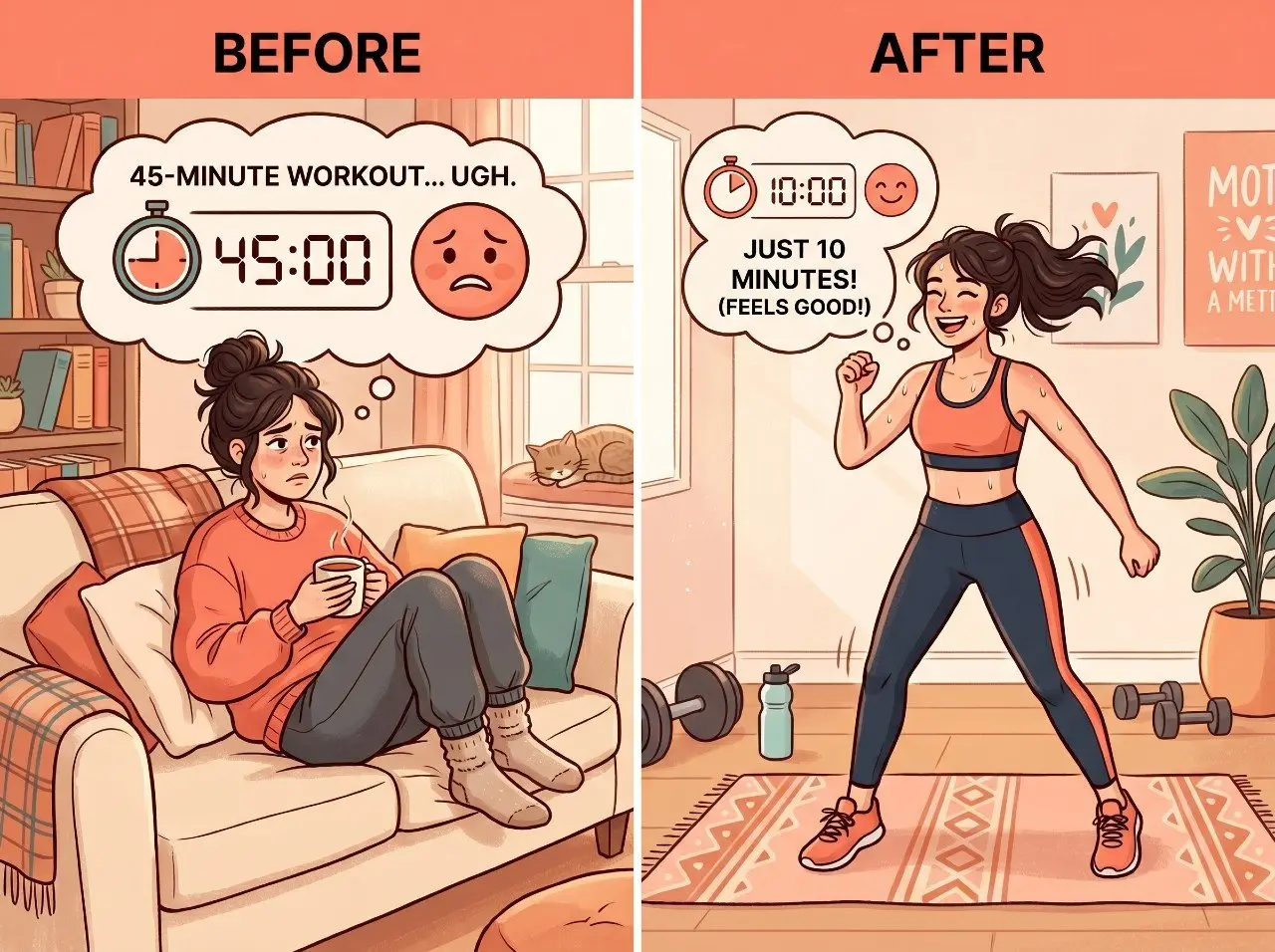
Commit to just 10 minutes of exercise. If you want to stop after 10 minutes, you stop — no guilt, no failure. Most of the time, you'll keep going. The rule works because starting is the hardest part, and 10 minutes is a threshold that the brain doesn't refuse.
This sounds like a trick. It is a trick — but it's backed by actual psychology. Research published in the journal Psychology of Sport and Exercise found that affective forecasting (how we predict we'll feel during exercise) is consistently negative before a workout and consistently positive during and after. You rarely regret starting. You almost always regret not starting.
The 10-Minute Rule exploits that gap. Once your body is in motion, inertia shifts in your favor. Getting started is the neurological barrier — not continuing.
Your Action Step
Replace "I'll work out for 45 minutes" with "I'll work out for 10 minutes." That's your only commitment. Put on your shoes. Press play. Go from there.

Tip 4: Find Your Accountability Anchor
An accountability partner, community, or commitment device significantly increases exercise follow-through. Social accountability activates a different neural circuit than self-motivation — one that humans are much better at honoring consistently.
Research on goal achievement consistently shows that making a specific plan with another person dramatically improves follow-through compared to private intentions alone. Your accountability anchor doesn't have to be a workout partner — it can be a fitness app community, a text check-in with a friend, a paid class you lose money on if you cancel, or a public commitment post.
The mechanism is straightforward: we honor commitments to other people more reliably than we honor commitments to ourselves. That's not a flaw — it's how the social brain works. Use it.
If you're a working mum navigating limited time, our guide on sustainable workout motivation for working moms addresses accountability strategies specific to that situation.
Your Action Step
Tell one person your workout plan for this week. Make a specific appointment to report back to them. That one step raises your follow-through probability significantly.
Tip 5: Track Progress The Right Way
For beginners, tracking workout frequency, energy levels, and strength improvements produces far better motivation than tracking body weight. The scale is a poor early motivator because it changes slowly and fluctuates daily based on factors that have nothing to do with your effort.
This is especially critical for women, because body weight shifts throughout the menstrual cycle — sometimes by several pounds — based on fluid retention and hormonal changes alone. A woman who goes from zero workouts to three a week for a month has made a real physiological change. The scale may not reflect it yet. If that's your only metric, you'll conclude nothing is working when actually everything is.
Track these instead:
- Workouts completed — a simple tally in a notes app is enough
- Energy levels after exercise — rated 1–10, you'll notice this trending upward by week 4
- Strength improvements — more push-ups, heavier weights, longer distance
- Sleep quality and mood — exercise improves both noticeably; these are real results
If you want to understand how your cycle affects your energy and workout performance — and adjust accordingly rather than fighting it — our cycle syncing guide for weight loss and workouts is the most useful resource on this site for that.
Your Action Step
Start a workout log today. Record the date, what you did, and how you felt afterward on a 1–10 scale. That's it. Review it at the end of week 4 — you'll be surprised.
Tip 6: Build In Rest Without The Guilt
Rest days are not optional extras or signs of weakness. They are when your muscles repair, your nervous system recovers, and the mental energy needed to show up again is restored. Skipping rest as a beginner accelerates burnout and injury, not results.
The "no days off" culture on fitness social media is genuinely harmful for beginners. Muscle adaptation — the process that makes you stronger and leaner — happens during recovery, not during the workout. The workout is the stimulus. The rest is when the adaptation occurs.
According to the CDC's adult physical activity guidelines, adults should aim for 150 minutes of moderate activity per week, which works out to 3–5 sessions with 2–4 rest days built in. For beginners, starting with 2–3 sessions per week is not going to be easy on yourself. It's intelligent programming that will take you further than training every day and burning out by week three.
Sleep quality also directly affects motivation, recovery, and body composition. If you're struggling with energy and sleep, our guide on how sleep affects weight loss in women covers the mechanisms and practical fixes.
Your Action Step
Schedule your rest days the same way you schedule your workouts. Block them in your calendar. They are not "skipped workouts." They are part of the program.
Tip 7: Build A Personal Motivation Library
A curated collection of motivational content — specific playlists, short videos, saved quotes — used exclusively in workout contexts trains anticipatory dopamine over time. The more consistently you pair it with movement, the more powerfully it primes the behavior.
There's neuroscience behind this. Music with a tempo between 120–140 BPM triggers rhythmic motor entrainment — your body wants to move in sync. A review in the Psychological Bulletin found that motivational music significantly improves both exercise performance and enjoyment across all fitness levels. That's a meaningful finding, not a minor one.
Your motivation library might include:
- A specific playlist reserved only for workouts — the exclusivity trains anticipatory dopamine
- Three or four short videos of women you admire training
- A notes file of your own journal entries from sessions that felt good
- A mood-boosting podcast reserved for warm-ups or walks
The exclusivity matters. The more consistently you pair this content with movement, the stronger the pre-workout priming effect becomes. Over time, pressing play on that playlist becomes a signal your brain recognizes as "it's time to move."
Your Action Step
Build a new workout playlist today. Eight to ten songs you associate with feeling strong. Listen to it only when exercising. Within a few weeks, the playlist itself will start to feel motivating.
Join Our Mailing List
Join thousands of women inside our community and receive our free guide, 10 Actions That Support Permanent Weight Loss — the exact behavioural shifts that make the difference between a two-week attempt and a lasting transformation.
No restriction plans. No guilt. Just what actually works — for real women with real lives.

Is There A Contrarian Take On Fitness Motivation For Beginners?
Yes: stop trying to stay motivated. Motivation is an emotional state, not a strategy. The most effective approach for beginners isn't to find more of it — it's to build a behavioral system that functions whether you feel like it or not.
Every credible behavioral science researcher reaches the same conclusion. James Clear (Atomic Habits) calls it "identity-based habits." Dr. Wendy Wood at the University of Southern California calls it "context-based cuing." BJ Fogg calls it "behavior design." The framing differs, but the core finding is the same: sustained behavior change doesn't run on motivation. It runs on systems, environment, and identity.
The beginner waiting until she feels motivated enough to start consistently will, in many cases, still be waiting. The one who builds a scheduled time, a prepared environment, a 10-minute minimum commitment, and one accountability contact will have logged six months of training before motivation even becomes a question she thinks about.
This is not tough love. It's the opposite. Placing the burden of consistency on a feeling you can't control is what's hard. Placing it on behaviors you can design and control — that's the path that actually feels easier over time.
You're not behind. You don't have a willpower problem. You have a system that hasn't been built yet. That's fixable.
How Long Does It Take To Build Fitness Motivation As A Beginner?
Most beginners move through the motivation dip and into consistent momentum between weeks 6–12, when physical changes become noticeable, and the neural habit loop strengthens. Before that point, systems carry you. After that point, momentum does.
A 2010 study by Phillippa Lally and colleagues at University College London found that habit formation takes between 18 and 254 days, with an average of 66 days — much longer than the popular "21 days" myth. For exercise specifically, most women report that consistent momentum starts to feel natural somewhere between weeks 8 and 12.
The first four to six weeks are the hardest. Knowing that in advance changes how you navigate them.
Beginner Workout Motivation: What To Expect Week By Week
| Week | Motivation State | What's Actually Happening | Best Strategy |
|---|---|---|---|
| 1–2 | High excitement, novelty-driven | Dopamine from novelty, not habit | Ride it — but don't overcommit |
| 3–4 | First dip ("this is harder than I thought") | Novelty fades, habit pathway not yet built | Use the 10-Minute Rule; lower intensity |
| 5–6 | Inconsistent and fragile | Cellular changes beginning; neural loop forming | Double down on accountability and environment |
| 7–8 | Occasional flow states | Habit loop strengthening | Start tracking strength and energy gains |
| 9–10 | More momentum, fewer mental battles | Anticipatory dopamine pathway emerging | Add progressive challenge |
| 11–12 | Consistency begins to feel natural | Habit consolidating | Celebrate — this is real |
| 12+ | Identity integration ("I work out") | Behavior anchored to identity | Focus on enjoyment and sustainability |
For a realistic picture of when physical results appear — separate from the motivation timeline — read our article on how long it takes to see workout results as a beginner woman.

What Are The Biggest Fitness Motivation Obstacles For Beginners?
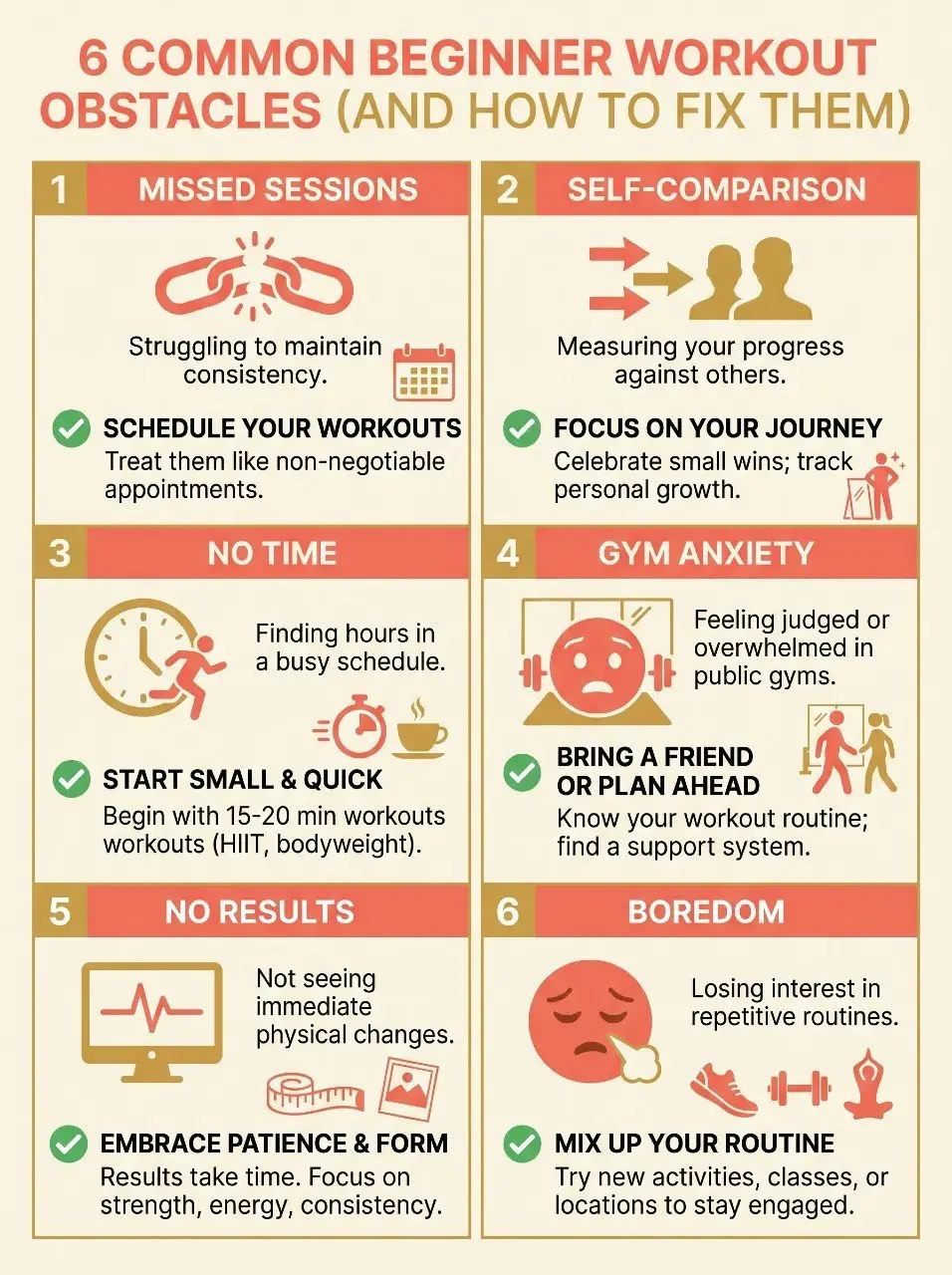
The most common motivation obstacles for beginners are perfectionism, all-or-nothing thinking, unrealistic timelines, gym intimidation, and poor initial workout selection. Each has a specific behavioral fix — and none of them requires more willpower.
Common Fitness Motivation Killers — And The Specific Fix For Each
| Motivation Killer | Why It Happens | The Fix |
|---|---|---|
| "I missed a day, so the week is ruined" | All-or-nothing thinking — one missed session triggers a full reset | Never miss twice. A single skipped session is a blip, not a failure |
| Comparing yourself to advanced athletes | Unrealistic reference points create a gap that feels impossible to close | Follow only beginner-stage creators; unfollow anything that makes you feel behind |
| Workouts feel too hard and unpleasant | Starting at the wrong intensity level for your current fitness | Choose workouts built for beginners — see our beginner fat loss workout guide |
| No time | Poor scheduling, not actual lack of time (most of us have 20 free minutes somewhere) | Schedule the workout first; fit everything else around it |
| Gym anxiety or intimidation | Real, valid, and very common — especially for women | Start with home workouts; read how to get started at the gym without feeling intimidated |
| "I'm not seeing results fast enough" | Unrealistic expectations + wrong metrics | Track non-scale victories — energy, mood, strength; results lag effort by several weeks |
| Boredom and dread before workouts | Repetitive routine; no variety or fun element | Rotate between 3 workout styles (strength, cardio, mobility); use your motivation library |
Motivation is neurologically unreliable — especially in the first 6–8 weeks. Stop using it as your primary strategy.
Now that you know how to engineer your fitness motivation, are you ready to put those principles into action? To help you get started, we've created a free guide that takes you through the first few days, step by step. Grab your free guide here and make those first few weeks stick!
Related Articles
The Bottom Line
Fitness motivation for beginners doesn't come from a perfect playlist, a new gym membership, or reading one more article. It comes from showing up often enough that your brain starts building the anticipatory dopamine pathway that makes exercise feel automatic — and from engineering your environment so that showing up is the path of least resistance.
Pick one tip from this list. One. Let it become automatic before you add another. That's not going slowly. That's the only approach with a track record that actually holds.
If you want a starting point, choose your "why," lay out your workout clothes tonight, and commit to 10 minutes tomorrow. Everything else can wait. She's not hoping you'll find her someday. She's ready for you right now. Go meet her.
Glossary Of Key Terms
FAQ
Start smaller than feels meaningful. Not 30 minutes — 10. Not a "real workout" — a walk around the block or five minutes of stretching. Your only goal in week one is to associate your workout time with a non-negative experience. Motivation follows behavior; it doesn't precede it. You can also explore the deeper psychological strategies in our article on how to motivate yourself to finish workouts, not just start them.
Research by Phillippa Lally at University College London found that habit formation takes an average of 66 days, with a range of 18 to 254 days depending on the behavior and the person. For exercise specifically, most women start to feel consistent momentum between weeks 8 and 12. The first four to six weeks are the hardest, which is precisely why systems and accountability matter more than motivation during that window.
Two to three sessions per week, 20–30 minutes each, at an intensity that feels challenging but not crushing. Focus on exercises you find repeatable — walking, beginner bodyweight circuits, cycling, swimming, or a beginner group fitness class. Consistency matters far more than intensity at this stage. Our beginner fat loss workout guide and healthy lifestyle tips for beginners are both good starting points.
This is the Phase 1 dip from the Motivation Momentum Framework — and it's neurological, not personal. The novelty dopamine from starting something new fades before the habit dopamine kicks in, leaving a motivation gap around weeks 3–5. The solution isn't to push harder or be harder on yourself. It's to reduce the commitment temporarily (shorter, easier, more enjoyable) and lean harder on your systems until you're through to Phase 2.
Yes — especially for women. Hormonal fluctuations throughout the menstrual cycle directly affect perceived exertion, energy levels, mood, and recovery capacity. What feels effortful during your luteal phase (days 15–28) doesn't mean you're losing fitness. Adapting your workout intensity to your cycle rather than fighting it makes a real difference. Our cycle syncing guide for weight loss and workouts gives you a full practical framework for this.
First, distinguish between acute fatigue (a hard week, poor sleep, high stress) and chronic fatigue (consistently over-training, under-recovering). Acute fatigue: a gentle 10-minute walk or stretch session will likely leave you feeling better than full rest, due to the post-exercise mood lift. Chronic fatigue: the answer is usually more rest days, better sleep quality, or a nutrition review — not more grit. Our article on how sleep affects weight loss and recovery in women is a useful starting point.
Yes — significantly. Generic fitness programs designed for men or the "average adult" routinely ignore hormonal cycling, differences in muscle fiber distribution, female-specific biomechanics, and the psychological barriers women face in fitness spaces (gym intimidation, body image pressure, social messaging about "getting too bulky"). Our article on why one-size-fits-all workout programs miss the mark for women explains the research behind this in detail.