

4 Tips For Balancing Your Diet During Weight Loss Without Feeling Like You’re On A Diet
Why Most Women Struggle With Balancing Their Diet During Weight Loss After 40 — And What To Do Instead

The biggest seller is cookbooks, and the second is diet books – how not to eat what you’ve just learned how to cook.
Andrew Aitken Rooney
Summary (TL;DR)
Balancing your diet during weight loss doesn’t mean eating “clean” — it means keeping all food groups on the table while eating in a smart, sustainable deficit. For women over 40, this matters even more: declining estrogen is already disrupting where your body stores fat, and rigid elimination diets compound that problem instead of fixing it. These four tips replace the all-or-nothing approach with a flexible, evidence-backed method that actually holds up long term.
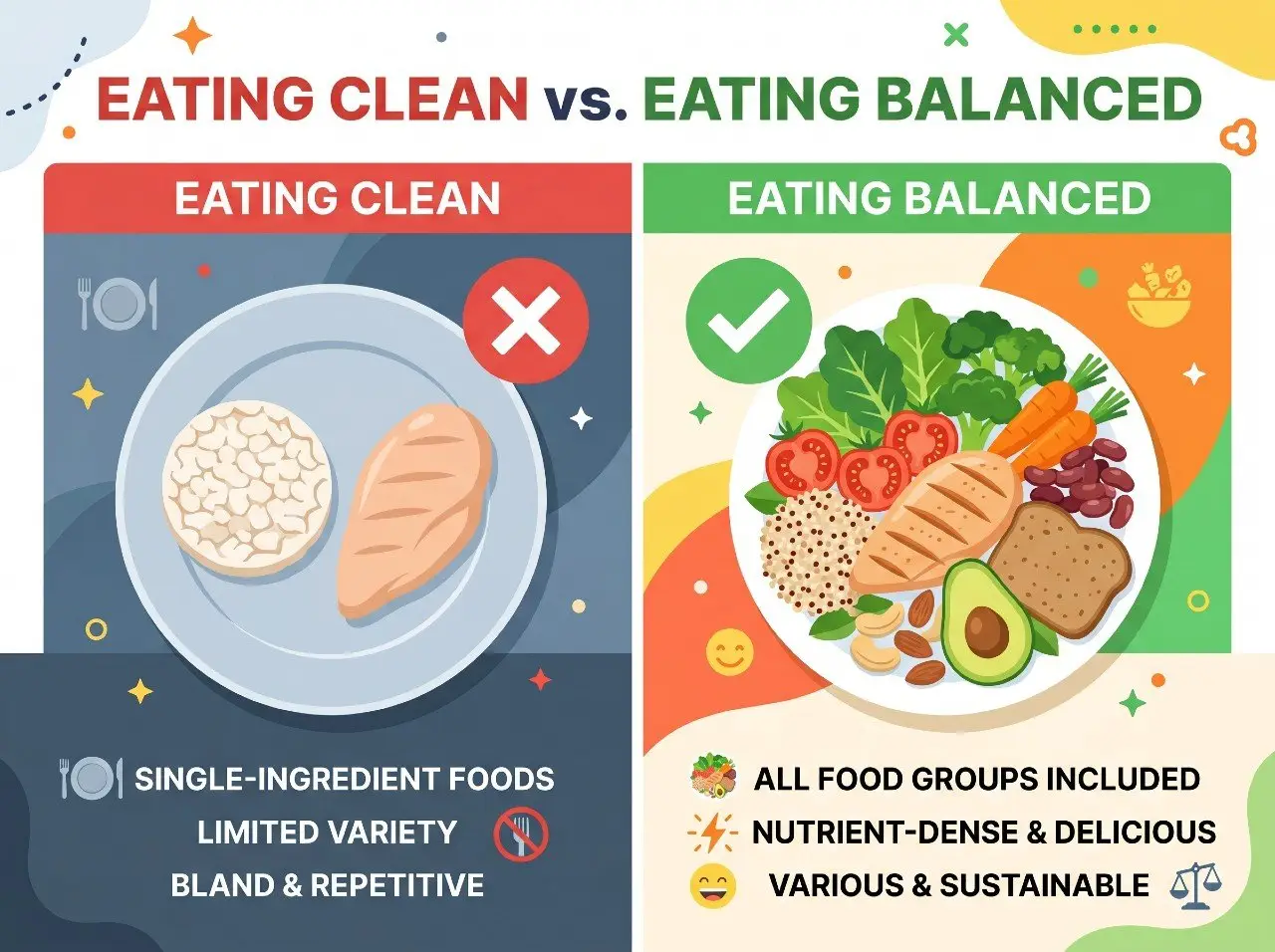
Here’s something most diet advice won’t admit: eating “clean” is not the same as eating balanced — and for women over 40, that distinction matters more than calories. You can eat nothing but grilled chicken, rice cakes, and kale for a month and still be nutritionally unbalanced.
Clean labels do not equal complete nutrition. And yet the wellness industry has spent decades convincing us that if we just cut out the “bad” stuff — the carbs, the fats, the dairy — the weight will come off and stay off. It won’t. At least not for long.
I understand why this is confusing — and honestly, maddening. You’ve probably tried eating healthily and still not seen the results you expected. Maybe you cut carbs for six weeks and lost a little, then gained it back the moment you ate a piece of bread again.
Maybe you followed a low-fat plan and felt foggy, exhausted, and hungrier than before you started. That’s not a willpower problem. That’s a balance problem. And the frustration of doing “everything right” and still not seeing lasting results is one of the most common things I hear from women who write to us.
The goal of this article is to give you four practical, research-backed tips for balancing your diet during weight loss — so that you lose the weight, keep your body properly fuelled, and don’t feel like you’re white-knuckling your way through every meal.
No food groups cut. No obsessive tracking. Just a smarter, more flexible approach that works with your biology instead of against it.
Medical & Referral Disclaimer
This article is for informational and educational purposes only. It is not a substitute for professional medical advice, diagnosis, or treatment. Always consult your physician or qualified healthcare provider before starting any new diet or exercise programme, particularly if you are perimenopausal, postmenopausal, or managing any health condition.
Key Takeaways
- Eating “clean” and eating balanced are not the same thing — balance means all macros present, not just whole foods on the plate.
- Women over 40 face hormone-driven metabolic changes that make rigid elimination diets especially counterproductive.
- Weight loss works best as a defined phase, not a permanent way of eating — knowing when to stop restricting is as important as knowing how.
- Every food group serves a function your body cannot replace during a calorie deficit — cutting one removes more than just calories.
- Protein is the macro that matters most for women over 40 who want to protect muscle mass while losing fat.
- Flexible eating patterns predict greater, more sustainable weight loss than rigid dietary rules — the research on older women is consistent and clear.
- Fine-tuning portions beats eliminating food groups every single time, for both results and long-term adherence.

#1. Treat Weight Loss As A Phase, Not A Forever Diet
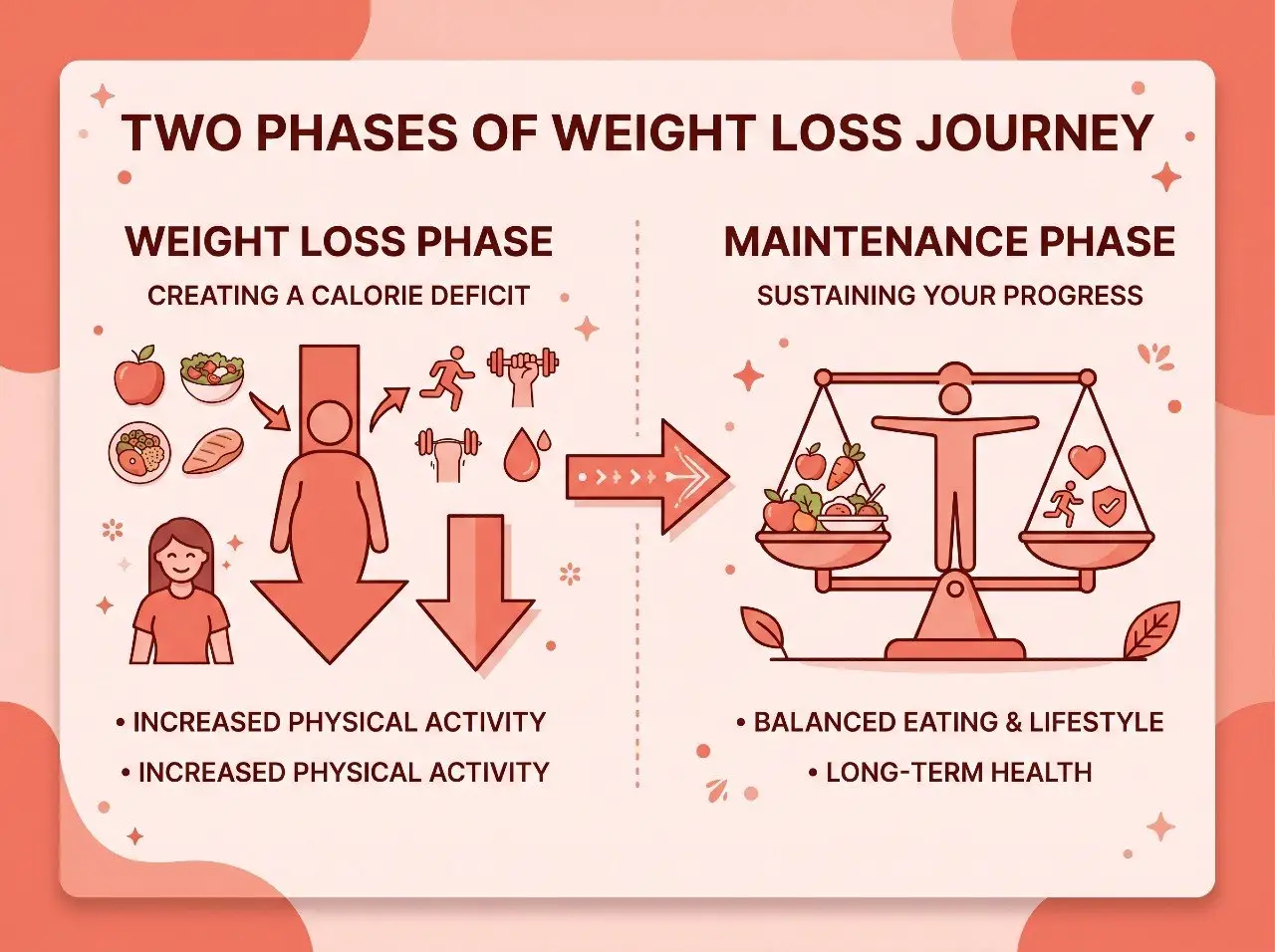
Weight loss is most effective — and most sustainable — when you treat it as a defined phase with a clear goal and a clear endpoint. Once you reach your target weight, your body needs more food, not less. Treating restriction as a permanent lifestyle is the fastest route to metabolic adaptation, burnout, and weight regain.
Notice the emphasis on the word phase. I want you to think of weight loss the same way you’d think of a short-term project — something you enter deliberately, work through methodically, and exit at a defined point. Not something you live inside forever. This shift in framing changes everything because it means you are always moving towards something instead of simply enduring.
Here’s why this matters biologically: your body doesn’t stay static during a calorie deficit. As you lose weight, your metabolic rate adapts slightly downward — because your body is doing exactly what it evolved to do when food is scarce.
Research published in Nutrition & Metabolism found that metabolic adaptation is associated with reduced fat and weight loss in response to low-energy diets, with the adaptive reduction averaging around 50 kcal/day. That’s not catastrophic on its own — but it signals that prolonged restriction makes the process progressively harder, not easier.
What this means practically: if you’ve been “dieting” for months or years without a real endpoint, you may be working against your own metabolism without realising it. The better approach is to set a realistic goal, work towards it deliberately using a balanced framework (covered in Tips #2–4 below), reach that goal, and then gradually shift into maintenance, which means eating more than you did during the weight-loss phase, not less.
Once the scale stabilises at your target weight, you’ll need to recalibrate upward. If it starts dipping below a healthy point, increase your food intake slightly. This is not failure — this is the goal. Knowing when to stop restricting is just as important as knowing how to restrict sensibly.
| Weight Loss Phase | Maintenance Phase | |
|---|---|---|
| Calorie intake | 300–500 cal below maintenance | At or near maintenance |
| Food groups | All present, portions reduced | All present, portions normalised |
| Protein priority | High active muscle protection needed | Moderate — ongoing muscle maintenance |
| Duration | Defined — until goal weight is reached | Indefinite — this is your sustainable lifestyle |
| Mental approach | Deliberate deficit with a clear goal | Flexible, enjoyable, no finish line pressure |
| Risk if prolonged | Metabolic adaptation, burnout, muscle loss | N/A — this is the destination, not a risk |
#2. Hit All Your Food Groups (Including The “Scary” Ones)
Every food group — including carbohydrates and fats — serves functions your body cannot skip during weight loss. Cutting one might move the scale short-term, but it also removes nutrients your hormones, brain, and muscles depend on. For women navigating the hormonal shifts of perimenopause, this is especially non-negotiable.
I know what you’re thinking. “But carbs are what make me gain weight.” Or: “Isn’t fat... fattening?” These are the myths the diet industry built its entire economy on. Here’s the reality: no single food group causes weight gain in isolation. A calorie surplus causes weight gain. And you can hit a calorie surplus eating nothing but “clean” foods just as easily as eating a varied, balanced diet.
For women over 40 in particular, there’s an added layer. A longitudinal study published in the International Journal of Obesity found that menopause onset is associated with a significant increase in visceral fat and a decrease in energy expenditure, driven by declining estrogen.
In fact, the study observed that women who became postmenopausal during the four-year follow-up showed fat oxidation rates that dropped by 32% — compared to no change in women who remained premenopausal. Your metabolism is already under hormonal pressure. Removing food groups on top of that amplifies the problem; it doesn’t solve it.
What Each Food Group Is Actually Doing For You
- Carbohydrates are your body’s preferred fuel source, especially for your brain and during exercise. Quality carbohydrates — oats, sweet potato, legumes, whole grains — also deliver fibre that feeds the gut microbiome, which plays a direct role in hormonal regulation and inflammation. Cutting them entirely doesn’t remove calories so much as it removes something your body and brain genuinely need.
- Fats are essential for hormone production — including oestrogen, progesterone, and cortisol. A very-low-fat diet removes the raw material your body needs to produce and regulate the very hormones that are already in flux during perimenopause. Healthy fats — olive oil, avocado, nuts, oily fish — are also required to absorb fat-soluble vitamins A, D, E, and K from the vegetables you’re eating.
- Protein is the macro nutrient most relevant to weight loss after 40, for reasons covered in depth in Tip #4. For now, it preserves the muscle mass you’re losing calories trying to protect, and it keeps you fuller for longer.
The bottom line is simple: don’t cut food groups. Adjust portions. These are very different things, and the second one is what actually works long term.
#3. Build Every Meal Around The WLBF Plate Balance Method
Balanced eating doesn’t require a nutrition degree or a macro-tracking app. The WLBF Plate Balance Method is a simple visual template for every meal — one that ensures all food groups show up in sensible proportions every time you eat, without the need to count a single calorie.
I created this method because I kept seeing the same pattern: women who were eating “healthily” but building meals that were nutritionally lopsided. A chicken breast with plain salad. A “clean” smoothie with three fruits, oat milk, and nothing else.
A big bowl of vegetables dressed in good olive oil, but with no protein in sight. Each of these meals has something missing — and the missing piece is what leaves you hungry, fatigued, or reaching for something in the kitchen at 10 pm.
The WLBF Plate Balance Method is intentionally visual because visual cues are far more practical at mealtimes than macros on a spreadsheet.
How To Build A Balanced Plate Every Time
- Half your plate: non-starchy vegetables. Leafy greens, broccoli, courgette, peppers, cucumber, tomatoes, mushrooms — whichever you enjoy. These are high in fibre and micronutrients, and low enough in calories that filling half your plate with them creates genuine volume and satiety without eating into your calorie budget.
- One quarter: quality protein. Chicken, salmon, eggs, Greek yoghurt, legumes, tofu, cottage cheese. This is the portion that protects your muscle mass during the deficit and keeps you satisfied beyond the next hour. If you find yourself hungry mid-morning after breakfast, check this quarter first — it’s usually under-filled.
- One quarter: quality carbohydrate. This is the quarter when most women shrink to almost nothing when they want to lose weight. Don’t. Whole grains, sweet potato, oats, quinoa, lentils — in appropriate portions. Not white bread every day, but absolutely not nothing. This portion fuels your brain, keeps energy stable, and prevents the kind of cravings that cause the whole plan to unravel at 4 pm.
- A small amount of healthy fat throughout. Olive oil on the vegetables, a quarter of an avocado, a small handful of nuts, and a drizzle of tahini. Fat adds flavour, extends satiety, and — critically — makes the vitamins in those vegetables bioavailable. Vitamins A, D, E, and K are fat-soluble. Eating them without fat is like buying a key and throwing away the lock.

This method also resolves a confusion I’ve noticed in popular diet advice: the idea that you should eat all food groups while simultaneously cutting carbs. Let me be clear about my position: there is a meaningful difference between adjusting the portion and quality of carbohydrates and eliminating them.
The WLBF method does the former. You keep carbohydrates — in a sensible quarter-plate portion from quality sources — and you lose weight while keeping your hormones, brain, and energy intact.
| Plate Section | What Goes Here | Why It Matters During Weight Loss | Example Foods |
|---|---|---|---|
| ½ Plate | Non-starchy vegetables | Volume, fibre, micronutrients — low calorie density keeps the deficit manageable | Spinach, broccoli, peppers, courgette, tomatoes, cucumber |
| ¼ Plate | Quality protein | Muscle protection, satiety, metabolic support during deficit | Chicken, fish, eggs, Greek yoghurt, legumes, tofu |
| ¼ Plate | Quality carbohydrate | Brain fuel, sustained energy, gut health — prevents cravings and energy crashes | Sweet potato, oats, whole grains, quinoa, lentils |
| Small addition | Healthy fat | Hormone production, fat-soluble vitamin absorption, and extended satiety | Olive oil, avocado, nuts, seeds, tahini, oily fish |
#4. Fine-Tune Your Macros Instead Of Cutting Food Groups
Instead of eliminating food groups, focus on adjusting how much of each you eat. For women over 40, protein is the macro nutrient worth prioritising above all others — clinical research shows it helps maintain muscle strength during weight loss in ways no other nutrient can replicate. And flexible eating, not rigid rules, is what predicts long-term success.
This is where the “clean eating” myth really falls apart. I’ve seen women eating nothing but whole foods — organic, colourful, Instagram-perfect — and still not losing weight, because their macros were completely off. Under-eating protein, over-relying on healthy fats, and eating carbohydrates inconsistently. All clean. None of it balanced in the way that actually moves the needle.
Join Our Mailing List
Join thousands of women inside our community and receive our free guide, 10 Actions That Support Permanent Weight Loss — the exact behavioural shifts that make the difference between a two-week attempt and a lasting transformation.
No restriction plans. No guilt. Just what actually works — for real women with real lives.
The Macro Priority Order For Women Over 40
Start with protein. A randomised controlled trial published in Obesity Facts examined the impact of protein intake in overweight postmenopausal women during a 12-week calorie-restricted diet. The study found that a higher-protein diet (1.5g/kg of body weight) helped maintain muscle strength compared to the standard 0.8g/kg recommendation — even without structured exercise.
You don’t need to obsess over hitting an exact number, but getting above the minimum recommended intake is the single most important macro shift you can make during weight loss after 40. If you’re currently eating protein as an afterthought, it’s worth making it the first thing you put on the plate.
Don’t obsess over fat. Fat is not the enemy, but it is calorie-dense — 9 calories per gram versus 4 calories per gram for protein and carbohydrates. The most practical approach is to include healthy fats at every meal in small amounts (as described in Tip #3) without tracking every gram.
Where women tend to go wrong is swinging between “low-fat everything” and full ketogenic elimination — neither extreme serves balanced weight loss, especially when hormones are already shifting.
Choose flexible over rigid. A randomised controlled trial published in the Journal of Nutrition, Gerontology, and Geriatrics followed overweight and obese older women through a six-month diet and exercise intervention. It found that an increase in flexible eating behaviour — combined with a decrease in rigid dietary restraint — predicted significantly greater weight loss over the intervention period.
Women who allowed themselves room to be human, rather than following rules to the letter, lost more weight and maintained it better. The birthday cake is not going to undo your progress. Chronic rigidity might.

I know that “macro fine-tuning” sounds like something that requires a spreadsheet and a nutrition qualification. It doesn’t. The practical version is: make protein the biggest deliberate choice at every meal, keep fats small and consistent, and keep quality carbohydrates in the quarter-plate portion from Tip #3. That’s macro balance without the intimidation.
Ready to build a diet that actually balances? Get our free women’s lean body formula guide — practical, hormone-aware nutrition strategies built specifically for women.
Related Articles
The Bottom Line
Balancing your diet during weight loss is not about perfection. It’s not about eating “clean” 100% of the time, eliminating food groups, or running a calorie calculator before every meal. It’s about a flexible, evidence-backed approach that keeps your body fuelled, your hormones functioning, and your muscle mass intact — while still moving the scale in the right direction.
For women over 40, especially, the hormonal context changes the game. Estrogen decline is already shifting your metabolism and fat distribution. Aggressive restriction layered on top of that doesn’t just feel harder; it is harder, and the research confirms it. Your biology isn’t working against you — but the wrong dietary approach is.
These four tips work because they work with your biology. Treat weight loss as a defined phase, not a permanent sentence. Keep all food groups on the table. Build every meal using a simple visual method that removes the guesswork. Fine-tune your macros instead of cutting them entirely. And give yourself enough flexibility to enjoy the process — because sustainable weight loss is the only kind that matters.
Glossary Of Key Terms
FAQ
For most women, yes — particularly over 40. Calorie counting is a tool, not a strategy. You can eat the right number of calories from nutritionally lopsided sources and still experience muscle loss, hormonal disruption, energy crashes, and cravings that torpedo the whole effort.
A balanced diet in a moderate calorie deficit addresses both the energy equation and the nutritional requirements simultaneously. If you can only focus on one thing, focus on balance first: the calorie management tends to follow naturally when every food group is represented in sensible portions.
Absolutely — and for most women over 40, you’ll do it more sustainably if you don’t. Low-carbohydrate diets can produce rapid initial weight loss, largely due to water loss (carbohydrates cause the body to retain glycogen-bound water).
But the majority of that initial loss is not fat, and the restrictive nature of very low-carb eating leads to poor adherence over time. The WLBF Plate Balance Method keeps carbohydrates in a quarter-plate portion from quality sources, which supports sustained energy, brain function, and gut health while still creating a calorie deficit.
The standard minimum recommendation is 0.8g of protein per kilogram of body weight per day — but during weight loss and in the context of perimenopause or menopause, this is almost certainly not enough. Clinical research suggests that higher protein intake (around 1.2–1.5g/kg) helps maintain muscle strength in postmenopausal women during calorie restriction. As a practical starting point: aim for a palm-sized serving of protein at every meal, and make it the first thing you plan on the plate — not the last.
Several reasons work together, and they’re not about willpower. Strict elimination diets trigger metabolic adaptation, appetite hormone changes (ghrelin rises, leptin falls), and the psychological rebound that comes from sustained rigid restriction.
When the diet ends — because it always ends — the body’s appetite signals and its slightly-reduced metabolism create the perfect conditions for weight regain. Transitioning to a balanced maintenance approach, rather than bouncing between restriction and no plan, is the most reliable way to keep weight off.
Yes — and the WLBF Plate Balance Method exists specifically for this reason. You don’t need to track macros, weigh food, or meal-prep for five hours on Sunday. The visual plate template — half vegetables, quarter protein, quarter quality carbs, a little healthy fat — works for packed lunches, restaurant meals, weeknight dinners, and everything in between. It’s a decision framework, not a rigid rule. The more you use it, the more automatic it becomes.
Not when it’s approached correctly. Fat is calorie-dense, so large portions in a calorie deficit can be counterproductive. But small, consistent amounts of healthy fat — as included in the WLBF Plate Balance Method — support hormone production (critical for women over 40), extend satiety after meals, and make fat-soluble vitamins bioavailable. The problem is not fat; it’s the extremes: either avoiding it completely or using it as the foundation of the entire diet.
When you reach your goal weight, or when sustained restriction is producing diminishing returns or affecting your energy, sleep, or mood. Moving into maintenance means gradually increasing your calorie intake by 100–200 calories per week until the scale stabilises — not reverting to old eating habits overnight. If the scale dips below your healthy range after transitioning, increase portions of quality carbohydrates and fats. The goal of maintenance is balance, not ongoing restriction. You are not meant to stay in a deficit forever.