

The Honest Benefits Of Coconut Oil: What The Research Confirms (And What It Doesn’t)
Julia Zumpano, RD, LD
Registered dietitian, Cleveland Clinic
Research shows that there’s little difference between coconut oil and other saturated fats like butter and palm oil.
Summary (TL;DR)
The real benefits of coconut oil are more modest and more interesting than the “miracle oil” hype suggests. It won’t melt fat off your body: a 2025 meta-analysis of 15 clinical trials found no clinically significant effect on weight, BMI, or waist size. What it can do, backed by real research: support quick-burning energy through MCTs, help repair the skin barrier, cut protein loss in damaged hair, and act as a stable, antimicrobial-rich cooking fat, used in moderation, because it’s still over 80% saturated fat.
For many women, the journey toward health feels less like a wellness path and more like an exhausting algebra exam. We are bombarded with limits on fat, salt, and sugar, while simultaneously trying to decode which “superfood” headline to trust this week for a truly nutritious diet.
Coconut oil sits right in the middle of that confusion: praised as a cure-all in one article, condemned as “liquid bacon fat” in the next.
That whiplash is exhausting, and it’s reasonable to feel a little intimidated by it. The truth, as usual, sits in the middle: coconut oil has real, evidence-backed benefits for energy, skin, hair, and gut health, and it also has real limits that most blog posts conveniently skip.
This guide walks through what the research actually supports, where the hype gets ahead of the science, and how to use coconut oil in a way that works with your body instead of against your wallet or your cholesterol panel.
I’ll be upfront: I keep a jar of virgin coconut oil in my kitchen, but not for the reasons the wellness aisle would have you believe. I use it in small amounts, about a teaspoon, stirred into oatmeal or brushed onto a pan for a medium-heat sauté, and I keep a second jar in the bathroom for my ends after a wash, not my scalp. It’s never been a weight-loss trick for me, and I’m not going to pretend it was.
It’s a good-smelling, shelf-stable fat that does two or three things well, and knowing which two or three things saves you from disappointment later. It’s one small, unglamorous piece of a fitness nutrition routine, not the centrepiece of one.
Medical & Referral Disclaimer
This article is for informational and educational purposes only. It is not a substitute for professional medical advice, diagnosis, or treatment. Always consult your physician or qualified health provider before starting any new diet or exercise program.
Key Takeaways
- Weight loss claims are overstated: a 2025 dose-response meta-analysis of 15 trials found coconut oil produces no clinically meaningful change in body weight, BMI, or waist circumference compared to other fats.
- The heart-health picture is mixed, not simple: coconut oil raises HDL (“good”) cholesterol, but the American Heart Association still advises against regular use because it also raises LDL, and it is roughly 80–90% saturated fat, comparable to bacon grease by weight.
- Skin and hair benefits are genuinely well-supported: randomized clinical trials show virgin coconut oil improves skin barrier function and reduces hair protein loss more effectively than mineral oil.
- MCTs are the real mechanism behind coconut oil’s energy and appetite effects, but coconut oil is only about 60–65% MCTs, and roughly half of that is lauric acid, which metabolizes more slowly than the caprylic and capric acid found in pure MCT oil.
- Moderation has a number attached to it: capping coconut oil at 1–2 teaspoons daily keeps saturated fat intake within a reasonable range for most women.
- Refined vs. unrefined matters for cooking: refined coconut oil (smoke point ~400°F) suits medium-high heat; unrefined virgin coconut oil (~350°F) is better for lower-heat cooking, baking, or using raw.

What Coconut Oil Actually Is (Before We Get To The Benefits)
Coconut oil is roughly 60–65% medium-chain triglycerides (MCTs), a type of lipid your body processes differently from the long-chain fats in most other cooking oils.
Instead of following the slow route through your lymphatic system, MCTs go almost directly to your liver, where they’re converted quickly into usable energy or ketones, which is the basis for nearly every legitimate benefit attributed to coconut oil.
About half of coconut oil’s fat content is lauric acid, a medium-chain fatty acid with genuine antimicrobial properties, but one that metabolizes more slowly than the caprylic and capric acids found in purified MCT oil.
That distinction matters: coconut oil and MCT oil are often marketed interchangeably, but they are not the same product, and they don’t behave the same way in your body (Acme-Hardesty, MCT Oil Overview).
The Benefits Of Coconut Oil, Ranked By What The Evidence Actually Shows
1. Energy And Metabolism Support
Coconut oil’s MCTs are absorbed and converted to usable energy faster than the long-chain fats in most other oils, which is why it’s become a staple in low-carb and keto kitchens.
Because MCTs bypass the slower digestive route long-chain fats take, they reach the liver quickly and can be converted into ketones for fast fuel, including for the brain (Acme-Hardesty).
The catch: coconut oil is a diluted source of MCTs compared to purified MCT oil, and much of its MCT content is the slower-metabolizing lauric acid. If your goal is a genuine energy boost rather than a flavor and cooking benefit, purified MCT oil (caprylic and capric acid only) will act faster and more predictably than coconut oil itself.

2. Appetite And Weight Management: The Correction
Despite the popular claim, current evidence does not support coconut oil as an effective weight-loss tool.
A 2025 dose-response meta-analysis of clinical trials found that, compared with other fats, coconut oil supplementation produced no clinically significant change in body weight, BMI, waist circumference, or fat mass (BMC Nutrition, 2025). An earlier randomized trial in overweight adolescents found a coconut oil-rich meal did not enhance thermogenesis compared to corn oil (PMC5531289).
This is worth sitting with, because it contradicts a claim you’ll see repeated across dozens of wellness blogs, including the earlier version of this article. The theoretical mechanism, MCTs boosting satiety and calorie burn, is real in isolated lab studies, but it does not translate into meaningful weight change once you eat coconut oil (rather than isolated MCT oil) as part of a real diet.
If cravings and appetite regulation are your goal, coconut oil is not the lever to pull; a consistent calorie approach built around your actual needs will do far more.
3. Heart Health: A Nuanced Picture
Coconut oil reliably raises HDL (“good”) cholesterol, but it also raises LDL (“bad”) cholesterol, which is why major cardiology bodies still advise limiting it.
A randomized crossover trial found daily virgin coconut oil intake significantly increased HDL cholesterol in healthy volunteers (PMC5745680), and a separate randomized trial found coconut oil raised HDL more than both butter and olive oil (PMC5855206).
But more than 80% of coconut oil is saturated fat: one tablespoon contains about 12 grams of saturated fat and 117 calories, putting it close to bacon grease by composition. The American Heart Association advises against regular use, a position backed by over 100 studies.
As Cleveland Clinic dietitian Julia Zumpano puts it: coconut oil isn’t meaningfully different from other saturated fats like butter or palm oil when it comes to your arteries (Cleveland Clinic). No randomized trial has yet measured coconut oil’s effect on actual heart attacks or strokes; the research so far is limited to cholesterol markers, not hard cardiac outcomes.

4. Skin Health And Barrier Repair
Applied topically, virgin coconut oil measurably improves skin barrier function and outperforms mineral oil for mild-to-moderate dry skin.
A randomized, double-blind clinical trial in pediatric patients with atopic dermatitis found topical virgin coconut oil was superior to mineral oil for improving SCORAD scores (SCORAD is a standard clinical measure of eczema severity) and reducing transepidermal water loss (International Journal of Dermatology, 2014).
A separate adult trial found virgin coconut oil had antibacterial effects against Staphylococcus aureus colonization that virgin olive oil did not. You can apply it directly to skin as a moisturizer, or consume it as part of a nutritious diet that supports overall skin health, and both routes have research behind them, which is more than can be said for most “glow from within” claims.
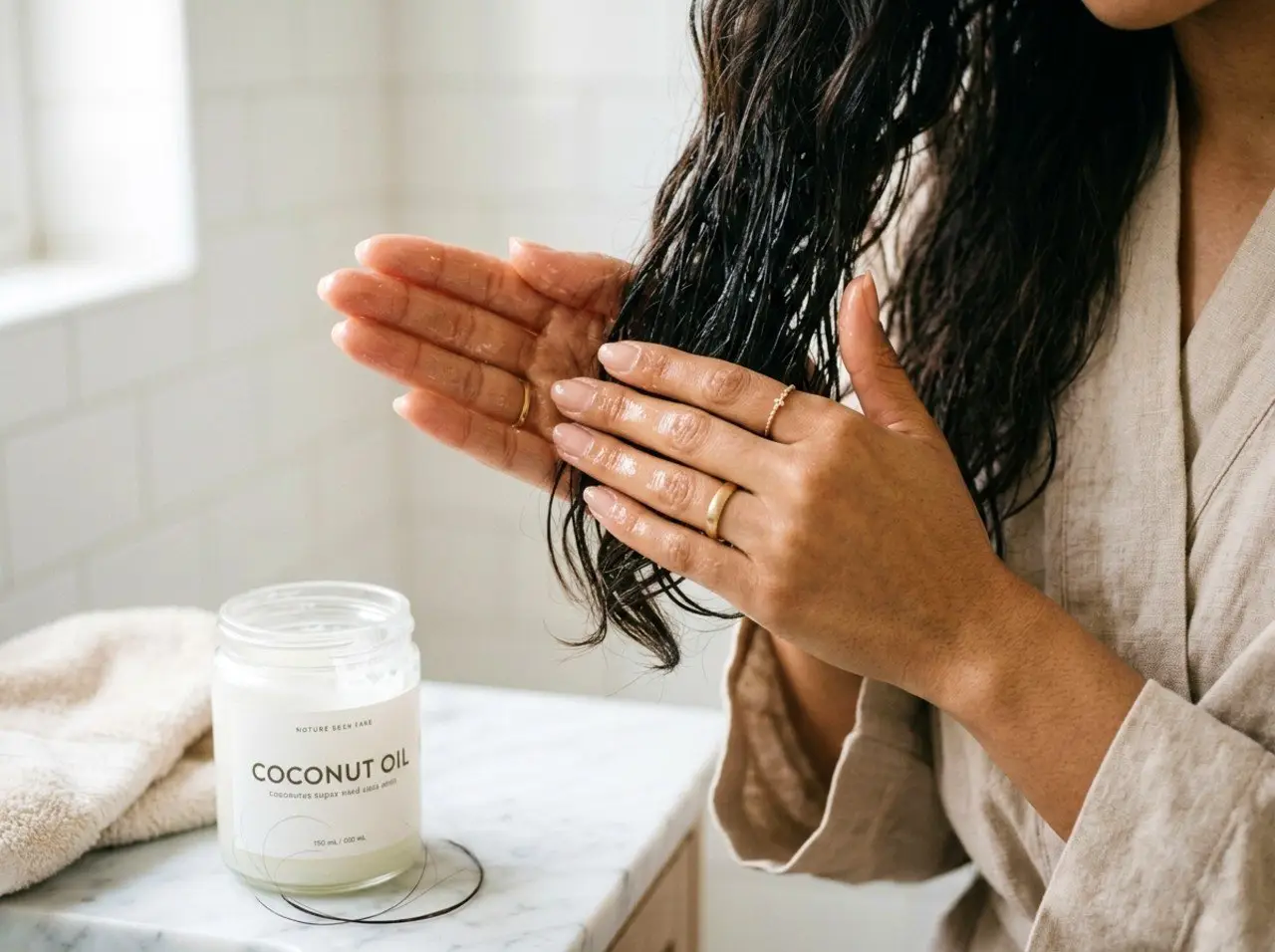
5. Hair Strength And Shine
Coconut oil is the only common hair oil shown to meaningfully reduce protein loss in both damaged and undamaged hair, because its lauric acid penetrates the hair shaft rather than just coating the surface.
The foundational study on this, published in the Journal of Cosmetic Science, compared mineral oil, sunflower oil, and coconut oil as pre-wash and post-wash treatments and found coconut oil was the only one to reduce protein loss significantly, in both intact and damaged hair (Rele & Mohile, J. Cosmet. Sci. 2003).
Mineral and sunflower oils sit on the hair’s surface; coconut oil’s small, straight-chain lauric acid actually gets into the hair shaft. Applying it before a wash and leaving it in for ten or more minutes is the protocol closest to what the research tested.
6. Gut And Antimicrobial Support
Lauric acid, which makes up roughly 45–52% of virgin coconut oil, has documented antibacterial, antifungal, and antiviral activity, particularly against gram-positive bacteria like Staphylococcus aureus.
A 2022 review of the antimicrobial properties of lauric acid and monolaurin (a compound the body makes from lauric acid) in virgin coconut oil found broad-spectrum inhibitory action against bacteria, fungi including Candida albicans, and several enveloped viruses (ChemBioEng Reviews, 2022).
This doesn’t make coconut oil a treatment for infection or digestive disease (that’s a leap the research doesn’t support), but it does explain the antimicrobial reputation the oil has earned, particularly in oral and topical use.
7. Keto And Low-Carb Diet Support
Because MCTs convert to ketones quickly, coconut oil is a popular (if imperfect) fat source for people following ketogenic or low-carb diets.
It can help maintain ketosis alongside other fats, though purified MCT oil, one of the most widely used natural supplements in keto circles, is generally more efficient for this specific purpose because it skips the slower-digesting lauric acid entirely.
If you’re building a healthy-fats strategy for weight management, coconut oil can be one ingredient in that toolkit, not the whole toolkit.
8. Cooking Versatility And Heat Stability
Coconut oil’s high saturated-fat content makes it more resistant to heat-driven oxidation than polyunsaturated oils, so it holds up well for everyday cooking.
Refined coconut oil has a smoke point around 400°F (204°C), suitable for saucing and baking; unrefined virgin coconut oil is lower, around 350°F (177°C), and is better suited to lower-heat cooking or using raw (WebstaurantStore Smoke Point Guide). It’s a common swap in healthy recipes ranging from baked goods to weeknight stir-fries.
Join Our Mailing List
Join thousands of women inside our community and receive our free guide, 10 Actions That Support Permanent Weight Loss — the exact behavioural shifts that make the difference between a two-week attempt and a lasting transformation.
No restriction plans. No guilt. Just what actually works — for real women with real lives.

Benefit vs. Evidence Strength: A Quick Reference
| Claimed Benefit | Evidence Strength | What The Research Actually Shows |
|---|---|---|
| Skin barrier repair | Strong | Randomized trials show it outperforms mineral oil for dryness and atopic dermatitis |
| Hair protein retention | Strong | The only common oil shown to reduce protein loss in damaged and undamaged hair |
| Antimicrobial activity | Moderate–Strong | Well-documented in lab studies against bacteria, fungi, some viruses |
| HDL cholesterol increase | Moderate | Confirmed in RCTs, but comes bundled with an LDL increase too |
| Quick-burning energy (MCTs) | Moderate | Real mechanism, but diluted by coconut oil’s slower-metabolizing lauric acid |
| Weight loss / fat burning | Overstated | 2025 meta-analysis of 15 trials: no clinically significant effect |
| “Heart-healthy” as a headline claim | Overstated | AHA advises against regular use; ~80%+ saturated fat |
Coconut Oil vs. Other Cooking Fats
| Fat | Saturated Fat | Smoke Point | Calories (1 tbsp) | Cholesterol Effect |
|---|---|---|---|---|
| Coconut Oil (refined) | ~80–90% | ~400°F / 204°C | 117 | Raises both HDL and LDL |
| Coconut Oil (virgin/unrefined) | ~80–90% | ~350°F / 177°C | 117 | Raises both HDL and LDL |
| Extra Virgin Olive Oil | ~14% | ~320°F / 160°C | 119 | Favors LDL reduction; heart-protective in Mediterranean diet studies |
| Avocado Oil | ~12% | 480–520°F / 249–271°C | 124 | Associated with lower LDL in animal studies |
| Butter | ~63% | ~300–350°F / 149–177°C | 102 | Raises LDL; little difference from coconut oil per Cleveland Clinic |
Sources: Cleveland Clinic, WebstaurantStore Smoke Point Guide.

How To Use Coconut Oil Without Overdoing The Saturated Fat
Capping coconut oil at roughly 1–2 teaspoons a day keeps it inside a reasonable share of your daily saturated fat allowance without needing to give it up entirely.
The American Heart Association’s general guidance is to keep saturated fat under 6% of daily calories, about 12 grams on an 1,800-calorie diet, which a single tablespoon of coconut oil alone would use up (Cleveland Clinic).
In practice, that means treating coconut oil the way you’d treat butter: a flavor and texture ingredient in select recipes, not your default everyday cooking fat. Reserve olive oil or avocado oil for daily saucing and salad dressings, and save coconut oil for baking, occasional stir-fries, or your hair and skin routine, where its distinct properties actually shine.
When you do buy it, an organic, cold-pressed virgin coconut oil retains more of the lauric acid and antimicrobial compounds discussed above than heavily processed versions.
Ready For A Plan That Doesn’t Rely On Miracle Ingredients?
If this breakdown left you wanting fewer myths and more of what actually moves the needle, that’s exactly what we built our free guide for. Join thousands of women inside our community and grab 10 Actions That Support Permanent Weight Loss, the practical, sustainable habits that replace “miracle oil” hype with what the research actually supports.
Related Articles
The Bottom Line
Coconut oil earns its place in a healthy kitchen and self-care routine, just not for the reasons most headlines claim. The strongest evidence supports it as a skin and hair treatment, a source of quick-digesting MCT energy, and a heat-stable cooking fat used in moderation as part of a broader nutritious diet.
The weakest evidence, by a wide margin, is the claim that it will help you lose weight; the best current research says it won’t.
None of that makes coconut oil useless. It makes it ordinary, in the best sense: a genuinely useful ingredient with real limits, the same as every other fat in your kitchen. Skip the miracle-oil marketing, keep the teaspoon-sized portions, and let it do the two or three things it’s actually good at.
Glossary Of Key Terms
FAQ
Not meaningfully. A 2025 meta-analysis of 15 clinical trials found no clinically significant effect of coconut oil supplementation on body weight, BMI, or waist circumference compared with other fats. The MCT mechanism is real in theory, but it doesn’t translate into measurable weight loss when coconut oil is eaten as part of a normal diet.
It’s complicated, not simply bad. Coconut oil reliably raises HDL (“good”) cholesterol, but it raises LDL (“bad”) cholesterol too, and it’s over 80% saturated fat. The American Heart Association advises against regular use as a heart-healthy oil, though no trial has directly measured its effect on heart attacks or strokes.
Most guidance points to roughly 1–2 teaspoons daily as a reasonable limit, since a single tablespoon already contains about 12 grams of saturated fat, close to a full day’s recommended saturated fat allowance on a moderate-calorie diet.
The research supports hair protein retention and reduced damage, not faster growth. Studies show coconut oil reduces protein loss in both damaged and undamaged hair more effectively than mineral or sunflower oil, which keeps existing hair healthier and shinier, but there’s no strong evidence it accelerates new hair growth.
Coconut oil is roughly 60–65% MCTs, about half of which is slower-metabolizing lauric acid, plus other long-chain fats. Pure MCT oil is stripped down to just caprylic and capric acid, which digest faster and more predictably, making it the better choice if energy or ketosis is your specific goal.
Refined coconut oil, with a smoke point around 400°F (204°C), handles medium-to-high heat reasonably well. Unrefined virgin coconut oil has a lower smoke point of about 350°F (177°C) and is better suited to gentler cooking, baking, or use raw.
Yes, this is one of coconut oil’s best-supported benefits. Randomized clinical trials show that virgin coconut oil improves skin barrier function and outperforms mineral oil for mild-to-moderate dry skin and atopic dermatitis, both by moisturizing and through mild antibacterial effects.
You Know Why. Now Learn Exactly How
Join thousands of women inside our community and receive our free guide: 10 Actions That Support Permanent Weight Loss — the practical, sustainable habits that translate everything you just read into real, lasting results.
No fad diets. No extreme plans. Just what the research actually supports — written for real women.