

Unveiling The Dark Side: The Worst Crash Diets Ever, Their Potential Risks, And What To Do Instead

The two biggest sellers in any bookstore are the cookbooks and the diet books. The cookbooks tell you how to prepare the food, and the diet books tell you how not to eat any of it!
Andy Rooney ‧ Journalist and broadcaster
Summary (TL;DR)
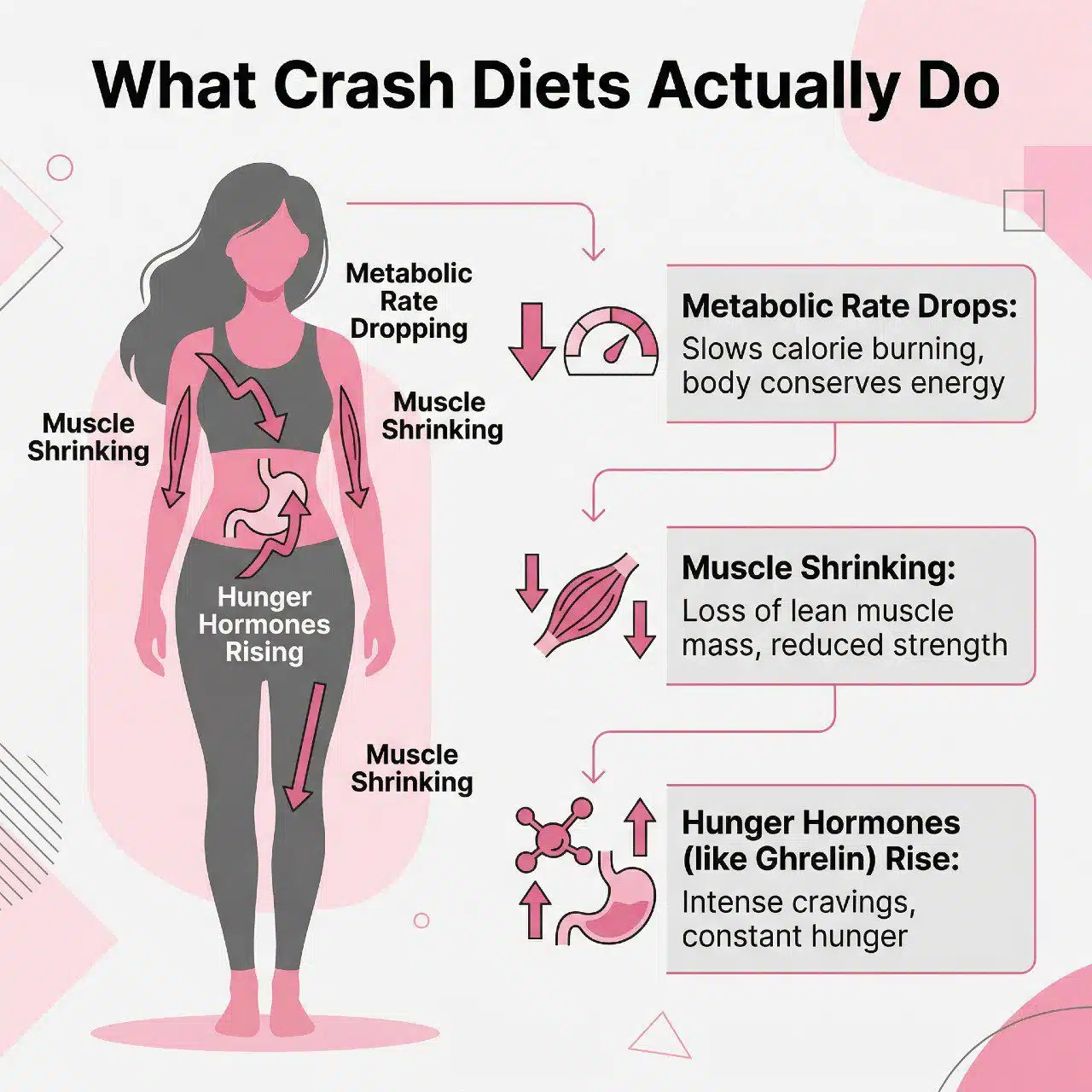
Crash diets promise rapid weight loss, but they often backfire. Severely cutting calories triggers a biological response: metabolism slows, muscle breaks down, and hunger hormones increase. Women face risks like menstrual disruption and bone density loss.
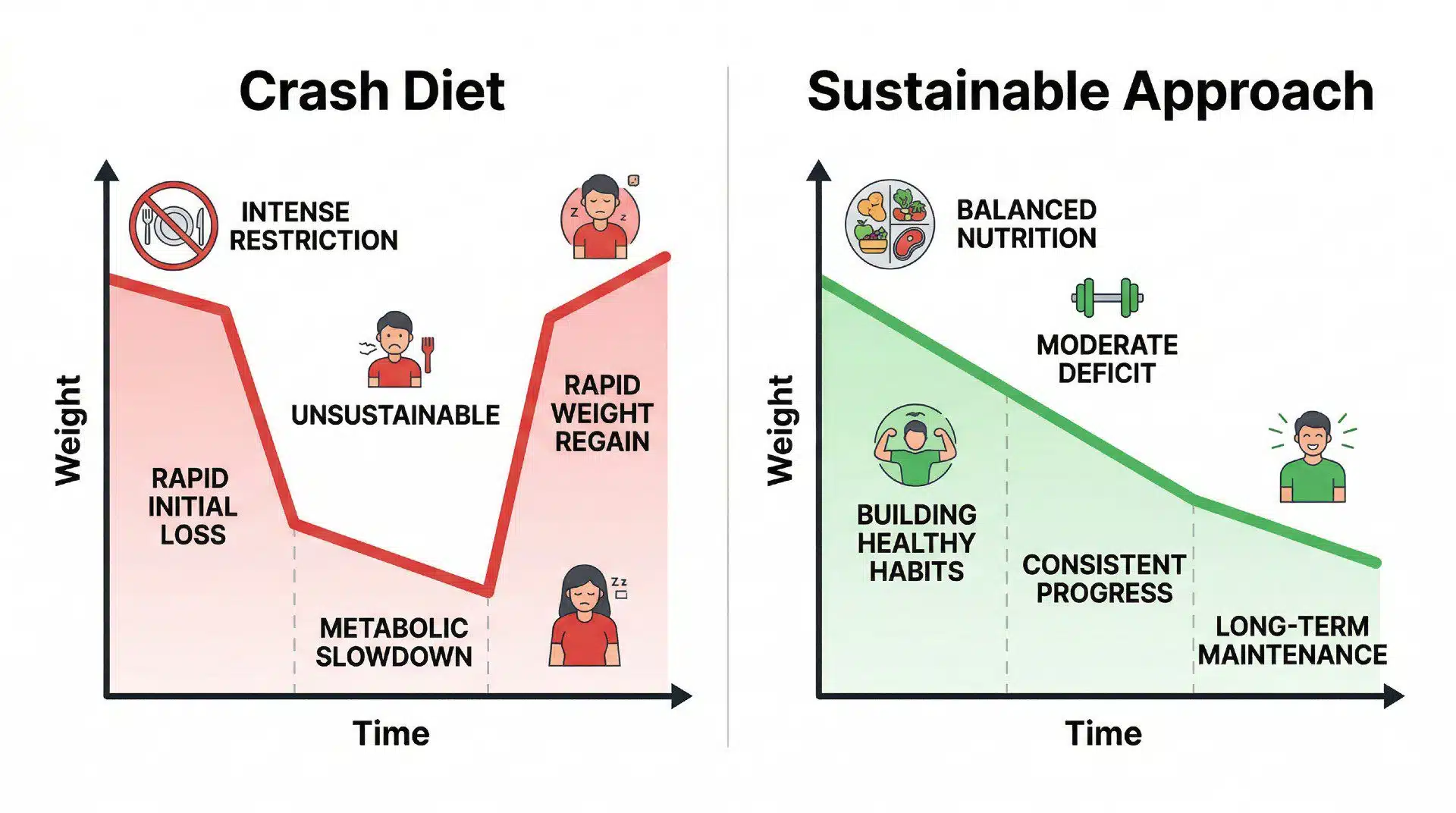
Many regain the weight, sometimes more, leading to "yo-yo dieting" which increases cardiovascular risk. Avoid dangerous fads like the HCG or Tapeworm diets. A moderate calorie deficit with strength training offers better, sustainable weight loss results, without the health risks.
Every January, millions of women commit to a diet that promises transformation in two weeks. By February, most have stopped. Many weigh more than they did at the start.
That's not a willpower failure. It's the predictable outcome of a strategy that fights your biology instead of working with it.
Crash diets don't work because your body reads starvation as a threat — and responds accordingly. Metabolism slows. Hunger hormones spike. Muscle breaks down. The moment you return to normal eating, the weight comes back faster than it left.
This article covers the worst crash diets ever, what each one actually does to the body, and why the evidence on all of them points in the same direction. If you've tried some of these and blamed yourself for failing, read this first.
Medical & Referral Disclaimer
This article is for informational purposes only. It is not a substitute for professional medical advice, diagnosis, or treatment. Always consult a qualified health professional before making significant changes to your diet.
Key Takeaways
- Crash diets slow your metabolism. Within days of severe caloric restriction, your body lowers its resting metabolic rate and begins breaking down muscle for energy — making future weight loss harder, not easier.
- Around 80% of crash dieters regain the weight within five years, according to research published in Obesity Reviews — and many end up heavier than when they started.
- Women face specific risks that men don't, including oestrogen suppression, menstrual disruption, and accelerated bone density loss — effects that can persist long after the diet ends.
- The most dangerous crash diets — including the HCG Diet (FDA-banned), Cotton Ball Diet, and Tapeworm Diet — are still circulating online, some repackaged as wellness trends.
- Rebound weight gain is biological, not a willpower failure. Elevated hunger hormones and a suppressed metabolism after crash dieting create conditions designed to make you regain weight rapidly.
- A deficit of 300–500 calories per day, combined with adequate protein and resistance training, consistently outperforms crash dieting for both fat loss and long-term results.
What Is A Crash Diet?
A crash diet is any eating plan that slashes calories drastically — typically below 800 per day — intending to lose weight as fast as possible.
The term covers a wide range. At one end, there are medically supervised very-low-calorie diets (VLCDs), used short-term for patients with obesity-related conditions and monitored by doctors. At the other end: the completely unscientific fads that cycle through social media dressed up in new names every season.
Most of what follows falls firmly into the second category.
Why Crash Diets Don't Work: The Biological Reality
When you cut calories severely, your body reads it as a famine. It responds with a series of adaptations designed to keep you alive: it lowers your resting metabolic rate, breaks down muscle tissue for energy, and elevates hunger hormones to drive you back towards food.
Fat does come off. But so does muscle — and muscle is the tissue that burns calories around the clock, even at rest.
A 2020 review published in Obesity Reviews found that roughly 80% of people who lost weight through very-low-calorie diets regained it within five years. Repeated cycles of loss and regain — what researchers call weight cycling, and most people call yo-yo dieting — are independently associated with increased cardiovascular risk.
For women, the stakes are higher. Oestrogen plays a direct role in how the body stores and mobilises fat. When calories drop sharply, oestrogen can fall with them — disrupting the menstrual cycle, weakening bones, and affecting mood and cognition. This isn't a theoretical risk. It's a documented consequence of severe restriction, and it's one reason hormones and weight loss for women are so closely linked.
What Crash Diets Promise vs. What The Research Shows
| Crash Diet Claim | What Actually Happens |
|---|---|
| Rapid fat loss | Initial loss is mostly water and glycogen, not body fat |
| Boosted metabolism | Resting metabolic rate drops within days of severe restriction |
| Sustained results | ~80% of people regain weight within 5 years |
| More energy | Most people report fatigue, brain fog, and irritability |
| A "body reset" | No clinical evidence supports the concept of a dietary reset |
| Detoxification | The liver and kidneys detox continuously — no diet required |

TIP: If you rely on diets to lose weight, you are most likely going to be disappointed. As a matter of fact, two-thirds of individuals who diet actually gain more weight than they lose.
The Worst Crash Diets Ever
These are not all ancient history. Many are still circulating on social media, rebranded and recycled. Here is what each one actually does.
1. The Cabbage Soup Diet
Origins: Circulating since at least the 1980s, allegedly as a pre-surgery cardiac protocol. That provenance has never been verified.
How it works: Eat unlimited cabbage soup for seven days, with a rotating list of permitted foods — some days fruit, some days beef, one bizarre day combining bananas and skimmed milk. Calorie intake typically lands between 500 and 800 per day.
The risks:
- Almost no protein, which accelerates muscle breakdown
- Severe flatulence and digestive discomfort from start to finish
- Most weight lost is water and glycogen — it returns the week you stop
- Nutrient deficiencies begin within days
There is no scientific evidence that cabbage soup has any fat-burning properties. The caloric restriction does the work, and it does it badly. Learn more about the real differences between a fad diet and one that actually works.
Risk level: Moderate. Unlikely to cause acute harm in otherwise healthy adults over seven days — but near-certain to result in rebound weight gain.
2. The Master Cleanse (Lemon Detox Diet)
Origins: Developed by Stanley Burroughs in 1941. It resurfaced in 2006 after Beyoncé mentioned using it to lose weight for a film role. Maple syrup sales spiked.
How it works: Consume a mixture of lemon juice, maple syrup, cayenne pepper, and water for 10 to 40 days. Nothing else, apart from optional saltwater flushes and laxative herbal teas.
Calorie intake: Approximately 650 per day, almost entirely from sugar.
The risks:
- No protein intake causes rapid muscle breakdown
- Blood sugar becomes erratic — high sugar, zero fibre
- The laxative teas can disrupt gut flora and cause chronic digestive problems
- Electrolyte imbalances from saltwater flushes can cause heart rhythm irregularities
The NHS explicitly advises against detox diets, noting there is no clinical evidence they remove toxins or improve health. Your liver and kidneys handle detoxification continuously. They don't need lemon juice to function.
Risk level: High. Extended use can cause dangerous electrolyte imbalances.

3. The HCG Diet
Origins: Proposed by British endocrinologist Albert Simeons in the 1950s, based on observations of pregnant women's fat distribution.
How it works: Combine a 500-calorie-per-day eating plan with injections or oral drops of human chorionic gonadotrophin (HCG) — a hormone produced during pregnancy. The theory was that HCG would direct the body to burn stored fat and suppress hunger.
What the research found: Multiple randomised controlled trials established that HCG injections offered no benefit over placebo when paired with a 500-calorie diet. The weight loss came entirely from near-starvation, not the hormone. The FDA banned over-the-counter HCG weight-loss products in 2011, and Mayo Clinic classifies the HCG diet as dangerous.
The risks of 500 calories per day:
- Gallstone formation (rapid weight loss is a primary gallstone risk factor)
- Severe nutrient deficiencies
- Significant muscle wasting
- Hormonal disruption in women, including interference with the menstrual cycle
Risk level: Very high. The 500-calorie protocol alone is dangerous without medical supervision — the HCG adds no benefit and doesn't reduce the risk.
4. The Tapeworm Diet
Origins: Early 1900s America. Newspaper advertisements offered "sanitised tapeworms" as a weight-loss solution, claiming the parasites would consume the dieter's excess calories.
This is not a metaphor. People bought these. Whether every pill actually contained tapeworm larvae is debated, but the marketing was real and taken seriously at the time.
What happens if you swallow a tapeworm:
- Larvae can migrate to the brain, causing neurocysticercosis — a condition that produces seizures, blindness, and can be fatal
- Organ damage and cyst formation throughout the body
- Severe malnutrition as the parasite competes for nutrients
- Intestinal obstruction
It is illegal in most countries to sell tapeworm larvae for human consumption. This belongs in medical history, not in any discussion of health strategies.
Risk level: Extreme. Potentially fatal.
5. The Sleeping Beauty Diet
Origins: Attributed to various historical figures, including — apocryphally — Elvis Presley. Documented cases from the 1970s involved doctors sedating patients for extended periods as a weight-loss intervention.
How it works: Sedate yourself so that you sleep for days at a time, because you cannot eat while unconscious.
Why it's dangerous:
- Prolonged sedation carries significant anaesthetic risks
- Muscle atrophy begins rapidly with extended immobility
- No eating habits are being addressed — the moment the patient wakes up, nothing has changed
- There is zero sustainable outcome
This isn't a diet. It's a temporary interruption of consciousness with no lasting benefit and real medical risk.
Risk level: Extreme when involving sedatives.
6. The Cotton Ball Diet
Origins: Emerged around 2013 through pro-anorexia communities online. The premise is to soak cotton balls in juice and swallow them to feel full without consuming calories.
Cotton is not food. It is a textile fibre. When ingested:
- It can cause intestinal blockages requiring emergency surgery
- It provides zero nutrition
- It may contain bleaches, dyes, and chemical residues from manufacturing
This diet circulates on TikTok and Instagram. The National Eating Disorders Association (NEDA) classifies these behaviours as disordered eating requiring professional support — not a dietary approach to evaluate.
Risk level: Extreme. Physical harm and a direct path into serious eating disorder behaviours.


FACT: Yo-Yo dieting has been shown to be capable of causing damage to blood vessels, leading to atherosclerosis and other types of heart diseases.
7. The Grapefruit Diet (Hollywood Diet)
Origins: Dates to the 1930s and has never quite gone away. The theory is that grapefruit contains a fat-burning enzyme that, when consumed before each meal, accelerates weight loss.
There is no such enzyme. Grapefruit does contain naringenin, a flavonoid with some metabolic effects observed in animal studies, but no human trial has demonstrated meaningful fat loss beyond caloric restriction. The weight loss on this diet comes from the 800-calorie-per-day limit — not the grapefruit.
One real risk: Grapefruit interacts with over 85 medications, including common statins, blood pressure drugs, and certain antidepressants." For anyone taking regular medication, this diet carries drug-interaction risks that can be medically significant.
Risk level: Low to moderate for healthy adults with no medications; higher for anyone on a regular prescription.
8. The Baby Food Diet
Origins: Attributed (probably incorrectly) to celebrity trainer Tracy Anderson around 2010.
How it works: Replace one or two meals per day with jars of commercial baby food, followed by a small "adult" dinner. Calorie intake in some versions drops to 600 per day.
Baby food is formulated for infants. Protein content is low, fibre is low, and the caloric density is designed for a 6-month-old, not an adult woman with a functioning, active metabolism. Sustained use leads to muscle loss, metabolic slowdown, and the predictable rebound. There is also something to be said about what this kind of eating pattern does to your relationship with food.
Risk level: Moderate. Nutritionally inadequate for adults, though unlikely to cause acute harm over very short periods.
9. Juice Fasting / Juice Cleanses
Origins: Ongoing. Juice cleansing has been commercially packaged and sold in various forms since at least the 1970s, and shows no sign of disappearing.
How it works: Consume only fruit and vegetable juices for three days to several weeks. Calorie intake typically sits between 800 and 1,200 per day, with almost no protein and no fibre (removed by juicing).
The problems:
- Without protein, muscle tissue cannot be maintained
- Without fibre, blood sugar spikes sharply after each juice, triggering hunger within hours
- Most people report headaches, fatigue, and irritability within 48 hours
There is no credible clinical evidence that juice fasting removes toxins, resets the gut microbiome, or produces superior fat loss compared to a calorie-equivalent whole-food diet. If you want to eat more vegetables, eat more vegetables — you don't need to remove the fibre and pay three times the price to do it.
Risk level: Low to moderate for short periods. Higher for people with blood sugar conditions or type 2 diabetes.
10. The Mono Diet
Origins: No clear provenance — it appeared on internet forums in the mid-2000s and spread from there.
How it works: Eat only one food for a set period. That food can theoretically be anything: bananas, potatoes, or chocolate. There is no scientific basis for the approach.
The problems are exactly what you'd expect:
- A single-food diet cannot meet adult nutritional requirements
- High-calorie mono choices (chocolate, for example) produce weight gain rather than loss
- People typically either develop an intense aversion to their chosen food and stop eating, or binge after a few days, neither of which is a healthy outcome
Risk level: Moderate to high, depending on the chosen food and duration.
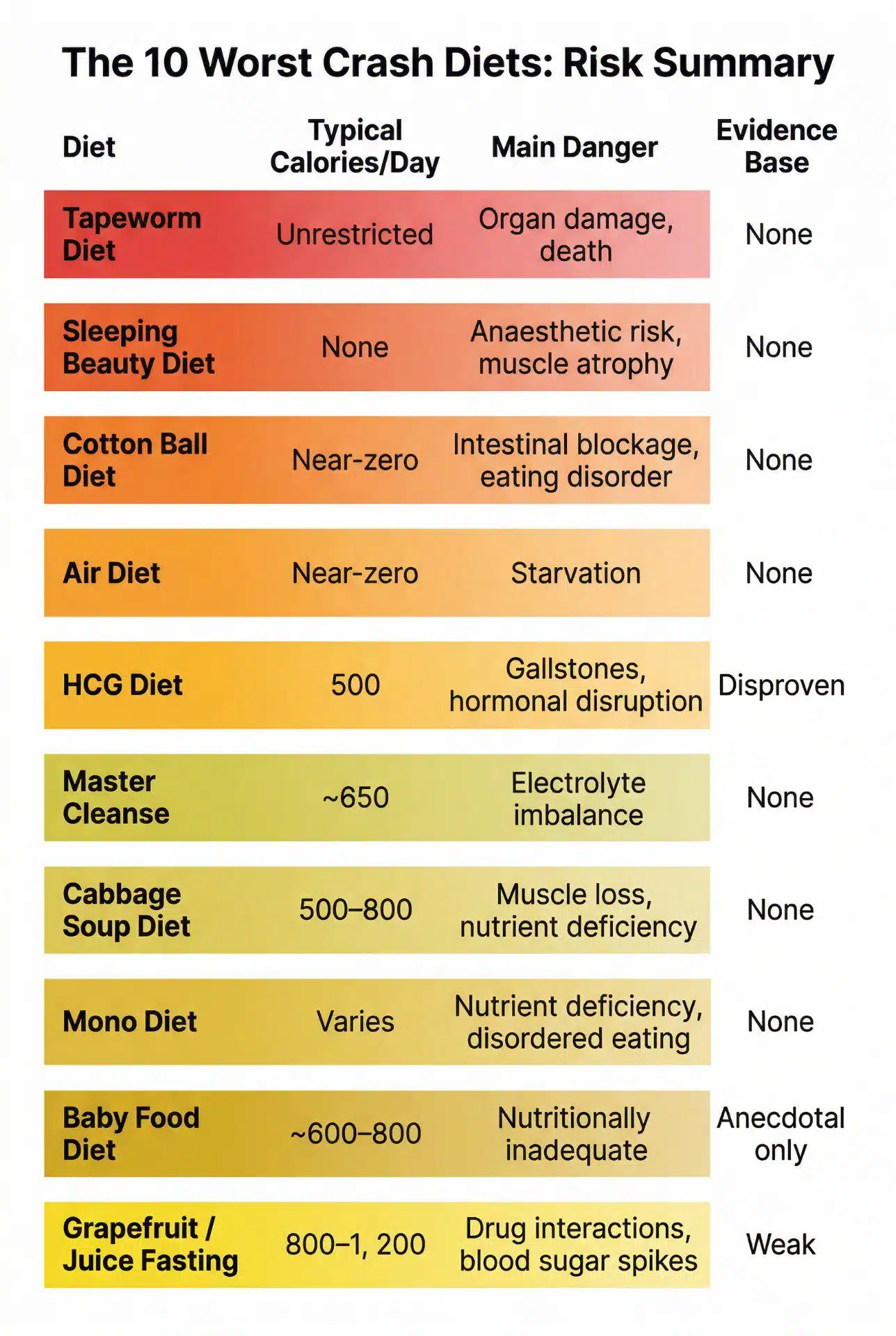
The 10 Worst Crash Diets: Risk Summary
| Diet | Typical Calories/Day | Main Danger | Evidence Base |
|---|---|---|---|
| Tapeworm Diet | Unrestricted | Organ damage, death | None |
| Sleeping Beauty Diet | None | Anaesthetic risk, muscle atrophy | None |
| Cotton Ball Diet | Near-zero | Intestinal blockage, eating disorder | None |
| Air Diet | Near-zero | Starvation | None |
| HCG Diet | 500 | Gallstones, hormonal disruption | Disproven |
| Master Cleanse | ~650 | Electrolyte imbalance | None |
| Cabbage Soup Diet | 500–800 | Muscle loss, nutrient deficiency | None |
| Mono Diet | Varies | Nutrient deficiency, disordered eating | None |
| Baby Food Diet | ~600–800 | Nutritionally inadequate | Anecdotal only |
| Grapefruit / Juice Fasting | 800–1,200 | Drug interactions, blood sugar spikes | Weak |
How Crash Diets Specifically Harm Women
The effects of crash dieting are not gender-neutral. Women are more frequently targeted by fad diet marketing. Women are also more physiologically vulnerable to the consequences of severe restriction — particularly around hormonal health, bone density, and the risk of developing disordered eating behaviours.
Research published in the Journal of the Academy of Nutrition and Dietetics found that women who engaged in restrictive dieting were significantly more likely to develop disordered eating than those who did not diet at all. The relationship between crash dieting and eating disorders is well-established in clinical literature.
For women navigating perimenopause, the consequences are even more pronounced — crash dieting during this phase can worsen hormonal imbalance and accelerate the very changes women are trying to manage. Read more about how to lose weight during perimenopause without starving yourself.
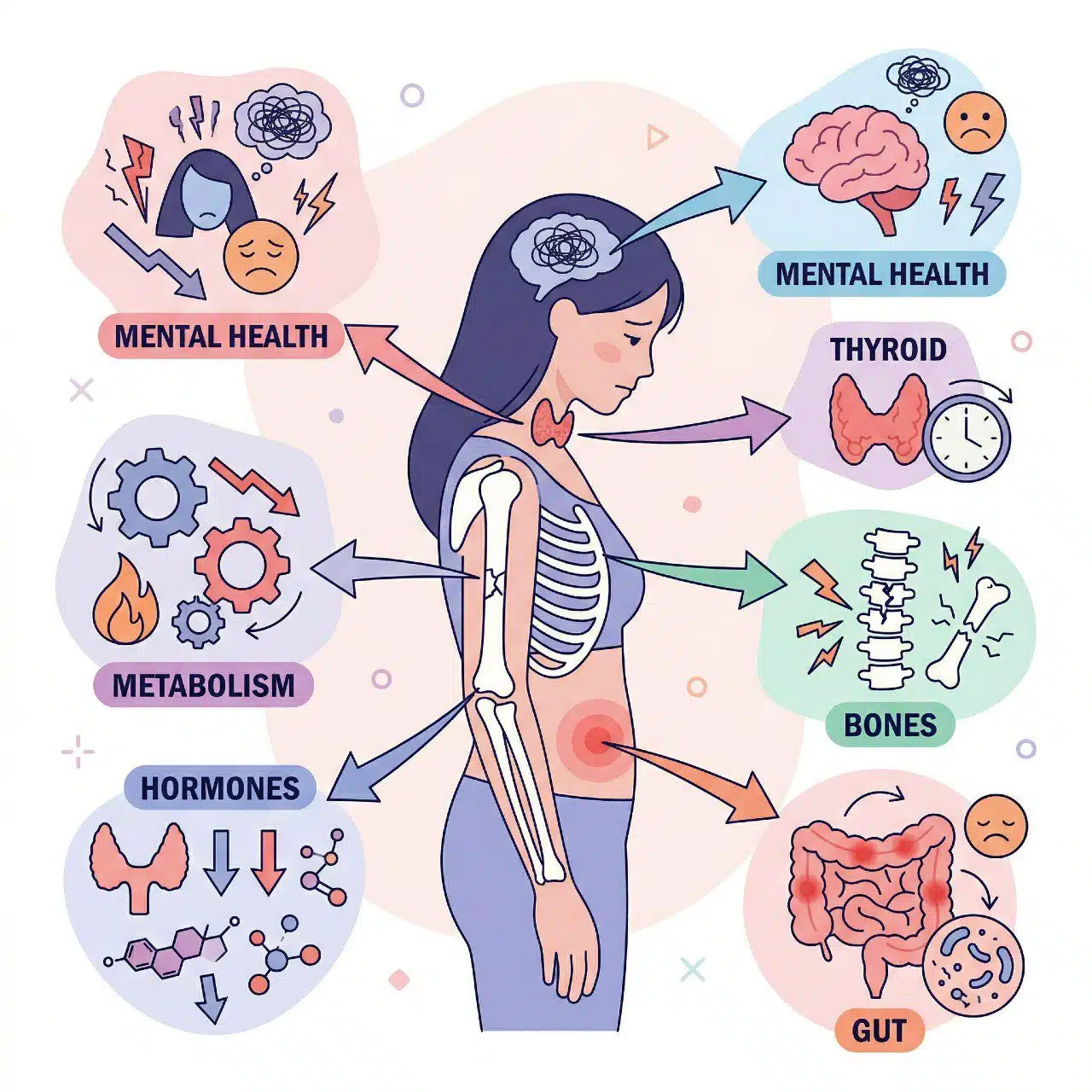
Crash Diet Effects On Women's Health
| Body System | What Happens | How Long It Lasts |
|---|---|---|
| Oestrogen / hormonal balance | Oestrogen drops; cortisol rises | Weeks to months after dieting ends |
| Menstrual cycle | Irregular or absent periods (amenorrhoea) | Can persist for months |
| Bone density | Calcium absorption reduces; bones weaken | Long-term; can be permanent with repeated dieting |
| Thyroid function | T3 (active thyroid hormone) levels fall | Normalises slowly with adequate nutrition |
| Resting metabolism | Metabolic rate decreases significantly | Can remain suppressed for years post-diet |
| Gut microbiome | Diversity of gut bacteria reduces | Takes months to restore with a balanced diet |
| Mental health | Increased anxiety, food preoccupation, depression | Can develop into clinical eating disorders |
The Yo-Yo Cycle: Why Each Crash Diet Makes The Next One Harder
There's a cruel pattern to crash dieting. After a severe restriction period, your resting metabolic rate is lower than before you started. Ghrelin — the primary hunger hormone — is elevated and stays elevated for months, driving you back towards food. Your muscle mass has decreased, which means you burn fewer calories around the clock.
When you inevitably return to normal eating, the weight comes back faster than it left. Studies consistently show that yo-yo dieters accumulate abdominal fat preferentially with each regain cycle — the type of fat most closely associated with cardiovascular risk.
The cycle is not a personal failure. It's a predictable biological response to a strategy that conflicts with how the human metabolism works. Understanding why fad diets don't work is the first step out of the cycle.
A 2016 study following contestants from the US TV show The Biggest Loser found that their resting metabolic rates remained significantly below expected levels six years after the competition — even in those who maintained their weight loss. The body adapts to extreme restriction in ways that don't simply reverse when the diet ends.
Join Our Mailing List
Join thousands of women inside our community and receive our free guide, 10 Actions That Support Permanent Weight Loss — the exact behavioural shifts that make the difference between a two-week attempt and a lasting transformation.
No restriction plans. No guilt. Just what actually works — for real women with real lives.
What Actually Works Instead
Sustainable weight loss is slower — typically 0.5 to 1 kg per week. It is also far more likely to stick.
The approaches with the strongest clinical evidence:
A modest caloric deficit — 300–500 calories below maintenance, not 1,000+. Combined with adequate protein (1.6–2.2 g per kg of body weight), this approach preserves muscle while losing fat. Read how many calories you should actually be eating for a practical guide.
Resistance training — builds and preserves muscle, preventing the metabolic rate from dropping. It's one of the most evidence-backed tools for sustainable fat loss, particularly for women.
High-protein eating — protein increases satiety, supports muscle retention, and has the highest thermic effect of any macronutrient (meaning you burn more calories digesting it). See a high-protein diet plan for sustainable weight loss for women for a structured starting point.
Addressing emotional eating — a significant portion of the overeating that drives people to crash diets in the first place is emotional, not physiological. Mindfulness-based approaches have solid evidence behind them.
Building a diet that actually fits your life — not a seven-day cabbage protocol, but a healthy eating pattern you can maintain long-term.
For a comprehensive framework, the guide on how to unlock lasting weight loss covers the practical steps.
Related Articles
The Bottom Line
There are no shortcuts that don't carry a cost.
Crash diets deliver fast results that don't last — and the process of losing and regaining weight repeatedly does more long-term harm than a modest, stable excess weight would have. The research on this is not ambiguous or contested.
If you've tried crash diets and they didn't work, that's the expected outcome. It says nothing about your discipline. It says something about the diet.
The approach that works is less dramatic: eat enough protein, maintain a modest deficit, build some muscle, and address the habits that drive overeating. It takes longer. It also tends to actually work — and the results tend to stay.
Your body is not your enemy. Feeding it adequately is not a failure.
Glossary Of Key Terms
FAQ
The most dangerous crash diets on record are those involving ingestion of harmful substances or extreme sedation — the Tapeworm Diet and Sleeping Beauty Diet, respectively. Among diets people still actively pursue today, the HCG Diet ranks highest in documented risk: combining a 500-calorie daily intake with unregulated hormone products, it carries a significant risk of gallstones, electrolyte imbalances, muscle wasting, and hormonal disruption. The FDA classified HCG weight-loss products as fraudulent in 2011 following multiple studies that showed the hormone offered no benefit over a placebo.
Crash diets trigger a measurable drop in resting metabolic rate and an elevation in ghrelin, the primary hunger hormone. When the diet ends, the body is burning fewer calories than before while simultaneously experiencing stronger hunger signals. The result is rapid weight regain — often exceeding the original starting weight. Research consistently shows that approximately 80% of people who lose weight through very-low-calorie diets regain it within five years, and each cycle makes subsequent weight management more difficult.
Yes — the damage can be long-lasting. A 2016 study following The Biggest Loser contestants found that resting metabolic rates remained significantly below expected levels six years after the competition, even in participants who maintained their weight loss. The body adapts to extreme caloric restriction in ways that persist well beyond the diet. This is why crash dieting can become progressively less effective with each attempt.
The consequences are different rather than simply worse. Women experience more pronounced hormonal disruption (oestrogen suppression, menstrual irregularities), greater bone density loss, and a higher risk of developing disordered eating behaviours as a result of crash dieting. Women are also more frequently targeted by fad diet marketing, increasing exposure and the pressure to repeat failed strategies. For women in perimenopause, crash dieting can actively worsen the hormonal changes they are trying to manage.
The NHS, CDC, and most major health authorities recommend 0.5 to 1 kg (1–2 lbs) per week, achieved through a deficit of approximately 500–600 calories per day combined with regular physical activity. This rate is slow enough to preserve muscle tissue, minimise metabolic adaptation, and produce results that last. Weight lost at this rate tends to be predominantly fat rather than water, glycogen, and muscle.
Intermittent fasting (IF) restricts when you eat, not necessarily how much. When implemented correctly, total daily caloric intake remains adequate across a shorter eating window, preserving more muscle than severe restriction. Crash diets cut total intake dramatically regardless of timing. The distinction matters because it's the depth of the caloric deficit — not the timing pattern — that drives metabolic adaptation. Some IF protocols do become effectively crash-diet-level in calories, however. The label doesn't determine the outcome; the total intake does.
Severe caloric restriction can suppress oestrogen production, elevate cortisol, and reduce levels of T3 (the active form of thyroid hormone). These changes can persist for weeks to months after the diet ends. In the short term, menstrual irregularities and mood changes are common. With repeated crash dieting, the cumulative effect on bone density, thyroid function, and metabolic rate can become significant. Women who have crash-dieted repeatedly often find that weight management becomes progressively more difficult over time — this is a physiological consequence, not a personal failing.