
Mindful Eating: How To Change Your Relationship With Food And Why It Works
Jean Anthelme Brillat-Savarin
French gastronome
Tell me what you eat, and I will tell you what you are.
Summary (TL;DR)
This article explores mindful eating, a practice of paying attention to the experience of eating without judgment. It's not a diet, but rather a way to address overeating by focusing on hunger, fullness, and the emotions tied to food.
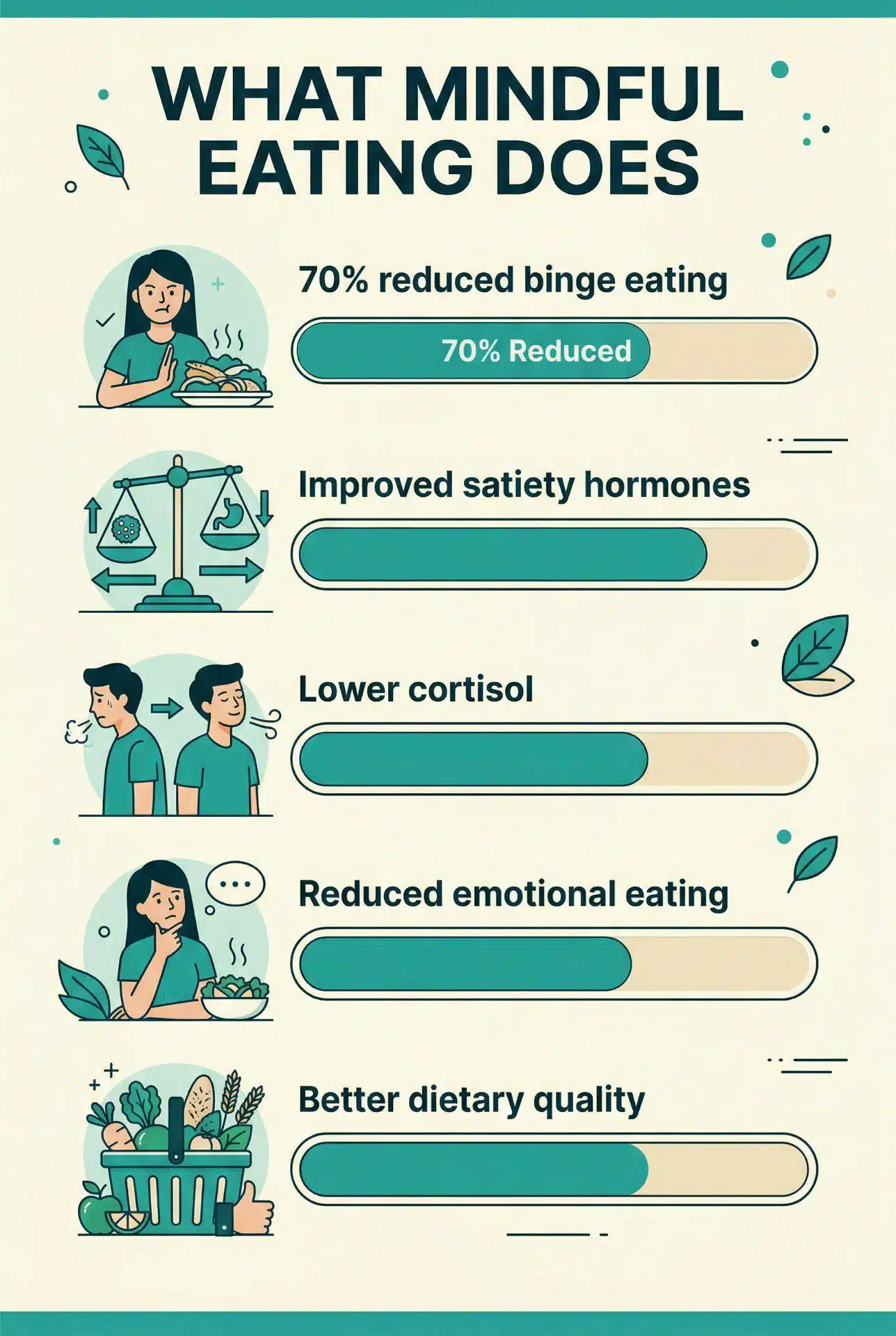
Research suggests mindful eating can reduce binge eating and improve weight management. Studies show women who practice mindful eating have lower cortisol responses. Core techniques can be applied quickly, especially when combined with nutrient-dense foods.
Most of us eat without really eating.
We scroll through our phones mid-meal. We finish lunch at our desks and can't remember what it tasted like. We open the fridge at 10 pm, not because we're hungry, but because something is wrong and we don't quite know what.
Mindful eating doesn't ask you to eat less, restrict food groups, or follow a set of rules. It asks you to pay attention — to notice when you're actually hungry, to taste what you're eating, and to stop when you've had enough. That sounds simple. It isn't, for most people. But the research on what it does to eating behaviour, weight, and mental health is genuinely compelling.
This guide covers what mindful eating is, how to practise it, what it does for women specifically, and how to make it work in a real, busy life.
Medical & Referral Disclaimer
This article is for informational purposes only and is not a substitute for professional medical or nutritional advice. If you are experiencing disordered eating, please consult a qualified healthcare professional or contact a support organisation such as Beat Eating Disorders.
Key Takeaways
- Mindful eating is not a diet. It's a practice of paying attention to hunger, fullness, and the experience of eating — without judgement or restriction.
- It addresses the root cause of overeating for many women: emotional hunger, distraction, and disconnection from the body's natural satiety signals.
- Research links mindful eating to reduced binge eating, lower emotional eating scores, and modest long-term weight management — without the metabolic damage caused by caloric restriction.
- Women who eat mindfully show lower cortisol responses to food-related stress, suggesting a direct link between the practice and hormonal regulation.
- You don't need a silent retreat or a meditation cushion. Core mindful eating techniques can be applied in under five minutes per meal.
- It works best when combined with whole, nutrient-dense foods — awareness of what you're eating matters as much as awareness of how you're eating it.
What Is Mindful Eating?
Mindful eating is the practice of bringing deliberate, non-judgmental attention to the experience of eating — the taste, texture, and smell of food, the body's hunger and fullness signals, and the thoughts and emotions that arise around eating.
It draws on the broader concept of mindfulness, developed in clinical settings by Jon Kabat-Zinn at the University of Massachusetts Medical School in the late 1970s and applied to eating behaviour by researchers including Jean Kristeller, who developed Mindfulness-Based Eating Awareness Training (MB-EAT).
Crucially, mindful eating is not:
- A calorie-counting system
- A list of foods to avoid
- A weight-loss programme
- Something that requires meditation experience
It's a skill — and like most skills, it develops with practice. The starting point is simply slowing down enough to notice what's actually happening when you eat.

The Science: What Happens When You Eat Without Thinking
Your body has a sophisticated system for regulating hunger and fullness. The problem is that it's slow, and modern eating habits routinely override it. When you begin eating, the gut releases hormones, including cholecystokinin (CCK) and peptide YY, that signal fullness to the brain. This process takes approximately 20 minutes. Eat fast enough, and you'll regularly consume far more than your body needs before those signals arrive.
Leptin (the fullness hormone) and ghrelin (the hunger hormone) are both sensitive to the pace and context of eating. Research published in the Journal of Clinical Endocrinology and Metabolism found that eating slowly increased post-meal concentrations of CCK and peptide YY, and decreased ghrelin, producing measurably greater satiety from the same amount of food.
Stress compounds the problem. Elevated cortisol increases appetite and drives cravings for calorie-dense, high-sugar foods. Women are disproportionately affected: studies consistently show that women are more likely than men to eat in response to emotional rather than physical hunger. This is not a character trait — it's a documented physiological response to stress that mindful eating addresses directly.
What The Research Shows: Mindful Eating Outcomes
| Study / Source | Participants | Key Finding |
|---|---|---|
| Meta-analysis, Obesity Reviews, 2014 | 21 studies | Mindful eating interventions reduced binge eating in 70% of studies reviewed |
| RCT, Nutrients, 2019 | 194 overweight adults | Mindful eaters showed lower BMI, better dietary quality, and reduced emotional eating scores |
| RCT, JAMA Internal Medicine, 2017 | 150 adults with BED | Mindful eating as effective as CBT for reducing binge eating frequency |
| Cohort study, Appetite, 2021 | 660 women | Higher mindful eating scores correlated with lower cortisol responses to food-related stress |
| Pilot RCT, Mindfulness, 2020 | 47 women | 8-week MB-EAT programme reduced emotional eating, improved body image, and maintained weight without restriction |
Mindful Eating Benefits For Women
Women face a particular set of pressures around food that mindful eating is well-placed to address.
Weight Management Without Restriction
The most counterintuitive thing about mindful eating and weight management is that it doesn't involve restriction. It doesn't tell you to eat less — it teaches you to notice when you've had enough, which tends to result in eating less naturally.
A 2018 review in Current Obesity Reports found that mindful eating interventions produced modest but sustained weight loss in the majority of trials, without the metabolic adaptation caused by caloric restriction. The approach is particularly relevant for women who have a history of yo-yo dieting, where the metabolism has already been disrupted. If that describes you, this article on why fad diets don't work gives useful context.
Hormonal Balance
Chronic stress eating elevates cortisol, which in turn promotes abdominal fat storage and disrupts oestrogen and progesterone balance. By reducing the stress response around mealtimes and breaking the cortisol-driven eating cycle, mindful eating has a measurable effect on hormonal health.
Women managing perimenopause or cycle-related appetite changes may find this particularly useful — read more about the connection between hormones and weight loss for women.

Reduced Binge Eating
Binge eating is rarely about food. It typically follows a period of restriction, a spike in stress, or an emotional trigger that bypasses rational decision-making. Mindful eating interrupts this cycle at the source — not by suppressing the urge, but by creating enough awareness to recognise what's driving it.
Digestive Health
Eating quickly and while stressed activates the sympathetic nervous system (fight or flight), which diverts blood flow away from the digestive tract. This impairs enzyme production, slows gut motility, and reduces nutrient absorption. Eating slowly, in a calm state, activates the parasympathetic system — the condition under which digestion actually works properly.
Self-Compassion And Food Guilt
The relationship many women have with food is shaped by decades of diet culture telling them that eating certain foods is a moral failure. Mindful eating takes a fundamentally different position: food is not a reward or a punishment, and eating something enjoyable is not something to atone for.
This shift doesn't happen overnight, but using mindfulness to break the cycle of emotional eating is a documented and effective starting point.


TIP: Low energy levels, mood swings, feeling tired all the time, unexpected weight change, uncomfortable with your own body are just a few signs that your diet is unbalanced.
Intuitive Eating vs. Mindful Eating — What's The Difference?
These two approaches are often used interchangeably. They're related, but not identical.
Mindful eating focuses on the how of eating: slowing down, using your senses, and paying attention to hunger and fullness cues. It can be practised alongside any dietary approach — including structured meal plans.
Intuitive eating is a broader framework developed by dietitians Evelyn Tribole and Elyse Resch in 1995. It comprises 10 principles built around rejecting diet culture, making peace with food, and honouring biological hunger. It explicitly opposes external food rules of any kind.
In practice, mindful eating is often the gateway to intuitive eating. Developing body awareness through mindful eating makes it easier to trust and act on internal signals — which is what intuitive eating ultimately asks of you. They work together, but they're not the same thing.
How To Practise Mindful Eating: A Practical Framework
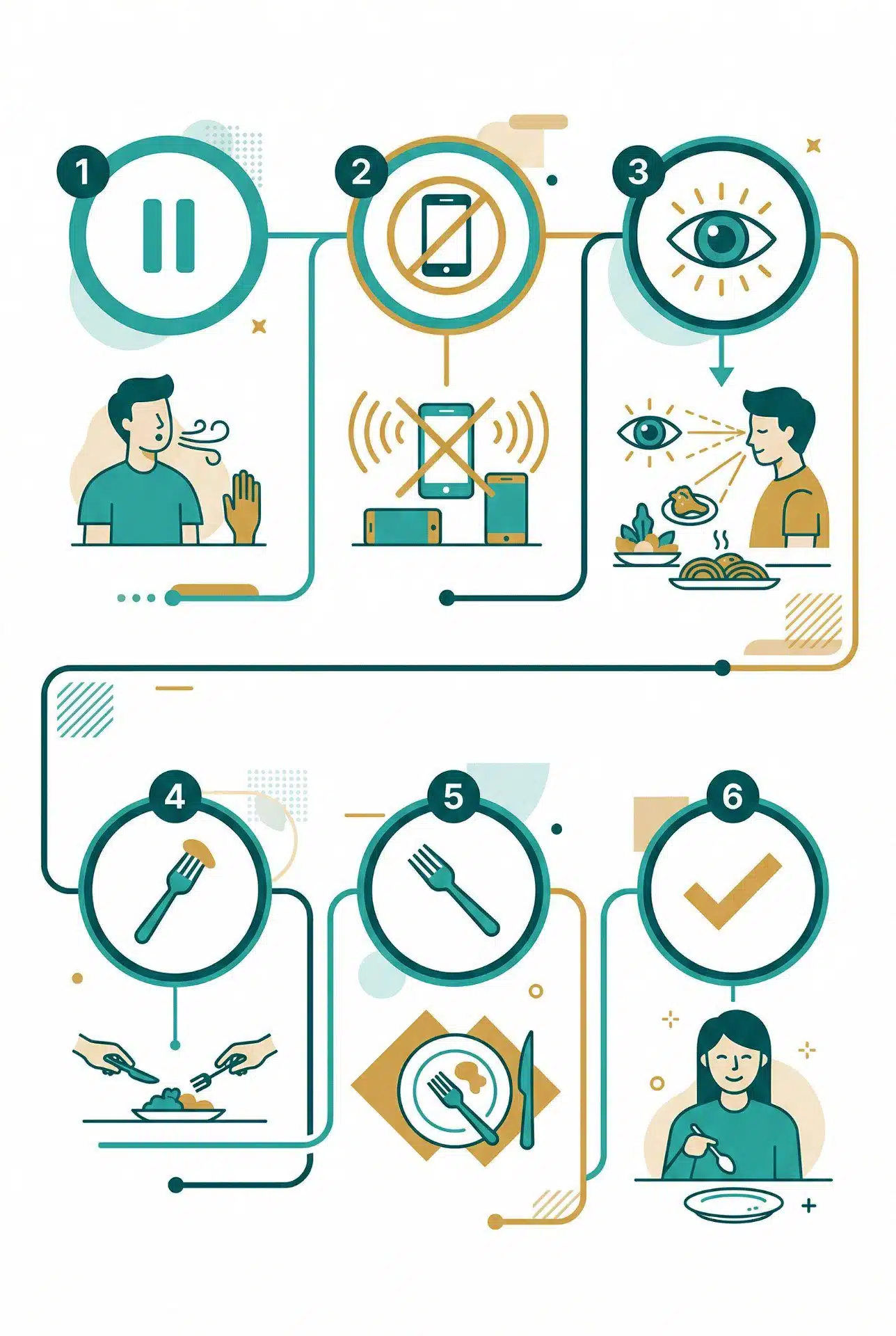
The following steps are based on the MB-EAT protocol and validated mindful eating research. You don't have to implement all of them at once — one change per week compounds quickly.
Step 1: Check In Before You Eat
Before reaching for food, pause for ten seconds and ask: Am I physically hungry, or am I looking for something else? Locate the sensation in your body. Genuine hunger typically presents as an empty or hollow feeling in the stomach. Emotional hunger tends to be more diffuse, and often arrives suddenly alongside a specific craving.
Step 2: Remove One Distraction
You don't have to eat in silence or ban your phone entirely. Start by removing one screen. Eating while watching television or scrolling actively reduces the brain's ability to process satiety signals — a phenomenon called eating amnesia. Studies show people eat an average of 10–25% more food in distracted conditions than when focused on their meal.
Step 3: Use Your Senses Before the First Bite
Take five seconds to notice the colour, smell, and texture of your food before eating it. This activates the cephalic phase of digestion — the body's preparatory response to food — which improves enzyme production and readies the gut for absorption.

FACT: Symptoms of malnutrition include lack of energy, irritability, a weakened immune system leading to frequent colds or allergies, and mineral depletion that can trigger a variety of health concerns, including anaemia.
Step 4: Chew More Than You Think You Need To
The NHS recommends chewing each mouthful 10–20 times. Most people chew 3–5 times. Thorough chewing increases surface area for digestive enzymes, slows the pace of eating naturally, and gives satiety hormones time to catch up with intake.
Step 5: Put Your Utensils Down Between Bites
This is the most practical and immediately effective technique in mindful eating. Putting your fork down forces a natural pause, slows your eating pace, and creates space to check in with your fullness level. It also makes eating feel more deliberate without requiring any additional effort.
Step 6: Stop At Satisfied, Not Full
The goal is to finish eating when you feel comfortable and satisfied — not when the plate is empty or when you feel full. Fullness is a trailing indicator; you'll feel it 15–20 minutes after you've stopped eating. Practise leaving the table at 80% — a principle known in Japanese culture as hara hachi bu, or "eat until 80% full."
The Hunger-Fullness Scale
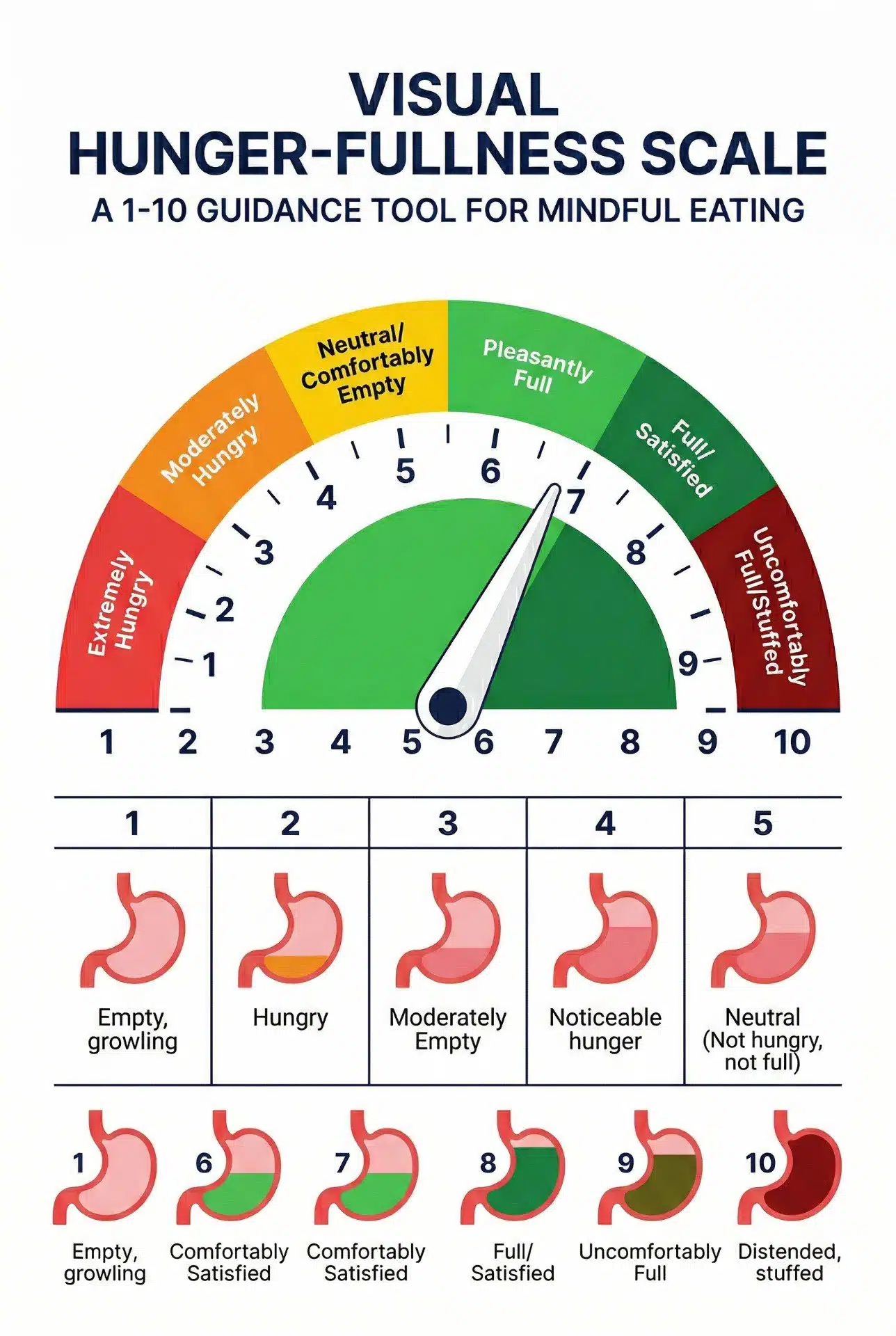
One of the most useful tools in mindful eating is a simple 10-point scale to assess hunger before, during, and after eating.
| Level | Physical Signal | What to Do |
|---|---|---|
| 1–2 | Intense hunger, headache, difficulty concentrating | Eat — you've waited too long |
| 3–4 | Clear hunger, stomach growling, ready to eat | Good time to eat |
| 5 | Neutral — neither hungry nor full | Notice the signal; don't eat from habit |
| 6–7 | Comfortable, satisfied, food tastes slightly less appealing | Ideal stopping point |
| 8–9 | Full, slightly uncomfortable, stomach feels stretched | You've likely overeaten |
| 10 | Overfull, nauseous, uncomfortable for hours | Your body's clear feedback signal |
The aim is to begin eating at 3–4 and stop at 6–7. Most people raised in environments that normalise clearing plates or eating on schedules rarely experience either end of this scale accurately.
Mindful Eating For Emotional Eaters
Emotional eating — using food to manage stress, boredom, loneliness, or anxiety — is not a character flaw. It's a learned coping mechanism, and for many women it's deeply ingrained.
Mindful eating doesn't cure emotional eating by itself, but it creates the awareness gap that makes change possible. You can't interrupt a habit you don't notice.
Distinguishing Emotional Hunger From Physical Hunger
| Physical Hunger | Emotional Hunger |
|---|---|
| Builds gradually over hours | Arrives suddenly and urgently |
| Can be satisfied by various foods | Craves specific foods (usually high-fat or high-sugar) |
| Stops when full | Continues even after eating |
| Accompanied by physical stomach sensation | Felt in the chest, throat, or mind |
| No guilt after eating | Often followed by guilt or shame |
When you notice you're experiencing emotional hunger, the mindful eating response is not to refuse food — it's to notice the feeling first. What is it? Stress, loneliness, boredom? Can you name it? Naming an emotion activates the prefrontal cortex and reduces the emotional charge enough to make a more conscious choice.
Can diet really help with emotional eating and stress-related weight gain? This article explores the evidence in more depth.
Cortisol is the most direct hormonal driver of stress eating. When cortisol is chronically elevated — as it is for many women managing demanding work, childcare, and limited sleep — appetite regulation breaks down.
Mindful eating lowers cortisol at mealtimes by shifting the nervous system from sympathetic (stressed) to parasympathetic (calm) activation. It won't fix a chronically stressful life, but it meaningfully changes the body's response to food within that context.
What To Eat Mindfully: Food Quality Still Matters
Mindful eating is not a pass to eat anything without consequence. Awareness of how you eat works best when combined with attention to what you eat.
Whole, nutrient-dense foods — vegetables, lean proteins, whole grains, healthy fats — provide the vitamins and minerals the body needs to function. They also tend to produce stronger, clearer satiety signals than ultra-processed foods, which are specifically engineered to override them.
What should women eat in the morning for hormone balance and fat loss? It is a practical starting point for the food quality side. For meal planning that supports mindful eating habits without turning food into another source of stress, weight loss meal prep ideas for women are worth reading.
Join Our Mailing List
Join thousands of women inside our community and receive our free guide, 10 Actions That Support Permanent Weight Loss — the exact behavioural shifts that make the difference between a two-week attempt and a lasting transformation.
No restriction plans. No guilt. Just what actually works — for real women with real lives.
Common Obstacles And Honest Answers
"I don't have time to eat slowly."
You probably have 15 minutes. The issue is usually habit and environment, not time. Setting a minimum eating time — 15 minutes per meal, even at a desk — is a manageable first constraint.
"I eat with family, and it's hard to slow down."
Table conversation naturally slows the eating pace. The challenge is internal, not external. Family meals are actually associated with better dietary quality and mindful eating behaviours in research — the social setting helps.
"I've tried paying attention to hunger, but I can't tell when I'm hungry."
This is extremely common after years of dieting or eating on schedules. The hunger-fullness connection gets suppressed. It comes back gradually with consistent practice — usually within two to four weeks of deliberate attention.
"I eat mindfully during the day and then binge at night."
Night eating and late-night bingeing are often driven by under-eating during the day (creating a physiological deficit), stress accumulation, or evening-specific triggers. If this is a consistent pattern, support from a registered dietitian or eating disorder specialist is worth considering alongside self-practice.
After reading about the impact of mindful eating, are you ready to take the next step? It's time to ditch the distractions and truly savour your food, paying attention to your body's signals. Start your journey towards a healthier relationship with food today! Grab your free guide here.
The Bottom Line
Mindful eating asks something deceptively simple: pay attention.
Not to macros, not to a list of banned foods, not to a meal plan with colour-coded portions. Just listen to what your body is telling you — before, during, and after you eat.
For many women, that's harder than any diet. We've spent years learning to override hunger cues, eat on schedules, follow rules, and feel guilty when we don't. Mindful eating asks you to unlearn most of that. It takes time.
But the research is consistent: women who develop mindful eating habits eat less without restriction, binge less without willpower, and relate to food with considerably less conflict over time. That's not magic. It's attention — applied consistently and without judgment.
Start with one meal a day. Put your fork down between bites. Ask yourself whether you're hungry before you eat. That's the whole beginning of it.
Glossary Of Key Terms
- Cephalic Phase: The body's preparatory response to food, triggered by the sight, smell, and thought of eating, which initiates enzyme production and gut readiness.
- Cortisol: A stress hormone that, when chronically elevated, increases appetite, promotes abdominal fat storage, and disrupts reproductive hormone balance.
- Eating Amnesia: A state of disconnected consumption caused by distractions (like screens), resulting in the brain's inability to process satiety signals and leading to overeating.
- Ghrelin: Often referred to as the "hunger hormone," its levels typically decrease after a meal as satiety signals take over.
- Hara Hachi Bu: A Japanese principle derived from Okinawa that encourages individuals to eat until they are only 80% full.
- Intuitive Eating: A 10-principle anti-diet framework developed by dietitians to help individuals reject diet culture and honour biological hunger.
- MB-EAT: Mindfulness-Based Eating Awareness Training; a clinical program developed by Jean Kristeller to address binge eating and disordered eating through mindfulness.
- Mindful Eating: The practice of bringing non-judgmental, deliberate attention to the physical sensations, emotions, and thoughts present during the experience of eating.
- Peptide YY: A hormone released by the gut during eating that signals the brain to produce sensations of fullness and satiety.
- Satiety: The physical feeling of being satisfied or full, which is regulated by a combination of hormonal signals and the pace of food consumption.
FAQ
What Is Mindful Eating, Exactly?
Mindful eating is the practice of bringing deliberate, non-judgemental attention to the experience of eating — including hunger cues, fullness signals, taste, texture, and the emotions present during a meal. It is based on the broader psychological practice of mindfulness and does not involve food restriction, calorie counting, or dietary rules. Clinical programmes such as Mindfulness-Based Eating Awareness Training (MB-EAT), developed by psychologist Jean Kristeller, have demonstrated its effectiveness in reducing binge eating, emotional eating, and disordered eating behaviours in controlled trials.
Does Mindful Eating Help With Weight Loss?
Mindful eating is associated with modest, sustained weight reduction in the majority of research trials — without the metabolic adaptation caused by caloric restriction. A 2018 review in Current Obesity Reports found that most mindful eating interventions produced meaningful reductions in BMI and emotional eating scores. The mechanism is indirect: by improving awareness of satiety cues, mindful eating reduces the chronic overeating that drives gradual weight gain. It is not a rapid weight-loss tool, but the results tend to be more durable than those produced by restriction-based diets.
What Is The Difference Between Mindful Eating And Intuitive Eating?
Mindful eating focuses specifically on the experience of eating — using attention and sensory awareness to tune into hunger and fullness. Intuitive eating is a broader anti-diet framework developed by dietitians Evelyn Tribole and Elyse Resch that encompasses 10 principles including rejecting diet culture, honouring hunger, making peace with food, and discovering body-movement satisfaction. Mindful eating is often described as a component of intuitive eating. The two are complementary, and mindful eating is typically easier to begin for women who are not yet ready to fully disengage from dietary guidelines.
How Does Mindful Eating Affect Hormones?
Mindful eating influences several hormones relevant to appetite and stress. Eating slowly and without distraction increases post-meal levels of satiety hormones (CCK, peptide YY) and reduces ghrelin (the hunger hormone). Practising calm, deliberate eating at mealtimes reduces cortisol — particularly relevant for women whose eating behaviour is driven by stress. Reduced cortisol over time supports better oestrogen and progesterone balance, which affects appetite, mood, and fat distribution in women. The hormonal effects are modest in isolation but meaningful as part of a broader lifestyle approach.
Can Mindful Eating Stop Binge Eating?
It is one of the most evidence-based non-pharmacological interventions for binge eating disorder (BED). A 2017 randomised controlled trial published in JAMA Internal Medicine found mindful eating as effective as cognitive behavioural therapy (CBT) in reducing binge eating frequency. The mechanism involves increasing the gap between emotional trigger and eating behaviour — creating enough awareness to recognise what's happening and, with practice, to respond differently. It works best when paired with professional support for those with clinical BED.
How Long Does It Take To See Results From Mindful Eating?
Most people notice changes in eating pace and awareness within one to two weeks of consistent practice. Reductions in emotional eating and improved hunger-fullness recognition typically develop over four to eight weeks. Research trials generally assess outcomes at 8 to 12 weeks, which is when the most meaningful changes in eating behaviour and self-reported wellbeing appear. Weight changes, where they occur, tend to follow rather than lead the behavioural changes.
Is Mindful Eating Suitable For Women With A History Of Dieting?
It is particularly suited to them. Women with a history of restrictive dieting frequently experience disconnection from natural hunger and fullness signals — satiety cues become suppressed after years of eating according to rules rather than physical sensation. Mindful eating is specifically designed to rebuild that connection. It requires patience: the hunger-fullness awareness that was suppressed over years of dieting doesn't return in a week. But it does return.