
Beyond The Numbers: The Science-Backed Answer To How Many Calories Should You Eat Every Day
Dr. Mark Hyman
Physician, author & educator
What most people don’t realize is that food is not just calories; it’s information. It actually contains messages that connect to every cell in the body.
Summary (TL;DR)
Your daily calorie target isn’t “2,000.” It’s a moving number built from your BMR, activity level, and hormonal stage — and for women over 40, it shifts more than any standard calculator accounts for. This guide shows you how to find the number that’s actually yours.
For many women, the journey toward a healthy weight feels less like a wellness path and more like an exhausting algebra exam. Fat, salt, sugar — all capped. Fibre, protein, fruit — all targeted.
As the British Heart Foundation puts it, eating well can start to feel like a “maths problem.” The frustration is real, the confusion is understandable, and the numbers? Often completely wrong for your body.
I know this from the inside. There was a point in my own journey when I had convinced myself that 1,200 calories was the magic threshold — the number that would finally move the scale. I was exhausted by early afternoon, irritable by dinner, and the results were almost nonexistent.
What I didn’t understand at the time was that I had triggered my body’s own defence system. It wasn’t burning more; it was conserving everything. The real breakthrough came only when I raised my intake, focused on what I was eating rather than how little, and stopped treating my body like a problem to starve into submission.
The truth is, sustainable weight management isn’t built on one rigid number. It’s built on understanding the system your body actually runs on. By shifting the focus from strict restriction to understanding how your body uses energy — and how that changes at every life stage — we can move toward something that actually works long-term.
Medical & Referral Disclaimer
This article is for informational and educational purposes only. It is not a substitute for professional medical advice, diagnosis, or treatment. Always consult your physician or a qualified health provider before starting any new diet or exercise programme.
Key Takeaways
- Your number is unique. Generalised magazine targets are not your prescription. Your ideal intake is a personalised formula based on age, activity level, lean muscle mass, and hormonal stage.
- Know your two layers of metabolism. Basal Metabolic Rate (BMR) covers basic life functions at rest. Total Daily Energy Expenditure (TDEE) is BMR plus everything you do in a day — including the low-key movement most people ignore.
- 1,200 calories often backfire. Eating below this threshold frequently triggers metabolic adaptation — your body slows its engine, stores fat, and leaves you depleted.
- Perimenopause changes the rules. Declining estrogen and accelerating muscle loss after 40 mean standard TDEE calculators can be meaningfully off — and eating to the wrong number makes fat loss harder, not easier.
- A moderate deficit works. A daily reduction of 250–500 calories supports a healthy loss of 0.5–1 lb per week without sacrificing muscle, hormones, or sanity.
- Quality matters alongside quantity. Nutrient-dense foods regulate appetite and support metabolic health in ways empty calories simply cannot replicate.
- Progress is more than the scale. Clothing fit, waist circumference, energy levels, and sleep quality are more reliable markers than daily weight.
Stop Guessing: The Science Of Finding Your Perfect Calorie Target
Most women struggle with their diets not because of willpower, but because they’re chasing a number that was never built for them. The real starting point is calculating your own Total Daily Energy Expenditure (TDEE) — the only calorie target that accounts for your actual biology.
If you’ve ever felt like you’re doing everything right but the scale won’t budge, the problem isn’t your discipline. It’s your math. A 20-year-old gym regular and a 48-year-old woman navigating perimenopause are running completely different metabolic engines — yet both are handed the same “2,000 calories” target as a starting point. That mismatch is where most diets quietly fail.
Understanding your calorie needs is the North Star of any fat loss or maintenance journey. Whether your goal is to shed body fat, preserve lean muscle, or find a sustainable “sweet spot,” it starts with calculating your TDEE. In this guide, we’re cutting through the noise and giving you a blueprint built on data — not magazine averages.
Your Body Is Not A Calculator: The Secret Power Of BMR
Before you look at a single food label, you need your Basal Metabolic Rate (BMR) — the energy your body burns just to stay alive. According to published research, BMR accounts for 60–75% of your total daily energy use.
Your BMR is the minimum number of calories your body needs to perform basic life-sustaining functions — breathing, circulation, cell repair, hormone production — while at complete rest. To understand the energy entering this system, it helps to know the calorie density of the three macronutrients. According to Cedars-Sinai, carbohydrates and protein each carry 4 calories per gram, while fat carries 9.

Because muscle tissue is metabolically expensive to maintain — burning more energy at rest than fat tissue — your BMR is entirely individual. Age, sex, and lean muscle mass are the primary drivers. This is also why two women of the same weight and height can have meaningfully different calorie needs.
“BMR is an essential starting point for calculating how many calories to eat, although it’s an estimate and isn’t 100% accurate.”
— Julia Zumpano, Registered Dietitian, Cleveland Clinic
The Science Of Metabolism: BMR vs. TDEE
To reach a lean body goal, you need to understand the two layers of your metabolism. They work together, but they serve very different functions.
Basal Metabolic Rate (BMR)
BMR is your body’s “idling speed” — the minimum energy cost of simply being alive, driven primarily by your age, sex, height, and lean muscle mass.
Think of BMR as the fuel your car burns sitting in the driveway with the engine running. It accounts for roughly 60–75% of total energy expenditure, which means the majority of the calories you need each day are spent before you even get out of bed. Factors like age, height, and Lean Body Mass (LBM) are the primary drivers.
Total Daily Energy Expenditure (TDEE)
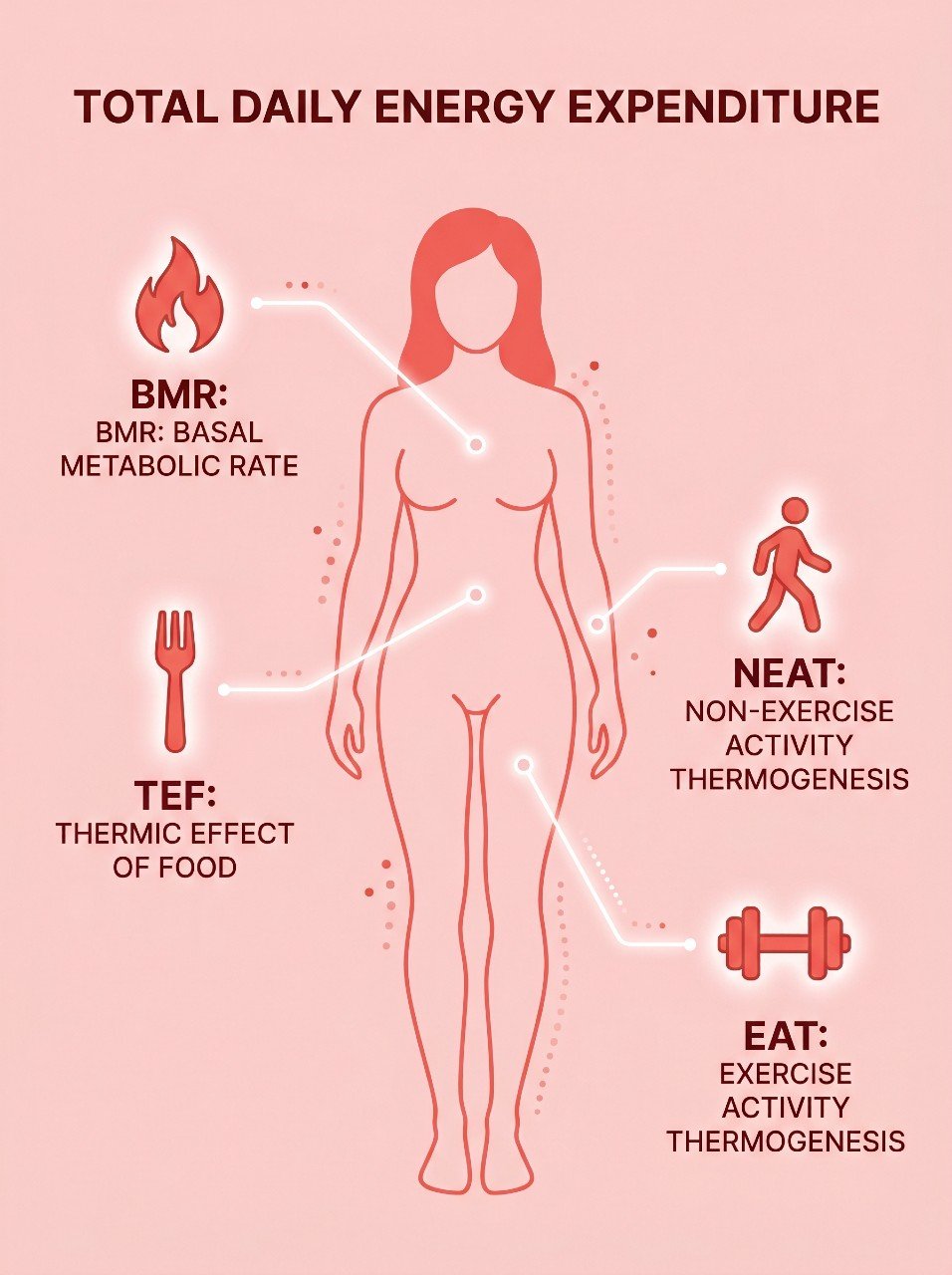
TDEE is BMR plus everything else: digesting food (TEF), planned exercise (EAT), and the low-key daily movement most people underestimate — steps, fidgeting, housework (NEAT).
- TEF (Thermic Effect of Food): Calories burned digesting meals. Protein has the highest TEF of all three macronutrients — another reason high-protein diets support fat loss.
- EAT (Exercise Activity Thermogenesis): Planned workouts.
- NEAT (Non-Exercise Activity Thermogenesis): Everything else — walking, fidgeting, standing, cleaning. Most women significantly underestimate this component, yet research consistently shows it’s one of the most variable and impactful parts of daily energy burn.
FitFormula HUB
Explore our comprehensive suite of health and fitness calculators to discover personalised insights. No sign-up required — get instant, goal-specific results.
The “Magic Number” Is A Moving Target
The “2,000 calories for women” guideline is a population average, not a prescription. As the British Heart Foundation explains, “hardly any of us are so routine… that we eat and do the same things every day.” Your number shifts with age, activity, and — critically — hormonal stage.
The following table synthesises data from the USDA and Cleveland Clinic to show how caloric maintenance shifts across a woman’s life:
| Life Stage | Sedentary | Moderately Active | Active |
|---|---|---|---|
| Early 20s (21–25) | 2,000 kcal | 2,200 kcal | 2,400 kcal |
| Ages 26–30 | 1,800 kcal | 2,000 kcal | 2,400 kcal |
| Ages 31–50 | 1,800 kcal | 2,000 kcal | 2,200 kcal |
| Ages 61+ | 1,600 kcal | 1,800 kcal | 2,000 kcal |
How Calorie Needs Shift In Perimenopause (And Why The Old Rules Stop Working)
If you’re a woman in your 40s eating the same way you did at 32 and wondering why nothing’s working, perimenopause may have quietly rewritten your metabolic rules — without sending you a memo. Standard TDEE calculators were not built for this transition.
Here’s what’s actually happening beneath the surface, and why it matters for how many calories you should be eating right now:
Estrogen Withdrawal Changes Your Fat Distribution
Research published in the American Journal of Clinical Nutrition confirmed that the loss of ovarian estrogen during the menopausal transition promotes abdominal fat accumulation and a measurable decline in energy expenditure.
In practical terms, your body begins preferring to store fat centrally — around the abdomen — even when your total calorie intake hasn’t changed. This is not a willpower failure. It is a hormonal shift with a well-documented metabolic fingerprint.
You’re Losing Muscle Faster Than You Realise
Muscle is your metabolic engine. It burns calories at rest; fat does not. According to peer-reviewed research on sarcopenia, women lose approximately 8% of lean muscle mass per decade from their 40s onwards — and this rate accelerates without deliberate resistance training.
Because each pound of muscle burns more energy than a pound of fat at rest, losing it steadily lowers your real-world TDEE below what any standard calculator will tell you.
Sleep Disruption Compounds The Problem
Perimenopause often disrupts sleep through night sweats and hormonal fluctuations. This is more than a comfort issue. Research published in Obesity found that sleep restriction potentiates susceptibility to visceral fat deposition — exactly the kind of central fat gain that becomes a concern during perimenopause.
Poor sleep also elevates ghrelin (the hunger hormone) and suppresses leptin (the fullness hormone), making you biologically hungrier on top of everything else.
The Contrarian Take: Your TDEE Calculator Is Probably Lying To You
Standard TDEE equations — Mifflin-St Jeor, Harris-Benedict — were validated largely on younger, non-perimenopausal populations. They plug in age as a variable, but they cannot account for where you are in the hormonal transition, how much muscle you’ve lost, or how your sleep quality is affecting your metabolism.
Specialised tools now estimate that the metabolic gap during perimenopause can be 100–200 calories per day below a standard TDEE estimate — enough to completely stall fat loss if you’re not aware of it.
What this means practically: If you’re 42–52, eating at your calculated TDEE, and still gaining weight — especially around the middle — it is worth consulting a registered dietitian who specialises in perimenopause. The answer is rarely “eat less.” It’s usually “eat smarter, train with more resistance, and protect your sleep.”
Why “Eat Less” Can Sometimes Backfire
When the scale stalls, the instinct is to slash calories. But diets under 1,200 calories are considered highly restrictive and often trigger metabolic adaptation — your body slows its engine to match, storing fat instead of burning it.
Eating below approximately 1,200 calories makes it extremely difficult to meet your body’s essential nutrient requirements. Beyond deficiencies, chronic under-eating can trigger “starvation mode” — a state where your metabolism downregulates to preserve energy.
The result is that the harder you restrict, the less your body burns. Any plan consistently at or below 1,200 calories should only be undertaken under direct medical supervision.
The 500-Calorie Rule And Realistic Timelines
A daily deficit of 500–600 calories is the gold standard for losing approximately 1–2 lbs (0.5–1 kg) per week — a pace that preserves muscle, supports hormones, and is actually sustainable.
To make this feel less like a subtraction and more like a lifestyle shift, Atlantic Health System highlights mindful eating behaviours that regulate appetite naturally:
- Use smaller plates for a visual cue of abundance with smaller portions.
- Eat with your non-dominant hand to force a slower pace.
- Set utensils down between bites to give your brain time to register fullness.
Scannable Activity Guide
Burning 500–600 calories through movement alone requires a meaningful commitment. As a rough guide, it equates to approximately:
- 1 hour of high-impact aerobics or cycling.
- 2 hours of brisk walking or vigorous housework.
This is why combining a modest dietary reduction with an increase in NEAT (your daily movement) is far more effective for most women than relying on gym sessions alone.

Quality Over Quantity: The Trap Of “Empty Calories”
Not all calories are created equal. Processed, sugary foods are often engineered to override your fullness signals — creating a biological cycle of overconsumption that has nothing to do with lack of willpower.
Empty calories found in sugary beverages and ultra-processed snacks can trigger gut dysbiosis and systemic inflammation, both of which are associated with impaired fat loss and persistent fatigue.
To achieve genuine nutritional balance, prioritise nutrient-dense foods and manage “free sugars” — those added to foods or found in honey, syrups, and fruit juices. The NHS recommends no more than 30g (about 7.5 teaspoons) of free sugars daily.
The “Traffic Light” Tool
When shopping, the BHF Traffic Light system on food labels is a fast, visual shortcut:
- Green: Best choice — low in salt, sugar, and saturated fats.
- Amber: Fine most of the time.
- Red: Enjoy in moderation or as an occasional treat.
Nutrient-Dense Swaps For A Healthy Diet
- Whole grains: Swap white bread and pasta for wholemeal or brown rice to hit your 30g daily fibre target.
- Protein & healthy fats: Replace biscuits and crisps with a handful of unsalted nuts, seeds, or legumes.
- Hydration: Trade sugary sodas and blended coffees for water or unsweetened tea to cut hidden liquid calories.
How Many Calories Should You Eat? | Dr. Neal Barnard
Contrary to what you might think, there is no 'one size fits all' approach to daily caloric needs. Learn how to calculate your calorie requirements with Dr. Neal Barnard, author of The Power Foods Diet.
Ditch The Scale: Better Markers That Actually Tell The Truth
Daily weighing is one of the least reliable ways to track fat loss. Water retention, hormonal cycles, and muscle gain all move the number independently of body fat. The BHF notes it’s “the trend over the course of a month that matters” — not what the scale says on a Tuesday morning.
Use these markers instead — they tell a much more complete story:
- Waist circumference: Measures changes in body composition directly. Aim for a consistent downward trend over weeks, not days.
- Waist-to-hip ratio: Particularly meaningful for women over 40, where central fat gain is more hormonally driven. A healthy ratio is generally below 0.85 for women.
- Clothing fit: How your jeans feel is more honest than a number. Clothes don’t lie.
- Energy and sleep quality: Improved afternoon energy and deeper sleep are often the first signs that your calorie and nutrient balance is moving in the right direction.
- Body Mass Index (BMI): A general indicator, not a verdict — useful as one data point among several, not as the sole measure of health.
Pro tip: Every woman’s health journey is unique. If you’re consistently doing the right things and results aren’t coming, consult a doctor or registered dietitian. They can factor in your specific medical history, medications, and hormonal profile in ways no online calculator ever will.
Practical Strategies For Sustainable Weight Management
Sustainable health is built on tools, not rules. The difference between a diet and a lifestyle is whether you can still do it in five years — on a busy Tuesday, on holiday, and after a bad night’s sleep.
- Mindful eating: Reduce distractions at meals. Try eating with your non-dominant hand and setting utensils down between bites to slow your pace and give your satiety signals time to arrive.
- Portion control: Use smaller plates and chew thoroughly. Your brain takes approximately 20 minutes to register fullness — eating slowly gives it the time it needs.
- Meal preparation: Planning and preparing meals in advance eliminates hungry, impulsive choices at the end of a long day.
- Hydration: Adequate water intake helps regulate appetite, supports metabolic processes, and is often confused with hunger.
- Resistance training: For women over 40 especially, protecting and building lean muscle mass is one of the most important calorie-management tools available. Muscle raises your BMR; losing it lowers it.
- Social accountability: Building habits with a friend or within a community consistently improves long-term adherence.

How To Set Your Goal: The “Goldilocks” Zone
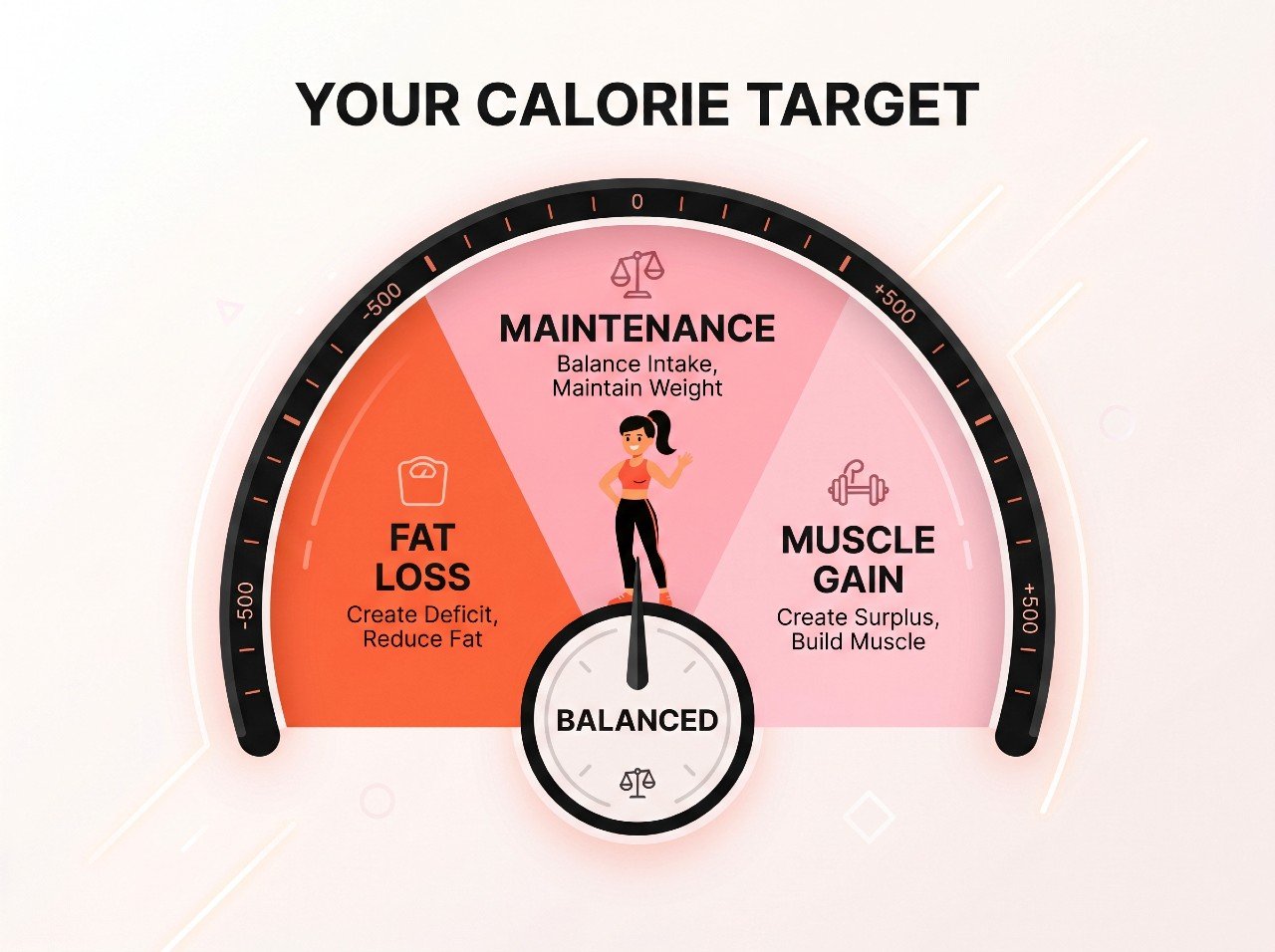
Once you have your TDEE, setting your calorie target is straightforward: subtract for fat loss, eat at it for maintenance, or add modestly for muscle gain — then adjust based on real results every three to four weeks.
| Your Goal | The Strategy | Calorie Adjustment |
|---|---|---|
| Fat Loss | Sustainable Deficit | Subtract 250–500 from TDEE |
| Maintenance | Metabolic Balance | Eat at TDEE |
| Muscle Gain | Lean Bulk | Add 200–300 to TDEE |
The WLBF “Find → Set → Flex” Framework
If calorie targets have always felt overwhelming, this three-step process is the simplest way to start — and the one that has worked consistently across our community of women at all life stages:
- Find: Calculate your BMR using the Mifflin-St Jeor equation (use the FitFormula HUB calculator), then multiply by your activity factor to get your TDEE. This is your baseline.
- Set: Apply the Goldilocks adjustment from the table above. This is your starting number — not your final one.
- Flex: Review every 3–4 weeks. If you’re losing 0.5–1 lb per week consistently, hold steady. If nothing has moved, reduce by 100–200 calories. If you’re exhausted or performance is dropping, add 100–200 back. The goal is always the highest number at which your body loses fat, not the lowest number you can endure.
The “Flex” step is the one most people skip — and the one that separates a diet from a system that actually works for your life.
Why “Low Calorie” Diets Usually Fail
It is tempting to slash intake to 1,200 calories or below for faster results. But chronic under-eating leads to metabolic adaptation — your body lowers its BMR to match the reduced supply. The outcome is a slower metabolism, hormonal disruption, muscle loss, and eventually a plateau that feels impossible to break through.
If you want results that last, aim for the highest calorie intake at which you can still lose fat. That approach preserves muscle, keeps hormones functional, and is a strategy you can sustain.
Now that you know how to calculate your real calorie needs, what's next? Grab your free guide here to discover how Women's Lean Body Formula can help you create a meal plan that fits your unique metabolism.
The Bottom Line
Your recommended calorie intake depends on factors unique to you: age, height, activity level, lean muscle mass, and where you are in your hormonal journey. A number from a magazine or a generic calculator is a starting point, not a prescription — and for women over 40 navigating perimenopause, it may not even be a particularly accurate starting point.
At its core, a calorie is simply a unit of energy — fuel that allows you to live, move, and function. Weight management is genuinely complex, influenced by genetics, hormones, sleep, and stress in ways that no single formula fully captures. Instead of asking, “How few calories can I eat?” the far more powerful question is: “What’s the highest number at which my body can lose fat and feel good doing it?”
When you shift from restriction to strategy — using the Find → Set → Flex approach, prioritising nutrients over numbers, and measuring progress by how you feel and function — sustainable health follows naturally.
Glossary Of Key Terms
- Basal Metabolic Rate (BMR): The minimum amount of energy (calories) required to maintain vital body functions while at rest.
- Total Daily Energy Expenditure (TDEE): The total number of calories burned in a day, calculated by adding BMR to the energy used for food digestion and all physical activity.
- Non-Exercise Activity Thermogenesis (NEAT): The energy expended for everything we do that is not sleeping, eating, or sports-like exercise, such as walking to work or cleaning.
- Thermic Effect of Food (TEF): The energy required for the digestion, absorption, and disposal of ingested nutrients; protein has the highest effect.
- Metabolic Adaptation: A biological process where the body slows its metabolism in response to chronic calorie restriction to preserve energy.
- Sarcopenia: The involuntary loss of skeletal muscle mass and strength, which typically begins to accelerate for women in their 40s.
- Visceral Fat: Body fat that is stored within the abdominal cavity and around internal organs, often increased by sleep disruption and hormonal shifts.
- Free Sugars: Any sugars added to food or drinks, as well as sugars found naturally in honey, syrups, and fruit juices; the recommended limit is 30g daily.
- Ghrelin: A hormone produced in the stomach that signals hunger to the brain; levels often rise during periods of sleep deprivation.
- Leptin: A hormone produced by fat cells that signals satiety (fullness); levels can be suppressed by poor sleep, leading to increased appetite.
FAQ
How Many Calories Should I Eat To Lose Weight?
Start by calculating your TDEE (use the FitFormula HUB calculator for a personalised result), then subtract 250–500 calories. This targets a fat loss rate of approximately 0.5–1 lb per week — the pace that protects muscle mass and keeps hormones stable. Revisit and adjust every three to four weeks based on real results.
Is Eating 1,200 Calories A Day Safe For Women?
For many active women, 1,200 calories is too low. It’s difficult to meet essential nutrient requirements at this level, and chronic restriction at or below it triggers metabolic adaptation — your metabolism slows to match the reduced supply. The result is often extreme hunger, fatigue, nutrient deficiencies, and an eventual plateau. Focus instead on a moderate deficit from your personal TDEE, not an arbitrary floor.
How Do Calorie Needs Change In Perimenopause?
As estrogen declines, your body tends to store more fat centrally and burn fewer calories at rest. Muscle loss accelerates (roughly 8% per decade), which further lowers your metabolic rate. Standard TDEE calculators can underestimate the metabolic impact by 100–200 calories per day. If you’re in your 40s–50s and eating “correctly” but still gaining weight, perimenopause-specific metabolic changes are likely a factor worth discussing with a specialist.
Should I Count Macros Or Just Focus On Calories?
Both matter, but for different reasons. Total calories determine whether you lose, maintain, or gain weight. Macros — specifically protein — determine what you lose. Adequate protein (typically 1.6–2.2g per kg of body weight) during a deficit helps preserve lean muscle mass, which in turn keeps your metabolic rate from falling. A combined approach — hitting a calorie target while prioritising protein — consistently outperforms either strategy alone.
How Does Exercise Affect My Daily Calorie Goal?
Exercise increases your TDEE, meaning you theoretically need more food to maintain weight on active days. However, the most common mistake is overestimating calories burned during workouts and eating them all back. A smarter approach: factor your general activity level into your TDEE calculation upfront, rather than adjusting daily. Wearable trackers typically overestimate calorie burn by 20–30%. If you’re consistently exhausted or your performance is declining, add a small, protein-rich snack around training rather than guessing at what you burned.
What Is The Best Way To Track Calorie Intake?
The best method is the one you’ll actually do consistently. A food tracking app (MyFitnessPal, Cronometer) provides the most accuracy and builds awareness quickly. Portion estimation using hand-size guides is a lower-friction alternative that works well for maintenance once you have a feel for your targets. Whatever you choose, the first two to four weeks of tracking are the most valuable — they reveal habits and patterns that are almost impossible to see any other way.
How Do I Know If My Calorie Target Is Working?
Track your trend, not your daily number. Over a two-to-four-week period, you should see 0.5–1 lb of loss per week if you’re in a moderate deficit. If you’re losing faster, add 100–200 calories back (you may be losing muscle). If nothing is moving after three weeks, reduce by 100–200. Also watch non-scale markers: improving energy, better sleep, clothes fitting differently, and stable mood are all signs the approach is working — even when the scale is being stubborn.
Hi Marry, I love to eat pizza, burger, etc and I am gaining my weight. I can’t understand how I control my Calories intake. I also have an exercise bike. Do you have any suggestions for me?
Hi Chris,
Thanks for your comment and question. I suggest you read this article > https://womensleanbodyformula.com/4-reasons-to-avoid-junk-food/. I hope it helps. Cheers!
Sure, I’ll follow it. Thank you for your quick response.