

Exploring The Impact Of Relationships On Weight Loss: Separating Fact From Fiction

You are the average of the five people you spend the most time with.
Jim Rohn ‧ Business philosopher and author
Summary (TL;DR)
Your relationships significantly impact weight loss by influencing hormones, sleep, and even calorie burning. Couple-based programs can boost weight loss more than individual efforts, unless partners are coercive. When one partner makes consistent changes, the other often follows.
Understand the effects of relationship dynamics with the RELATE framework, and build a support system beyond one person for long-term success. Remember, hostility elevates cortisol, which increases cravings and impacts fat storage.
Most weight loss advice treats you like you live alone. You don't. Your partner, your household's food environment, and the emotional climate at home act on your hormones, your appetite, and your consistency in ways that no meal plan accounts for.
She'd tried three times in five years. Tracked calories, exercised five days a week, followed a plan that genuinely should have worked. By week eight of the third attempt, the pantry had quietly refilled with her trigger foods. Dinners out were a weekly ritual again. The low-level friction wore her down more than any hunger did — and she blamed herself for quitting.
She wasn't weak. She was fighting two battles at once, and nobody had named the second one.
The research on relationships and weight loss is more specific than most wellness content acknowledges. Relationship quality affects cortisol output, sleep architecture, hunger and fullness hormones, and the food environment you navigate every single day. None of this is vague "stress affects health" territory. The effects are measurable, documented in randomized trials, and they explain a lot about why motivated women end up right back where they started.
This article covers what the evidence actually shows — including a few things that cut against conventional advice — plus a practical framework for protecting your progress no matter where your relationship currently stands.
Medical & Referral Disclaimer
This article is for informational and educational purposes only. It does not constitute medical advice, nutritional therapy, or psychological counseling. The research cited reflects findings available at the time of writing; individual circumstances vary. If you are experiencing significant relationship distress, disordered eating, or persistent difficulty managing weight, please speak with a qualified healthcare provider, registered dietitian, or licensed therapist.
Key Takeaways
- Relationship conflict produces measurable metabolic disruption — lower calorie burning, elevated insulin, disrupted hunger hormones — not just emotional stress.
- Couple-based programs produce roughly 2.25 kg more weight loss than individual programs on average, but coercive partner involvement wipes out that advantage entirely.
- The ripple effect is real: when one partner makes consistent changes, the other is three times more likely to follow without being asked.
- Partner sabotage is often driven by the "equilibrium threat" — your change disrupting a shared relational identity — not a lack of care.
- The RELATE Framework (Recognize, Express, Lead, Align, Tackle, Evaluate) gives you a structure for navigating weight loss inside a relationship without ultimatums.
- Your support system should never rest entirely on one person; resilience requires at least a peer community, one accountability partner, and one professional resource.
- Healthy boundaries mean declaring your own choices, not restricting your partner's behavior.
- Sleep disruption from relationship friction creates a "double hit" on hunger hormones that no nutrition plan fully compensates for.
Video Overview
Does Your Relationship Affect Your Ability To Lose Weight?
Yes, directly. Relationship quality influences cortisol levels, sleep quality, and hunger hormones — all of which shape weight loss outcomes. Research shows hostile couple interactions measurably reduce calorie burning after meals and elevate insulin. Supportive partner involvement can triple your odds of long-term success.
The connection runs through several biological pathways at once:
- Cortisol: Chronic relationship conflict keeps cortisol elevated, which promotes visceral fat storage — particularly around the abdomen — and ramps up cravings for calorie-dense food
- Ghrelin and leptin: Marital distress disrupts these appetite hormones. Ghrelin (hunger) climbs; leptin (fullness) drops. You end up hungrier and less satisfied regardless of what or how much you ate
- Sleep: Relationship friction shortens and fragments sleep, compounding the hormonal disruption above
- Food environment: What your partner buys, cooks, and eats at home quietly shapes your daily choices — especially when you're stressed or tired
The finding most people don't expect is how quickly the metabolic effects show up. A 2015 study by Kiecolt-Glaser and colleagues gave couples a high-fat meal, then had some pairs engage in hostile interactions while others stayed calm. The hostile-interaction group burned significantly fewer calories in the following hours and showed measurably higher insulin levels — a direct fat-storage signal triggered by a single argument. The researchers found a dose-response pattern: the more hostile the exchange, the larger the metabolic suppression.
These weren't bad marriages. They were ordinary couples having ordinary disagreements. The biology reacted the same.
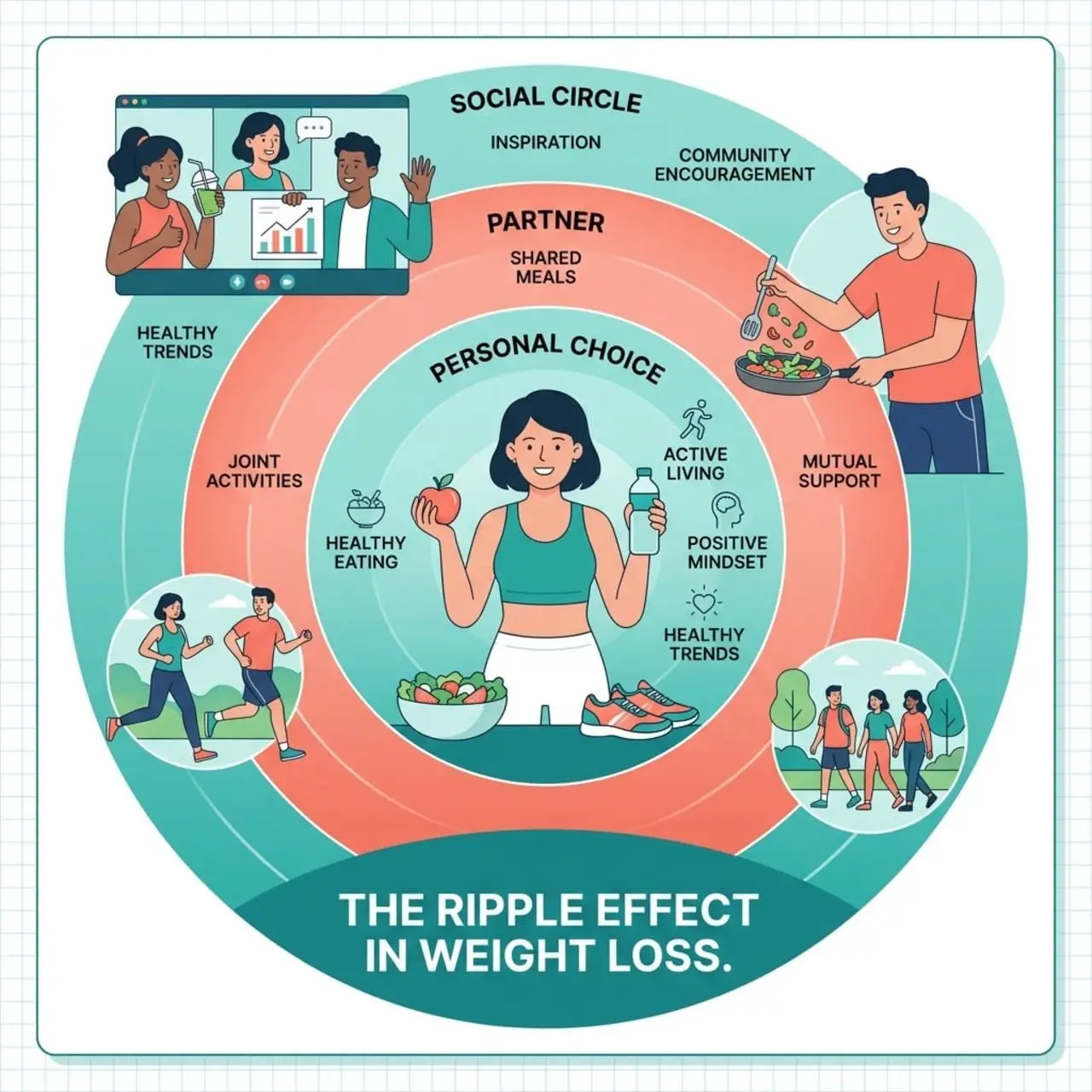
The Ripple Effect: One Person's Habits, Two People's Bodies
In 2018, researchers analyzing data from more than 3,500 couples published one of the most-cited findings in the couple health literature: when one partner successfully lost weight, the other was three times more likely to also lose weight — without enrolling in any program, receiving any instruction, or consciously deciding to change.
This is the ripple effect. It works because couples share food environments, daily schedules, and unspoken norms about what "normal" eating looks like. When one person shifts those norms — cooking differently, skipping the nightly wine, going to bed earlier — the other person often drifts in the same direction without deciding to. Untreated partners of women in structured programs lost an average of 2.5 kg over 12 weeks, compared to 0.2 kg in control groups. No instruction. Just proximity to change.
If you're the one trying to shift, that's worth sitting with. Your consistency is more persuasive than any conversation you could have.

How Does Relationship Stress Physically Block Weight Loss?
Relationship stress blocks weight loss through three overlapping pathways: cortisol drives fat storage and cravings, sleep disruption amplifies hunger hormones, and chronic tension triggers emotional eating. Even moderate recurring conflict produces enough hormonal disruption to impair fat loss — independent of how good your diet is.
The Cortisol-Conflict Connection
Every unresolved argument is a low-grade stress event. Your adrenal glands release cortisol. Blood glucose rises. Your appetite shifts toward dense, high-calorie food. One fight won't derail a diet. But chronic low-level tension — the background friction of a difficult relationship — keeps cortisol elevated continuously.
Research confirms that chronically elevated cortisol specifically promotes visceral fat accumulation — the abdominal fat linked to metabolic disease. The mechanism is direct: cortisol signals the body to hold onto stored energy because it interprets the stress as a physical threat.
This connects directly to what we cover in our guide on cortisol and belly fat in women. The same physiology that makes job stress hard on your waistline applies doubly when the stress is coming from inside the house.
Sleep, Hunger, And The Double Hit
Relationship distress disrupts sleep — not always dramatically, but enough to matter. And sleep disruption dysregulates the two hormones most responsible for appetite:
- Ghrelin increases when sleep is short, making you hungrier earlier in the day
- Leptin decreases, so you never fully feel full
As we detail in our piece on how sleep affects weight loss in women, even two nights of poor sleep can add 300 or more calories to daily intake — not through any failure of discipline, but through hunger signals you can't simply override.
When relationship conflict drives both elevated cortisol and poor sleep at the same time, researchers call it a "double hit" on appetite regulation. You're hungrier, less satisfied after eating, and drawn toward the exact foods that stall fat loss. This is the physiological story behind what women describe as "everything was fine until things got hard at home."
Emotional Eating: The Third Pathway
The Mayo Clinic defines emotional eating as eating to suppress or soothe negative emotions — stress, anxiety, loneliness, boredom. A 2025 research review on stress and eating found that stress-driven eating isn't purely about hunger. Participants turned to food as emotional avoidance — a way to numb difficult feelings, not address them. High-calorie foods were accessible; sitting with the feeling was not.
Relationship tension is one of the most reliable triggers. The food doesn't need to be in front of you. It just needs to be the easiest available response to a feeling you don't have another way to handle.
Can relationship stress directly cause weight gain?
Yes — the mechanisms are biological, not motivational. Cortisol promotes visceral fat storage, sleep disruption amplifies hunger hormones, and emotional eating driven by relationship stress raises caloric intake. Women in chronically conflicted relationships show higher average BMI and more difficulty sustaining weight loss, independent of dietary habits.

What Is Partner Sabotage, And How Do You Spot It?
Partner sabotage happens when a romantic partner — consciously or not — makes your healthy choices harder through repeated behavior: bringing home trigger foods, expressing doubt about your goals, scheduling conflicts with your exercise, or pulling back support when you succeed. Research shows it predicts slower weight loss even when the behavior appears mild or unintentional.
A 2025 study found that romantic partner undermining decreased weight loss outcomes even in structured behavioral programs where the partner played no formal role and received no instruction. The undermining didn't have to be overt. It just had to be consistent.
Subtle vs. Overt Undermining
Overt undermining is easy to name: "You don't need to lose weight." Bringing home your specific trigger foods the week you restart. Making dismissive remarks about your food choices in front of other people.
Subtle undermining is harder to see, partly because it can look like affection or humor:
- Eating tempting food in front of you without comment or offering alternatives
- Framing your healthy choices as antisocial ("You're no fun anymore")
- Expressing doubt disguised as concern ("I just don't want you to become obsessed")
- Scheduling things over your regular workout time, repeatedly
- Minimizing milestones: "Two months and only five pounds?"
TABLE 1: Partner sabotage vs. genuine support — how to tell the difference
| Behavior | What sabotage looks like | What support looks like |
|---|---|---|
| Food brought home | Repeatedly stocks your trigger foods | Asks what helps; adjusts shared items |
| Comments on progress | Minimizes results or fixates on "obsession" | Acknowledges effort, not just outcome numbers |
| Social events | Pressures you to eat off-plan to "be normal" | Backs your choices without drawing attention |
| Your exercise time | Schedules conflicts with no acknowledgment | Works around times you've established |
| Cooking at home | Makes no accommodating options, no discussion | Willing to try new recipes or make parallel choices |
| Your growing confidence | Creates tension; mood shifts when you succeed | Relationship feels stronger when you succeed |
The Equilibrium Threat — The Thing Most Weight Loss Articles Skip
Some partners sabotage because your change threatens the relationship's existing identity. Not because they don't love you. Not because they want you to stay heavy. Because you're disrupting an equilibrium.
Relationships develop invisible shared identities — routines, roles, habits that define "us." When you start eating differently, exercising consistently, and declining the nightly snacks, you're changing "us" without agreeing to. Your partner may feel left behind, inadequate by comparison, or quietly anxious that a change you will want a different life. None of that surfaces cleanly. It comes out as undermining instead.
This isn't a reason to abandon your goals. It's context for why the resistance is there — and it means the response is a calm, direct conversation about what's shifting, not a food fight.
Naming this dynamic out loud often dissolves it faster than any negotiation over what's allowed in the kitchen.
Does Couple Dieting Actually Work?
Couple-based weight loss programs outperform individual programs in most randomized controlled trials, producing roughly 2.25 kg more weight loss on average. But the quality of the partner's involvement matters more than the program structure. Coercive partner behavior — guilt, pressure, withdrawn affection — produces worse outcomes than going it alone.
What the meta-analysis found
A 2024 systematic review of 17 randomized controlled trials found:
- Couple-based vs. individual programs: −2.25 kg additional loss (statistically significant)
- Couple-based vs. no intervention at all: −4.5 kg additional loss (highly significant)
- Best outcomes came from interventions longer than six months with active, non-coercive partner participation
The important nuance: when partners used coercion — guilt, pressure, withdrawing affection as leverage — outcomes were worse than solo programs. The presence of a partner wasn't the determining variable. The quality of their involvement was.
TABLE 2: Individual vs. couple-based weight loss — what the research shows
| Approach | Average additional loss | 12-month maintenance | Main advantage | Main risk |
|---|---|---|---|---|
| Individual program alone | Baseline | ~30% | Full autonomy | Social isolation; less accountability |
| Partner-coached (one enrolled) | +2.25 kg | ~42% | Mutual accountability; ripple effect | Partner coercion or disengagement |
| Both partners enrolled together | +4.5 kg vs. no intervention | ~48% | Aligned food environment; shared identity change | One partner quitting affects both |
| Individual with peer/community network | Varies | ~35% | Diverse support; no single point of failure | Requires active, ongoing network maintenance |
Sources: PMC systematic review 2024; JAMA Internal Medicine ripple effect study; Partner2Lose RCT 2024
The Contrarian Take: Stop Focusing On Coordination
Most "couple dieting" content focuses on logistics — syncing meal plans, agreeing on what to cook, and sharing a gym schedule. The research suggests that's not where the leverage is.
What actually predicts outcomes in couple interventions isn't coordination. It's identity alignment: whether both people see the change as ours rather than yours. Partners who understood weight loss as a shared lifestyle shift were receptive to accountability and honest feedback. Partners who experienced it as their partner's solo project were far more likely to drift into undermining — without intending to.
Before changing the meal plan, change the framing.
Romantic Relationships And Body Weight
Join Sarah Novak, PhD, Associate Professor of Psychology and Adjunct Faculty member in the Master of Public Health program at Hofstra University, for a public health webinar on "Romantic Relationships and Body Weight: Satisfaction, Weight Changes, and Stigmatization."
What Is The RELATE Framework, And How Does It Help With Weight Loss In Relationships?
The RELATE Framework is a six-step operating structure for managing weight loss in a romantic relationship. It addresses the most common failure points — food environment friction, communication breakdown, social pressure, misaligned goals — based on patterns that appear consistently across the research on couples and health behavior change.
This isn't couples therapy. It's a practical structure for two people whose daily habits are entangled, trying to move in the same direction without burning the relationship down.
R — Recognize Your Food Environment
What's accessible and visible at home is what you'll eat under stress. That's not a character flaw; it's how the brain works under load. Work with your partner to adjust shared spaces through mutual agreement, not unilateral decisions. A simple shared list of what lives in common areas — arrived at through a single conversation — removes most of the daily friction without anyone feeling controlled.
E — Express Goals Without Demands
Lead with your experience, not their behavior. "I feel genuinely better when I eat this way and I'd love your support" lands differently — and works better — than "you need to stop buying chips." The research is consistent on this: framing centered on your own experience gets a more receptive response than framing centered on their behavior.
L — Lead By Example, Not Lecture
Modeling is more effective than education in close relationships. Don't try to persuade your partner to change. Cook a meal they love more healthily. Invite rather than instruct. Your results — your energy, your mood, your consistency — will do more convincing than any argument. The ripple effect research backs this up entirely.
A — Align On Shared Meals (Not Identical Eating)
Shared meals don't have to be negotiation sessions. The goal isn't eating the same thing. It's identifying three or four dinners a week that you both genuinely enjoy, and that also meet your nutritional needs. Let each person opt out of any specific meal without making it a thing. Separateness isn't failure; it's flexibility that keeps the peace.
T — Tackle Social Pressure Together, Proactively
Dinners out, family gatherings, parties — these are where plans quietly collapse. A pre-event strategy makes them manageable: look at the menu beforehand, agree on how to respond to comments about what you're eating, and decide what you'll eat before you arrive if you need to. Preparation converts a recurring threat into a handled situation.
E — Evaluate And Adjust Regularly
Short monthly conversations about what's working and what isn't stop resentment from hardening. This doesn't need to be a formal relationship check-in. Fifteen minutes, once a month, three questions: "What's making this harder? What could we do differently? What's actually working?" Small course corrections early prevent large conflicts later.
Join Our Mailing List
Join thousands of women inside our community and receive our free guide, 10 Actions That Support Permanent Weight Loss — the exact behavioural shifts that make the difference between a two-week attempt and a lasting transformation.
No restriction plans. No guilt. Just what actually works — for real women with real lives.

How Do You Build A Weight Loss Support System That Actually Holds Up?
The most durable support structures for long-term weight loss include several different relationship types, not sole reliance on a romantic partner. Relying on one person creates a single point of failure that collapses when the relationship has friction, which every relationship eventually does.
Why Your Spouse Isn't Always Your Best Accountability Partner
Research on social networks and health behavior consistently shows that "weak ties" — acquaintances, community members, group participants — often provide more effective and resilient support than close partners. A spouse shares your stress, your schedule conflicts, and your food environment. An accountability partner outside the relationship typically doesn't. That difference is the point.
Women who maintain weight loss over the long term tend to have:
- One close accountability partner — not necessarily their spouse
- A peer community with shared goals, online or in-person
- A professional or coach for objective, judgment-free feedback
- Social environments that reinforce their habits — a walking group, a meal prep friend, a consistent fitness class
The structure matters less than the consistency. Weekly check-ins outperform monthly ones. Process-focused accountability ("Did you follow your plan?") outperforms outcome-focused accountability ("How much did you lose?"). Both parties having agreed-upon expectations upfront — frequency, format, what's off-limits — eliminates most of the awkwardness.
How do I lose weight when my partner eats badly?
Keep your nutritional environment separate where possible — personal snack storage, individual meal prep containers in the fridge. Cook shared meals that meet your nutritional needs without announcing them as "diet food." Build a support network outside your relationship. Your consistent example is the most powerful influence you have over your partner's habits; the ripple effect research is clear on that. But you shouldn't have to rely on it.
How Do You Talk To Your Partner About Weight Loss Without It Turning Into A Fight?
Effective conversations about weight loss in relationships require calm timing, experience-centered framing, and clear asks. Conversations held during hunger, fatigue, or active tension reliably fail. Proactive, specific conversations — started at a neutral moment with an invitation rather than a demand — produce consistently better outcomes.
Three Framing Approaches That Work
The "I" frame. "I feel more energetic when I eat this way, and having less junk food at home would help me stay consistent" outperforms "you need to stop bringing chips home." The first is harder to argue with. The second invites a defense.
The collaborative frame. "Can we figure out how to make this work for both of us?" invites partnership rather than compliance. It positions the problem as shared rather than yours to fix and theirs to accommodate.
The appreciation anchor. Opening a difficult conversation with something specific you genuinely appreciate about your partner doesn't just soften the delivery — it activates their receptivity to difficult feedback. This is documented in couples communication research, not wellness folklore.

What Healthy Boundaries Actually Mean Here
Boundaries in this context are declarations of your own behavior — not restrictions on your partner's.
Restriction on their behavior: "You can't keep alcohol in the house."
Declaration of your own: "I'm not keeping alcohol at home anymore."
The first invites an argument. The second is yours to own. Your partner can still make their own choices — you're just being clear about yours. That distinction removes most of the friction.
What if my partner refuses to be supportive no matter what?
If calm, direct communication consistently produces more resistance rather than less, this isn't a diet problem anymore. It's a relationship problem that happens to show up through food and exercise. Trying to find a more airtight nutrition plan won't address the actual source of friction. Some couples benefit considerably from a few sessions with a therapist who works with health behavior and relationship dynamics.
Thinking about how your relationships affect your weight loss? It's a bigger piece of the puzzle than most people realize. Grab your free guide here to learn how to navigate those tricky dynamics and stay on track with your goals: Grab your free guide here.
Related Articles
The Bottom Line
Your relationship isn't a background variable in your weight loss. It's an active input into your metabolism, your appetite, your stress load, and your daily habits. The research on this is specific enough to be genuinely useful — not just worrying.
If your relationship is working with your goals, lean into it. The ripple effect is one of the most underused forces in long-term health change, and consistency on your part is the most persuasive thing you can do.
If it's working against you, you now have a clearer picture of why that happens, what it actually looks like, and how to address it — without treating it as evidence that you or your partner is fundamentally the problem. Most of it comes down to a single question: Does this change feel like yours alone, or shared? That conversation is worth having before you adjust another meal plan.
Your health doesn't require a perfect relationship. It does benefit from an honest one.
Glossary Of Key Terms
FAQ
Some research finds couples in satisfying relationships gain modest weight over time — roughly 3 to 5 kg in the first couple of years of marriage. Social performance pressure eases, shared meals increase, and daily routines become less active. Relationship quality is a stronger predictor of body composition than relationship status alone.
Yes. Social isolation activates the same stress pathways as relationship conflict, raising cortisol and promoting emotional eating. A 2020 meta-analysis found lonelier individuals had significantly higher average BMI and were far less likely to sustain long-term behavior changes without social reinforcement. The context in which you eat — and live — matters.
The ripple effect describes how one partner's consistent healthy behavior spontaneously influences the other's habits, without any direct instruction or shared program. Documented across diet, exercise, smoking cessation, and sleep, it appears to work through shared environments and changed household norms. Research published in JAMA Internal Medicine found that affected partners are three times more likely to lose weight on their own.
In most randomized trials, yes, by about 2.25 kg on average, with better 12-month maintenance rates. But the effect depends almost entirely on how the partner is involved. Couples who frame weight loss as a shared lifestyle change outperform those where one partner is coaching, monitoring, or — worse — pressuring the other. Tone determines outcome more than program design does.
You Know Why. Now Learn Exactly How
Join thousands of women inside our community and receive our free guide: 10 Actions That Support Permanent Weight Loss — the practical, sustainable habits that translate everything you just read into real, lasting results.
No fad diets. No extreme plans. Just what the research actually supports — written for real women.