


8 Gym Motivation Tips For Women That Actually Work (Science-Backed)
Breaking Barriers: Top 8 Gym Motivation Tips For Women To Crush Your Fitness Goals
Jim Ryun
Olympic gold medalist
Motivation is what gets you started. Habit is what keeps you going.
Summary (TL;DR)
I still remember the day I realized my gym problem wasn't really a motivation problem.
I'd been doing what most of us do. Waiting to feel ready. Waiting for the right playlist, the right Monday, the right level of energy that never quite arrived on schedule. When the motivation did show up, I rode it hard for two or three weeks — then it vanished, taking my gym bag and my good intentions with it.
Sound familiar?
Here's the thing that changed everything: I stopped trying to manufacture motivation and started building a system that didn't need it.
The science backs this up. A 2024 study published in Frontiers in Psychology found that women are primarily motivated to exercise by stress management and enjoyment — intrinsic factors that run deeper than appearance goals. Research on Self-Determination Theory consistently shows that intrinsic motivation predicts long-term exercise adherence far better than external pressure or short-term incentives.
The problem with most gym motivation advice? It's built around external triggers. A transformation challenge. A new outfit. A 30-day countdown. These work for two weeks, maybe four. Then life gets loud, serotonin shifts with your cycle (more on that in Tip #4), and you're back at the starting line feeling worse than before you started.
That's not a character flaw. It's a design flaw.
ASICS' global Move Her Mind study — conducted with nearly 25,000 women across 40+ countries — found that women who exercise regularly report 52% greater happiness, 50% more energy, 48% increased confidence, and 67% less stress. Those outcomes are real, and they're waiting for you. But they don't arrive through motivation alone. They arrive through system design.
These 8 gym motivation tips for women go deeper than the usual advice. They address the neuroscience of dopamine, the reality of hormonal cycles, the specific barriers women face in gym environments, and the behavioral psychology of making something stick. Not as a list of suggestions — as a system you can actually build.
Medical & Referral Disclaimer
The information in this article is for educational purposes only and does not constitute medical advice, diagnosis, or treatment. Women with specific health conditions, hormonal disorders, PCOS, endometriosis, or those who are pregnant or postpartum should consult a qualified healthcare provider before starting or significantly modifying a fitness routine. The hormonal cycle guidance in this article is based on general physiological patterns; individual cycles vary and may differ from the four-phase model described. Always listen to your body and work with a healthcare professional when in doubt.
Key Takeaways
- You don't need more motivation. You need a better system. Motivation is a feeling — systems are what actually get you there.
- Identity-based habits outlast goal-based motivation. Start with who you're becoming, not what you're chasing.
- Environment design removes friction before willpower fails. Pack the bag tonight.
- Your hormonal cycle affects your energy and motivation in measurable ways. Train with your biology, not against it.
- Gymtimidation is real — 44% of women report it as a barrier. Tackle it with systematic exposure, not forced confidence.
- Micro-rewards bridge the gap between starting and seeing results, which take 8–12 weeks to appear.
- The motivation dip at weeks 3–6 is predictable. Write your minimum viable workout before you hit it.
- Habit formation averages 66 days. Give yourself that timeline before deciding whether something is working.
Why Do Most Gym Motivation Tips Fail Women?
Most gym motivation tips fail women because they ignore the biological, psychological, and social barriers that are specific to us. Generic advice fixes the wrong problem. Here's what the data actually shows.
Data from a PLOS One 2024 study on women's experiences in gym settings found that women regularly navigate body image anxiety, unsolicited attention, and the experience of fighting for space in environments that often don't feel built for them. According to Strength Ambassadors' Women's Fitness Statistics, 44% of women cite intimidating gym environments as a barrier to exercise, and women are more likely to experience "gymtimidation" (25%) than men (16%).
Add hormonal fluctuations that shift energy and serotonin levels across the month, the mental load most women carry outside the gym, and the absence of women-specific advice in most fitness content, and you start to see why "just try harder" has never worked.
Every one of these barriers has a science-backed solution. Here are eight of them.
Tip #1: Shift From A Goal Identity To A Gym Identity
Identity-based motivation lasts longer than goal-based motivation because it changes who you are, not just what you're chasing. "I'm someone who takes care of her body" holds up on a tired Tuesday in a way that "I want to lose 10 lbs" never does.
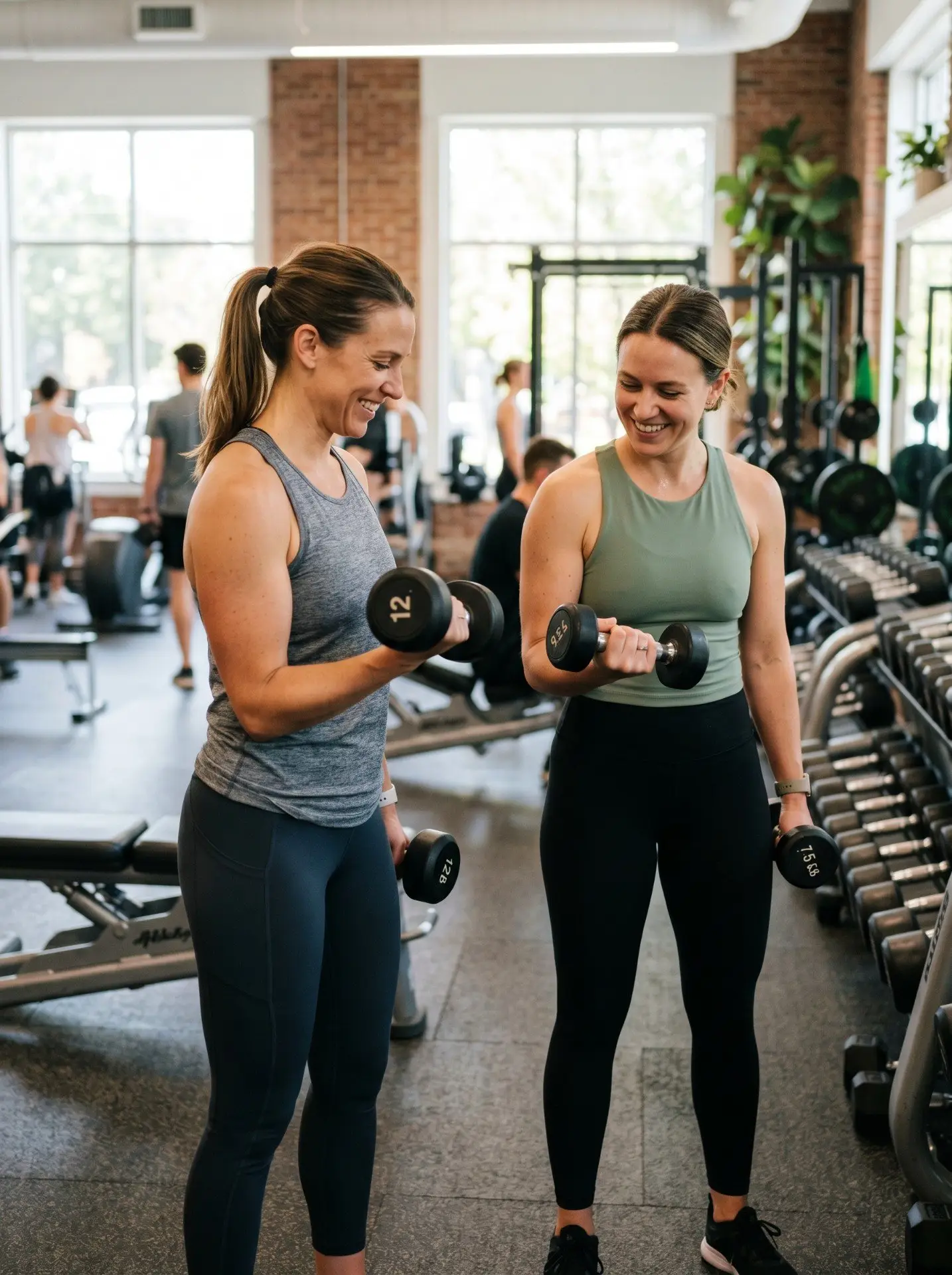
Most fitness goals are written as outcomes: lose weight, tone up, run a 5K. These work as starting points, but they collapse the moment results slow down or life intrudes.
Identity-based habits work differently. Research from behavioral scientist BJ Fogg at Stanford's Behavior Design Lab, and popularized further by James Clear's work on habit formation, consistently shows that when you tie a behavior to your identity rather than an outcome, consistency becomes self-reinforcing. You don't go to the gym because you have to. You go because it's part of who you are.
In practice, this sounds like:
- Replacing "I'm trying to get fit" with "I'm a woman who moves her body".
- Voting for that identity with any action, even a 15-minute walk, counts.
- Not needing every session to be impressive, because the habit still happened.
This reframe is particularly powerful if you've started and stopped multiple times. Every trip to the gym — even the short, low-energy ones — is a vote for the identity you're building. Votes accumulate. That's how the gym person version of you gets built.
Tip #2: Design Your Environment Before Your Willpower Fails
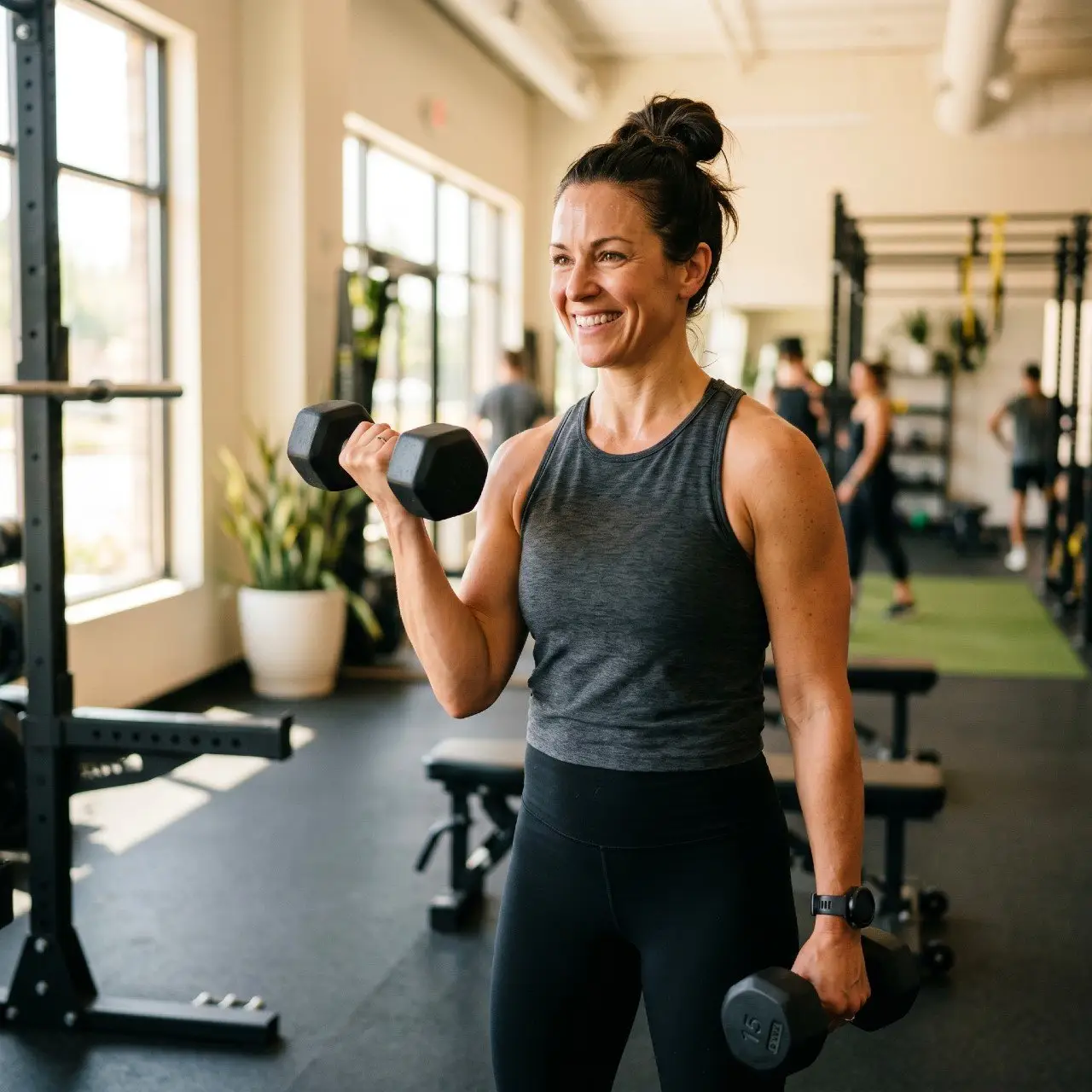
You go where the path is clearest. Pack your gym bag the night before, put your trainers by the door, and lay out your workout clothes. Environmental design removes the friction that kills motivation before you even leave the house — and it works when motivation doesn't.
Stanford researcher BJ Fogg has spent years studying why behavior change fails. His conclusion: it usually isn't a lack of motivation. It's an environment that doesn't support the behavior.
This matters more for women than most fitness content acknowledges. The Frontiers in Psychology 2024 study on motivational variations found that women are strongly driven by enjoyment and autonomy — but those factors disappear fast when getting to the gym feels like a logistical battle.
Practical environment changes that actually move the needle:
- Pack your gym bag the night before — reduces morning decision fatigue.
- Set your workout clothes out where you can see them — visual cues trigger habitual behavior (this is called "implementation intention" in behavioral psychology, and it works).
- Keep a resistance band or mat visible at home — lowers the activation energy for days when gym travel isn't realistic.
- Choose a gym that's on your daily commute route — convenience predicts attendance more reliably than quality.
The point isn't to become more motivated. The point is to make the right behavior the easy behavior. Willpower is a finite resource; environment design is not.
For more on building gym confidence alongside environment setup, see our guide: How To Build Fitness Confidence When You Hate The Gym.
Tip #3: Use The 10-Minute Rule To Beat Activation Energy
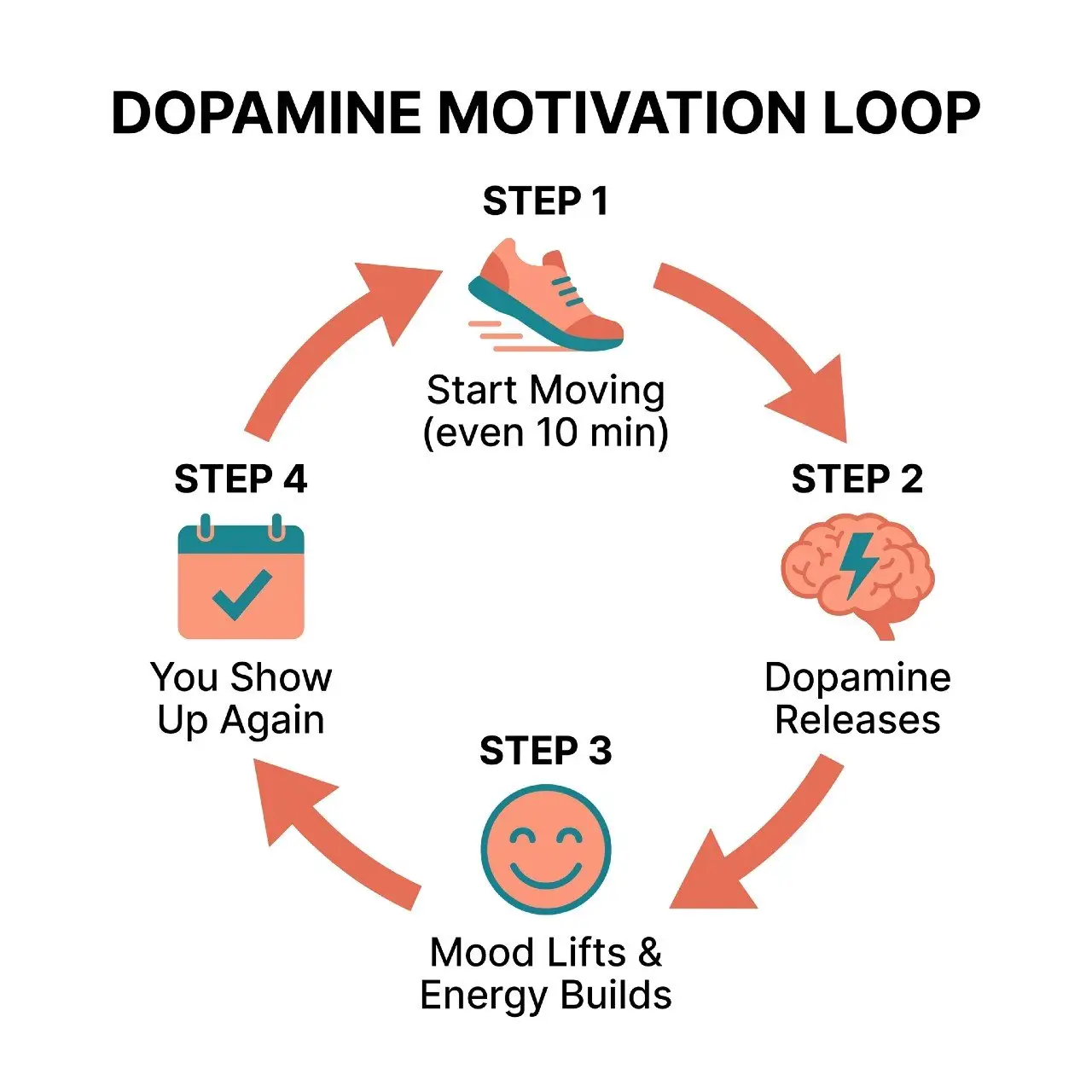
Commit to only 10 minutes. If you want to stop at 10, stop — no guilt. What actually happens in practice: once you're moving, dopamine kicks in, and you rarely stop at 10 minutes. This works because starting is the hardest part, and the 10-minute rule removes the psychological weight of commitment.
This isn't a motivational trick. It's a neuroscience one.
Research from NYU Grossman School of Medicine, published in the Journal of Neuroscience, found that voluntary exercise significantly boosts dopamine release in the brain, with runners showing 30–40% higher dopamine levels than non-exercising controls. Notably, the dopamine boost remained elevated even after a week of rest. While these findings were in animal models, and human studies are ongoing, they offer a compelling neurological explanation for why regular exercise becomes self-reinforcing over time.
What's important here: dopamine release doesn't just reward you after the workout. It begins in anticipation of movement, which is why starting, just getting your shoes on, initiates the loop.
The 10-minute rule works by giving your brain permission to begin without demanding a full hour of commitment. And once dopamine is doing its job, forward momentum usually takes care of the rest.
Use it on days when you genuinely don't want to go. Not as a trick to force yourself, but as an honest deal with yourself: 10 minutes. If it's truly not working, I can leave. Most days, you won't.
Tip #4: Sync Your Workouts With Your Hormonal Cycle
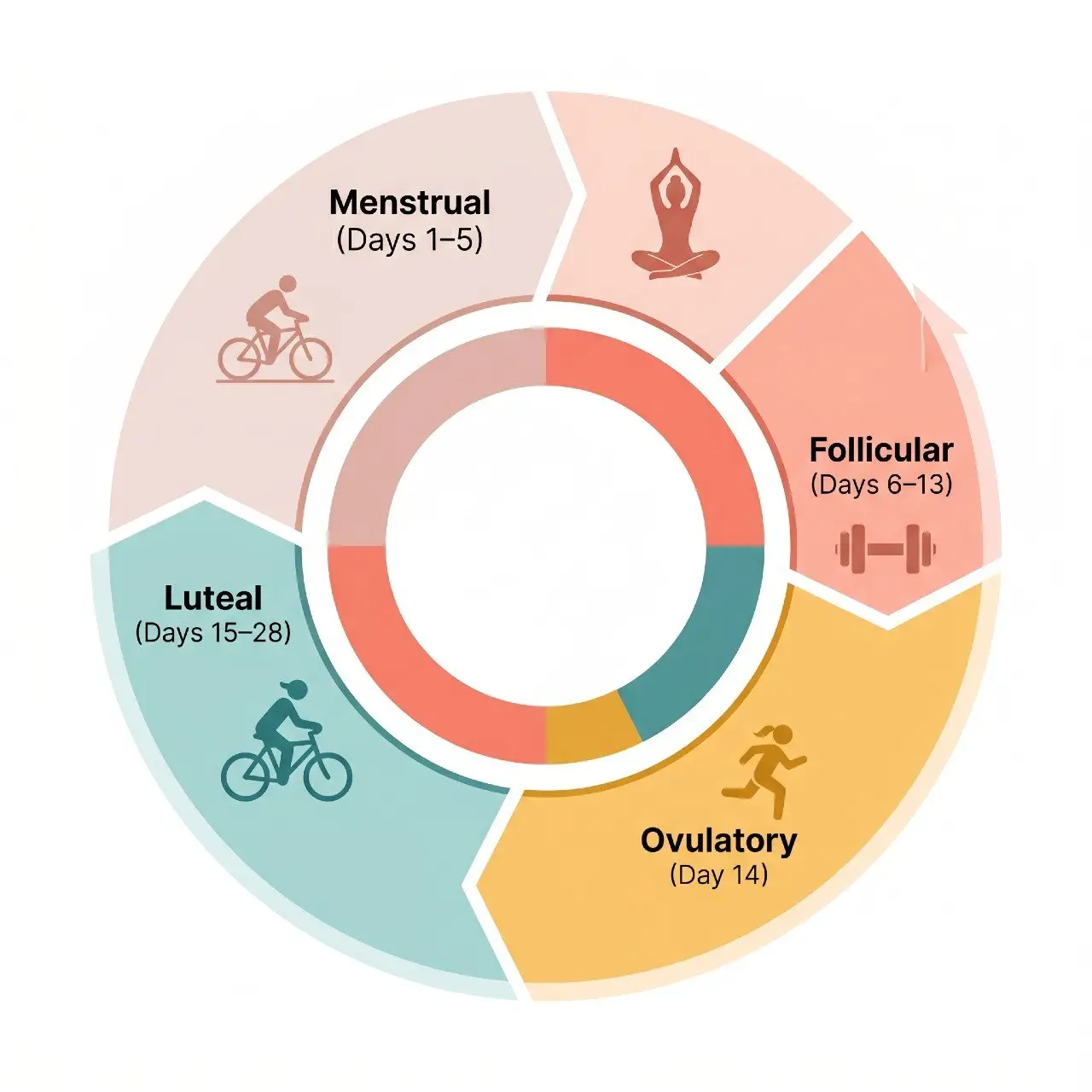
Women's energy, strength output, and motivation change significantly across the four phases of the menstrual cycle. Trying to train at the same intensity every day of the month is working against your biology — and it's a common reason women feel like they're "failing" in week three. Adjusting intensity to match your cycle makes motivation easier and results better.
This is one of the most overlooked gym motivation tips for women — and one of the most impactful.
During the luteal phase (roughly days 15–28), serotonin drops and fatigue increases. This is documented endocrinology, not an excuse. It explains exactly why motivation tends to crater in the week before your period, and why pushing through with high-intensity training during this phase so often leads to burnout. During the follicular phase (days 6–13), estrogen rises, coordination improves, and your body is primed for harder efforts, heavier weights, and new challenges.
The table below is a simplified training guide for each phase:
Table 1: Your Hormonal Cycle Workout Guide
| Cycle Phase | Days (Approx.) | Hormone Trend | Energy Level | Best Workout | Motivation Note |
|---|---|---|---|---|---|
| Menstrual | 1–5 | Estrogen & progesterone at the lowest | Low to moderate | Walking, gentle yoga, light stretching | Celebrate showing up. Any movement counts. |
| Follicular | 6–13 | Estrogen rising | Building | Strength training, HIIT, trying new movements | Try the exercise that's been intimidating you. Your resilience peaks here. |
| Ovulatory | 14 | Estrogen peaks | Highest | High-intensity sessions, strength PRs | Your best performance window of the month. Use it. |
| Luteal | 15–28 | Progesterone rises, then falls | Declining | Moderate cardio, pilates, lighter strength work | Plan lower-intensity sessions deliberately. This isn't laziness — it's smart. |
This doesn't mean yoga-only in your luteal phase or skipping everything in week one. It means you stop judging yourself for lower-output days in week three, and start planning around your cycle rather than against it. The women who feel consistently motivated to train are usually training with their biology, not despite it.
For a full deep-dive: Cycle Syncing For Weight Loss: How To Eat And Work Out With Your Menstrual Cycle.

Tip #5: Conquer Gym Intimidation With A Confidence Blueprint
Gym intimidation affects 25% of women (vs. 16% of men), making it one of the most common reasons women avoid the gym or cut sessions short. The fix isn't to "just get over it" — it's to build familiarity and competence systematically, one small exposure at a time.
Let me be direct about something: the gym can feel like a space that wasn't designed for women.
That feeling isn't imagined. The PLOS One 2024 study found that women in gym settings regularly report navigating body image anxiety, unsolicited attention, and the experience of competing for equipment in spaces that often default to male gym culture. Gymtimidation is real, it's measurable, and it directly reduces attendance.
The confidence blueprint approach treats this as a skill-building problem, not a mindset problem. Here's the four-step version:
- Do a reconnaissance visit first. Go in during off-peak hours without a workout planned — just to walk the space, locate equipment, and get a feel for the environment. Familiarity reduces anxiety before you even begin training.
- Master one section before expanding. Pick one area — the cable machines, the stretching zone, the squat racks — and get comfortable there before moving on. Competence builds confidence faster than pep talks.
- Use off-peak hours intentionally at first. Quieter gyms feel like practice rather than performance. Morning gym sessions (5 am–7 am) or midday sessions on weekdays are typically the least crowded.
- Ask for a brief equipment orientation. Most gym staff are trained for this. A five-minute walkthrough removes the "am I doing this wrong?" anxiety that cuts workouts short far more than physical fatigue does.
Confidence doesn't arrive pre-formed. It's built in small reps, exactly like a muscle. Full resource: How To Get Started At The Gym Without Feeling Intimidated As A Woman.
Tip #6: Build A Micro-Reward System That Hijacks Dopamine
Visible body composition changes take 8–12 weeks. Waiting for those results as your only reward will almost certainly cause dropout before they arrive. Micro-rewards — small, immediate payoffs attached to every session — keep your brain engaged in the habit loop until intrinsic motivation catches up.
Dopamine doesn't just reward completed goals. It fires in anticipation of rewards. That's the neurological mechanism behind habit formation: your brain tags a behavior as worth repeating when it reliably predicts something pleasurable is coming.
The problem with most fitness approaches is that the reward (a leaner physique, more energy, stronger lifts) is weeks or months out. Your brain doesn't wait graciously. A micro-reward system fixes this by creating immediate, specific feedback after every session.
Build yours with three layers:
- A post-workout ritual. Something small and pleasurable that only happens after you train. A specific coffee drink. A podcast episode you save for the walk home. Ten minutes of a show you're rationing. The specificity matters — a reward that happens anyway isn't a reward, it's just a treat.
- Progress tracking beyond the scale. Track the metrics that actually move week to week: reps, weights lifted, how long you held a plank, and how far you walked. Seeing these numbers shift is intrinsically satisfying in a way that body weight — which fluctuates daily with water, hormones, and food timing — is not.
- A weekly milestone recognition. If you hit your weekly workout target, acknowledge it. Not with food (that creates its own complications), but with something that signals: I did what I said I'd do. A Saturday morning coffee ritual. A new song has been added to your training playlist. A check mark in your habit tracker that turns a full week green.
This approach leans on the same neuroscience that drives any habit: shorten the feedback loop until intrinsic motivation arrives. According to Dr. Phillippa Lally's UCL research, habit automaticity — the point where showing up feels normal rather than effortful — arrives around the 66-day mark on average (range: 18–254 days). Micro-rewards are how you bridge that gap.

Tip #7: Build A Three-Tier Accountability System
"Find a workout buddy" is real advice, but it's fragile. The most durable accountability structure has three layers: a person who notices when you go quiet, a platform that logs your commitment, and a community that normalizes movement. All three together are far more resilient than any one alone.
A 2024 social support and exercise study found that adults who discussed their exercise habits with peers were more likely to increase and sustain physical activity compared to those relying purely on self-motivation. Social accountability isn't a soft strategy — it's behavioral science.
Here's the three-tier structure:
- Tier 1 — The Person. One friend, family member, or colleague who checks in when you go quiet. This doesn't have to be someone who trains with you daily. It's someone who asks "how's the gym going?" and actually listens to the answer. That single point of external awareness changes behavior.
- Tier 2 — The Platform. An app (Strava, Strong, Apple Fitness+, a simple spreadsheet) that tracks your sessions. The act of logging creates a visible streak — and habit research shows that noticing when you've broken a streak motivates re-engagement, especially when you log again quickly rather than abandoning the tracker entirely.
- Tier 3 — The Community. A fitness class, an online group, or a forum of women with similar goals. Not for performance — for normalization. Surrounding yourself with people who treat regular movement as part of a normal life is one of the quietest, most effective motivation strategies available.
If you're a working mum trying to build this structure around a packed schedule, this article is specifically for you: Practical Strategies To Build Sustainable Workout Motivation For Working Moms.
Tip #8: Plan For The Motivation Dip — Because It's Coming
The motivation dip at weeks 3–6 is predictable, documented, and nearly universal. The women who stay consistent aren't the ones who avoid it — they're the ones who planned for it in advance, with a minimum viable workout and a written response to their own excuses.
Weeks one and two of a new gym routine feel good. You're riding novelty, intention, and the dopamine wave of a fresh start. Then, around week three or four, the novelty fades. Results haven't arrived yet. Life intrudes. The dip shows up.
Here's what the research says: the popular "21 days to form a habit" rule is a myth. Dr. Phillippa Lally's landmark UCL study, published in the European Journal of Social Psychology, found that the average time to form a daily habit is 66 days, with a range of 18–254 days depending on the behavior. Gym workouts sit at the harder end of that range. Week four is not a failure. It's the middle of the process.
Having a plan for the dip changes everything. Before you start your next routine, write down your "dip protocol":
- Your minimum viable workout. The smallest version of training you can always say yes to, regardless of energy level or schedule. Fifteen minutes of movement. One strength exercise. A walk around the block. Define this now, before fatigue defines it for you.
- A prepared response to common excuses. "When I feel too tired to train, I will do ___." Fill the blank when you're clear-headed, not when you're tired.
- A commitment-over-motivation check-in. On low days, don't ask "Am I motivated?" Ask "Am I still committed?" Motivation fluctuates. Commitment is a decision.
Missing one workout doesn't break a habit. Missing two starts a new one. The dip protocol is how you stop one skipped session from becoming a month.
For specific strategies on finishing what you start once you're in the gym: How To Motivate Yourself To Finish Workouts, Not Just Start Them.
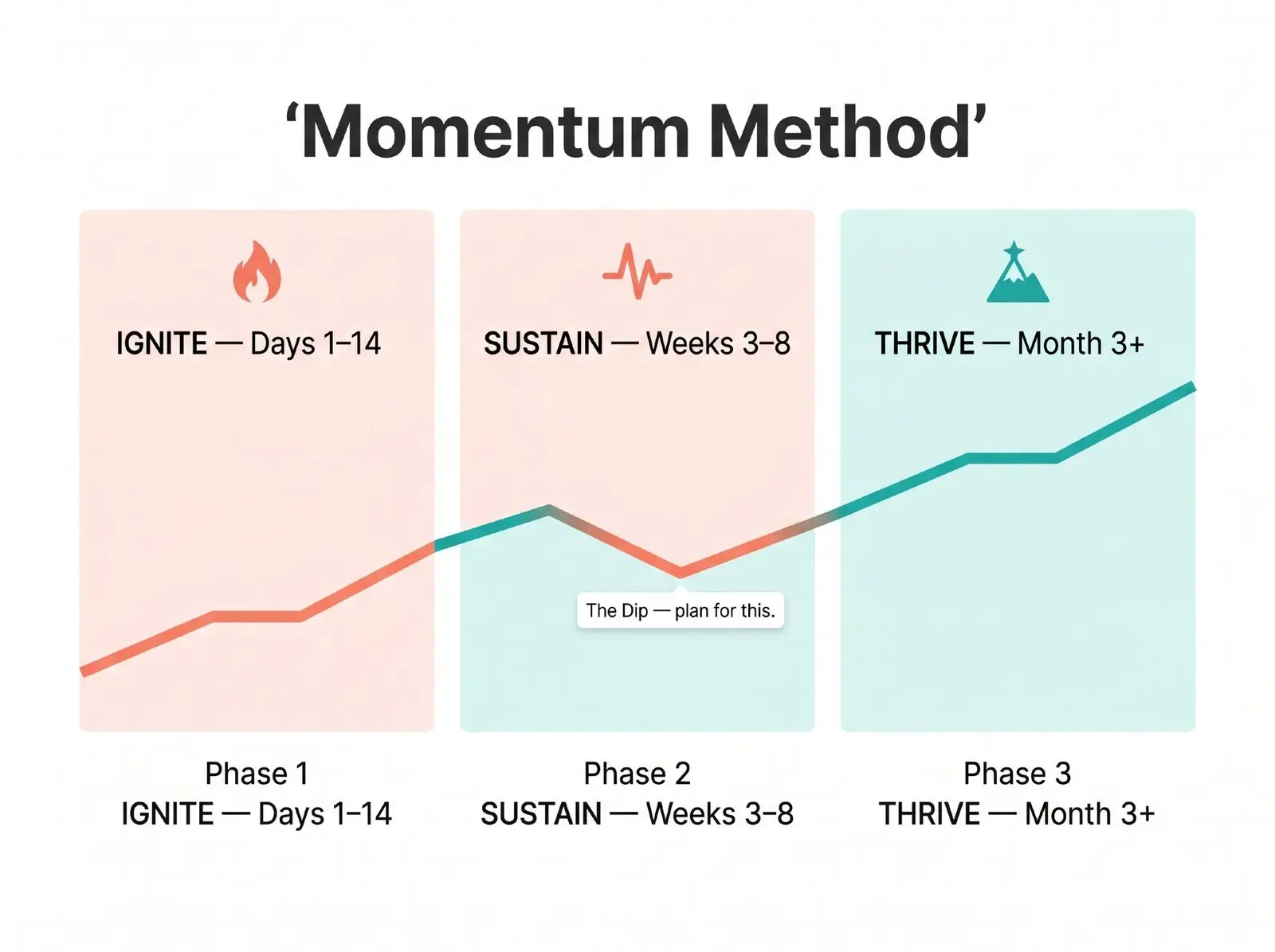
The Momentum Method: A Three-Phase Framework For Lasting Gym Motivation
Most gym motivation advice treats consistency as a switch — you either have it, or you don't. The Momentum Method treats it as a progression with three distinct phases, each with different challenges and different tools.
Phase 1: Ignite (Days 1–14)
The goal here isn't impressive results. The goal is to show up. Twice a week is enough. Use the 10-minute rule on hard days. Accept that some sessions will feel flat. Identity-based framing matters most in this phase: you're not performing, you're voting for the version of yourself you're building.
Phase 2: Sustain (Weeks 3–8)
The dip lives here. Novelty is gone, and results haven't arrived. This is where most women quit. The tools that work in this phase: micro-rewards, accountability architecture, and the minimum viable workout. Lower the bar when life gets heavy. Consistency beats intensity every time in this phase.
Phase 3: Thrive (Month 3 onward)
By this point, habit formation research suggests the behavior is becoming automatic. You can now add complexity: training progressions, cycle syncing, and performance goals. Self-Determination Theory identifies three elements that sustain intrinsic motivation long-term: autonomy (you choose your workouts), competence (you feel your skills growing), and relatedness (you feel connected to a community). Design your gym life to satisfy all three, and the habit becomes self-sustaining.
Join Our Mailing List
Join thousands of women inside our community and receive our free guide, 10 Actions That Support Permanent Weight Loss — the exact behavioural shifts that make the difference between a two-week attempt and a lasting transformation.
No restriction plans. No guilt. Just what actually works — for real women with real lives.
The Best Workout Motivation Ever
We know that starting a fitness routine can be difficult, but with the right mindset and strategies, you can make it a habit.
What Is The Fastest Way To Fix Common Gym Motivation Problems?
The fastest fix is usually environmental, not psychological. Match the challenge to its root cause, and the solution becomes obvious. This table covers the six most common scenarios women face:
Table 2: Gym Motivation Problem Solver
| Challenge | Root Cause | Science-Backed Solution | Expected Timeframe |
|---|---|---|---|
| Can't get myself to go | Activation energy too high | 10-minute rule + pre-packed bag + environment redesign | 1–2 weeks |
| Start strong, quit after 2–3 weeks | Novelty wore off; dip arrived | Written dip protocol + minimum viable workout | Ongoing management |
| Go consistently, then disappear for a month | No accountability layer | Three-tier accountability system | 2–3 weeks to establish |
| Motivation collapses before the period | Luteal phase hormonal shift | Cycle-synced workout plan (lower intensity, days 15–28) | 1–2 cycles |
| The gym feels intimidating or unwelcoming | Gymtimidation (affects 25% of women) | Confidence blueprint: off-peak hours, one section at a time | 3–4 weeks |
| Results aren't showing; feel like quitting | Reward gap (results take 8–12 weeks) | Micro-reward system + progress tracking beyond the scale | Immediate to set up |
Enjoyed the article on science-backed gym motivation tips? There's plenty more where that came from. For a done-for-you system to build momentum and finally achieve your goals, grab your free guide here.
- How To Motivate Yourself To Finish Workouts, Not Just Start Them
- How To Build Fitness Confidence When You Hate The Gym
- Fitness Motivation For Women Who Work From Home
- Practical Strategies To Build Sustainable Workout Motivation For Working Moms
- Strength Training For Women Over 40: Build Lean Muscle Without Bulking
- Your Weight Loss Mindset: How To Think Like A Woman Who Succeeds
The Bottom Line
You have started over before. So have I. That doesn't mean the habit never took — it means the system wasn't built to outlast the motivation.
These 8 gym motivation tips for women aren't about summoning willpower you don't have or finding the perfect song. They're about understanding why motivation comes and goes, and designing a routine that keeps going anyway.
That's the difference between women who restart every January and women who've quietly been training for five years — not because they always feel like it, but because they built something that doesn't require them to.
Pick two strategies from this list. Set them up this week. The gym will be there, and honestly — so will you.
Glossary Of Key Terms
FAQ
The most durable approach for women who've restarted multiple times is identity-based habit formation. Shift from "I want to lose weight" to "I'm someone who takes care of her body." Every gym session — even a short one — becomes a vote for that identity rather than a performance against a goal. Pair it with a written dip protocol and a minimum viable workout, and you have a system that holds on the days motivation doesn't show up.
Significantly and predictably. During the luteal phase (days 15–28 of your cycle), serotonin drops and fatigue increases, which directly reduces exercise motivation and recovery capacity. During the follicular phase (days 6–13), estrogen rises, energy builds, and your body handles higher training loads well. Cycle syncing means adjusting your workout intensity to match these phases, which reduces the experience of "failing" and makes showing up feel less like a battle.
Use the 10-minute rule. Commit to exactly 10 minutes. If you want to leave after 10, leave — no guilt. What happens in practice: once you've started moving and dopamine begins its job, you rarely stop at 10 minutes. The rule works by removing the psychological weight of a full-session commitment, which is usually the only real obstacle on low-energy days.
Treat it as a skill-building problem, not a mindset problem. Visit the gym during off-peak hours with no workout planned — just to walk around and get familiar. Then master one area before expanding. Ask for a brief equipment orientation. Each small exposure builds competence, and competence builds confidence in a way that pep talks don't. It's worth knowing that gymtimidation affects 25% of women (vs. 16% of men) — you are in significant company, and it does pass with consistent low-stakes exposure.
University College London research found an average of 66 days, with a range of 18–254 days depending on the complexity of the behavior. Gym workouts sit toward the longer end of that range. The practical implication: give yourself at least three full months before deciding whether a routine is working, and don't evaluate it by how it feels at week four.
A workout partner helps, but single-point-of-failure accountability is fragile. The more resilient approach is a three-tier system: one person who checks in on you, one platform or log that tracks your sessions, and one community (a class, an online group) that normalizes regular movement. When your partner is busy, the other two tiers hold.
Completely normal. Motivation is a feeling, and feelings fluctuate with sleep, stress, hormonal phases, life events, and a hundred other variables. The goal isn't to feel motivated every day — it's to build a system that gets you moving anyway. On zero-motivation days, the minimum viable workout (defined in advance) is your anchor: the smallest version of training you can always say yes to.