
Practical, Proven Money-Saving Hacks That Cut Your Food Spending And Grocery Bill Without Cutting Corners On Health Or Taste
Benjamin Franklin
Poor Richard's Almanack
Beware of little expenses; a small leak will sink a great ship.
The Executive Summary
To reduce your grocery bill, implement smart strategies like meal planning and setting a grocery budget. Utilize weekly sales flyers, shop with a list, and conduct pantry audits to minimize food waste.
Reduce meat consumption by incorporating cheaper protein sources such as beans and lentils. Buying store brands, using cashback apps, and opting for seasonal or frozen produce can also lead to significant savings without sacrificing nutrition.
You scan the receipt. Then you scan it again. You bought essentially the same things you always buy. You cooked at home most nights. And somehow, the grocery bill is still jaw-dropping.
Sound familiar? You do not have an income problem. You have a grocery strategy problem — and that is entirely fixable.
The average American family spends between $412 and $1,279 per month on groceries, according to the USDA's monthly food cost reports. The difference between those extremes is not the quality of the food. It is the presence or absence of a system.
This guide gives you 10 specific, evidence-backed strategies to reduce your grocery bill — without compromising on the nutrition that supports your health goals. Because eating well and spending wisely are not competing priorities. They are, with the right approach, the same priority.
Key Takeaways
- Meal planning before you shop eliminates the impulse purchases that silently inflate every receipt.
- A written grocery budget is the single most impactful habit for consistent grocery savings.
- Reducing meat 2-3 times per week and substituting cheap protein sources (beans, lentils, eggs) can save $30-60 per month.
- Frozen produce is nutritionally equivalent to fresh and costs 30-50% less, with zero waste.
- Store brands save an average of 25-30% versus equivalent name-brand products with no measurable quality difference.
- Bulk buying non-perishables on a lower unit price basis consistently delivers 20-40% savings.
- Seasonal produce is always cheaper, fresher, and more nutritionally dense than out-of-season alternatives.
- Cashback apps and digital coupons require 5 minutes of setup and can save $15-40 per month passively.
- Reducing food waste by just 25% could save the average household $500-1,000 annually.
Why Is Your Grocery Bill So High — And How Much Can You Actually Save?
Most grocery overspending is not caused by eating well — it is caused by shopping without a plan, purchasing convenience over cost, and systematically wasting food that was bought with good intentions. The USDA Economic Research Service reports that American households waste roughly 30-40% of the food they purchase — meaning a significant portion of every grocery bill is funding food that never gets eaten.
The encouraging reality: grocery savings are available at every income level and do not require extreme couponing, hours of planning, or sacrificing the nutritional quality that supports your health. Most households can reduce grocery spending by $50-200 per month with the strategies below — applied gradually, one habit at a time.
What The Average Household Spends — And Where Overspending Hides
| Spending Category | % of Average Grocery Bill | Primary Overspend Driver | Savings Potential |
|---|---|---|---|
| Meat and seafood | 25-30% | Frequency + premium cuts | High — $30-60/month |
| Fresh produce (wasted) | 10-15% | Poor planning, no rotation | High — $20-40/month |
| Branded packaged goods | 20-25% | Brand loyalty vs. value | Medium — $15-30/month |
| Beverages | 8-12% | Juice, soda, sports drinks | Medium — $10-20/month |
| Impulse purchases | 10-20% | Shopping without a list | High — $20-50/month |
| Bulk staples (missed) | 5-10% | Not buying in bulk | Medium — $10-25/month |

FACT: Grocery savings are available at every income level and do not require extreme couponing, hours of planning, or sacrificing the nutritional quality that supports your health.
How Does Meal Planning Reduce Your Grocery Bill?
Meal planning reduces grocery spending by eliminating the two biggest budget killers: impulse purchases made without a plan and food waste from ingredients bought without a clear use. Research consistently shows that households with a weekly meal plan spend 15-25% less on groceries than those who shop reactively, and waste significantly less food.
The logic is simple: when you know exactly what you are cooking this week, you buy exactly what you need — and nothing else. Every item in your basket has a job. Nothing is speculative.
How To Build A Meal Plan That Saves Money
The most effective meal planning system for grocery savings is built around what you already have and what is currently on sale — not what you feel like eating.
Step 1: Inventory first. Before writing a single meal plan, check your refrigerator, freezer, and pantry. Plan at least 2-3 meals around what is already there. This is the fastest path to reducing food waste and saving money simultaneously.
Step 2: Check the weekly sale flyer. Most supermarkets publish digital weekly circulars. Build 1-2 meals around whatever protein or produce is discounted this week. This is how to plan meals around sales — the backbone of frugal meal planning.
Step 3: Write the full week's meals before you write a shopping list. Breakfast, lunch, dinner, and snacks. Then — and only then — create your list based on what the plan requires minus what you already have.
Step 4: Never shop without that list. The list is not a suggestion. It is your budget shield. According to consumer behaviour research, shoppers who use a prepared list spend an average of 20% less than those who do not.
Pairing good meal planning habits with clean eating strategies for women ensures your budget goes toward food that actually serves your health — not toward expensive processed convenience items.
How Do You Set A Grocery Budget — And Actually Stick To It?
Setting a realistic grocery budget requires calculating your household's actual food needs by person and week, then committing to that number as a firm limit — not a guideline. The act of having a specific budget changes shopping behaviour measurably: it forces trade-off decisions at the point of purchase rather than after the fact when the damage is done.
How To Set Your Number
A reasonable starting baseline for budget-friendly grocery shopping, using USDA Thrifty Plan figures:
- Individual adult: $200-280/month ($50-70/week)
- Couple: $350-450/month ($87-112/week)
- Family of 4: $550-750/month ($137-187/week)
These numbers assume whole foods cooking at home — no restaurant meals, no meal kit services, no ready-made convenience foods.
Household Budgeting Techniques That Work
- Cash envelope method: Withdraw your weekly grocery budget in cash. When it is gone, it is gone. The physical nature of cash creates spending friction that credit cards and contactless payments do not.
- Expense tracking app: Apps like Mint, YNAB, or even a simple spreadsheet — logging grocery spending weekly reveals patterns of overspending that are invisible when you do not track.
- Per-person daily food budget: Divide your monthly grocery budget by household members and days. This per-person lens makes overspending feel concrete rather than abstract.
- The Sunday Reset: Conduct a weekly 20-minute pantry audit every Sunday. Identify what needs to be used before it spoils, plan those items into the week's meals, and write the upcoming week's shopping list. This single habit prevents the food waste that inflates most grocery bills.
How Can Reducing Meat Consumption Save Significant Money?
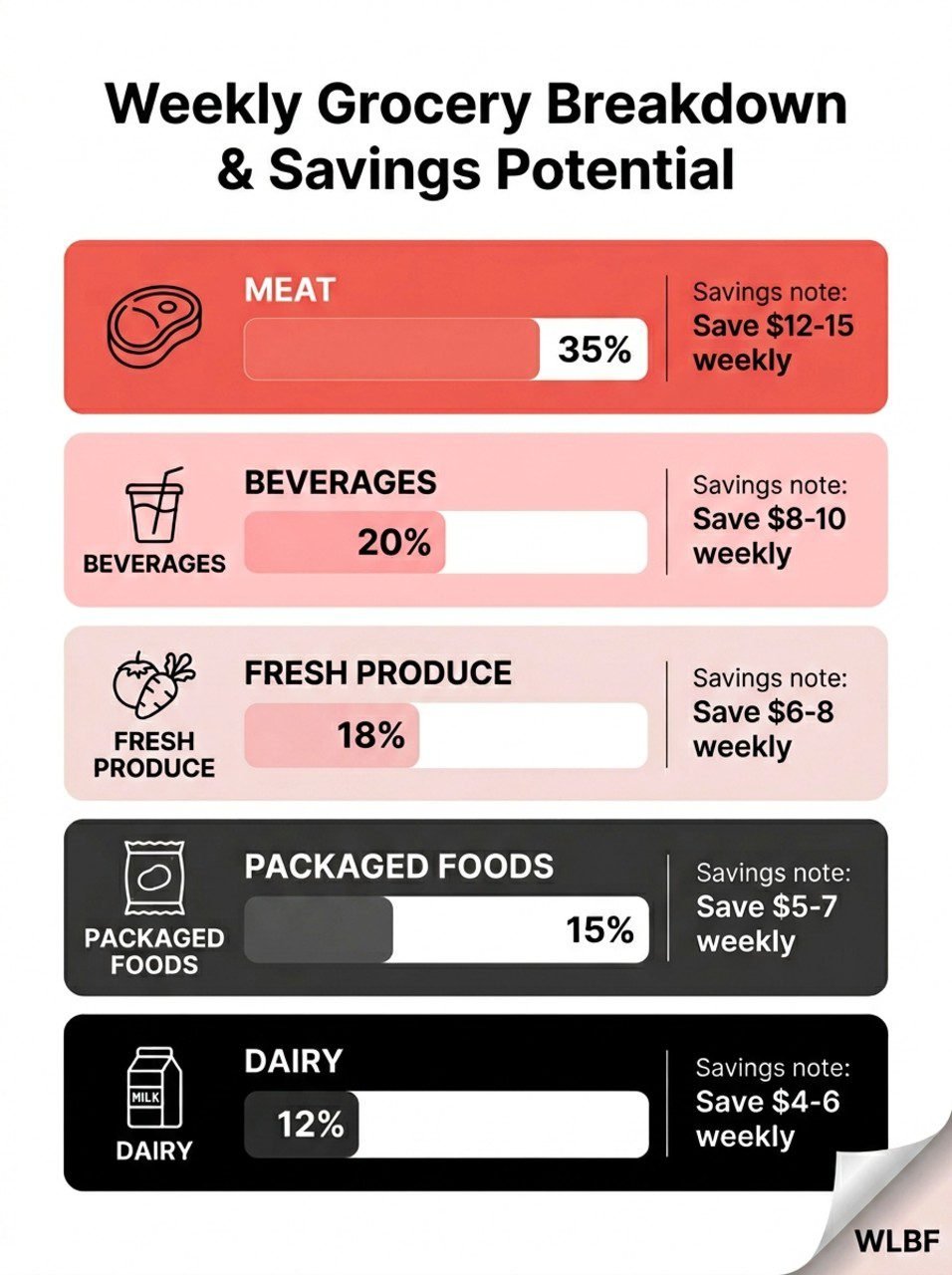
Meat is the single most expensive item in the average household's grocery basket, often representing 25-30% of total food spending. Replacing meat 2-4 times per week with plant-based proteins — beans, lentils, eggs, tofu, and canned fish — can reduce grocery spending by $30-60 per month without reducing protein intake or meal satisfaction.
This is not about eliminating meat. It is about recognising that the cheapest protein sources are, coincidentally, among the most nutritionally complete for women.
Cheap Protein Sources: Price Per Gram Of Protein Comparison
| Protein Source | Approximate Cost | Protein (per serving) | Cost Per 10g Protein |
|---|---|---|---|
| Chicken breast (skin-off) | $3.50-5.00/lb | 31g per 100g | $0.35-0.50 |
| Canned chickpeas | $0.80-1.20/can | 7g per 100g | $0.12-0.18 |
| Dried red lentils | $1.50-2.50/lb | 9g per 100g (cooked) | $0.08-0.14 |
| Eggs (large, dozen) | $2.50-4.00/doz | 6g per egg | $0.25-0.35 |
| Canned tuna | $0.90-1.50/can | 25g per 100g | $0.10-0.18 |
| Tofu (firm) | $2.00-3.50/block | 8g per 100g | $0.18-0.30 |
| Ground beef (80/20) | $4.50-7.00/lb | 17g per 100g | $0.60-0.95 |
The data is clear: dried lentils and canned legumes deliver protein at 5-10x less cost than ground beef. Two bean-based meals per week consistently deliver $15-25 in monthly savings per household — and support the gut health that clean eating approaches prioritise.
Easy Cheap Protein Meal Ideas
- Lentil soup: Dried lentils + canned tomatoes + vegetable stock + spices. Under $2 per serving, 4 servings per batch.
- Bean tacos or burrito bowls: Canned black or pinto beans seasoned with cumin, paprika, and garlic. Under $1.50 per serving.
- Egg-based dinners: Frittata, shakshuka, or a vegetable omelette. 3-4 eggs per serving = under $1 in protein cost.
- Canned fish dishes: Tuna pasta, sardine toast, or canned salmon patties — all deliver 25-30g protein per serving under $2.

TIP: Still packed with essential vitamins and minerals, frozen vegetables are also much more affordable. Save an average of $5 or more when switching to frozen from fresh.
Is Frozen Produce As Nutritious As Fresh, And How Much Does It Save?
Frozen fruits and vegetables are nutritionally equivalent to fresh produce — and in some cases contain higher micronutrient levels, because they are frozen at peak ripeness within hours of harvest, while fresh produce loses nutrients during transport and storage. Switching from fresh to frozen produce for cooking (not raw eating) saves an average of $5-15 per week with zero sacrifice in nutritional value.
This single strategy is the most compelling value-for-nutrition swap in grocery budgeting — and the most underutilised.
The Science Behind Frozen Produce
Research published in the Journal of Food Composition and Analysis found that frozen vegetables retain comparable or superior levels of vitamin C, folate, and other heat-sensitive nutrients compared to "fresh" vegetables that have spent days in transit and display. The freezing process halts enzymatic degradation that begins the moment the produce is harvested.
Practical implications for your grocery bill:
- A 1-pound bag of frozen spinach costs $1.50-2.50. An equivalent fresh bunch costs $3-5 and wilts within 4-5 days.
- A 2-pound bag of frozen mixed berries costs $4-6. Fresh berries cost $5-8 per pound.
- Frozen broccoli, peas, corn, green beans, and edamame all deliver equivalent nutrition at 30-50% lower cost.
Freezer Meal Prep: The Multiplier Strategy
Batch cooking and freezer meals amplify grocery savings by:
- Allowing you to buy in bulk when items are on sale and freeze the excess.
- Eliminating weeknight decision fatigue that drives takeaway spending.
- Reducing per-serving costs through large-batch cooking efficiency.
A Sunday batch cooking session — producing 3-4 frozen meals from discounted or bulk-bought ingredients — can eliminate 2-3 takeaway or convenience food purchases per week. The savings are significant.
How Much Can You Save By Choosing Store Brands Over Name Brands?
Switching to store-brand (own-label) products for pantry staples delivers an average saving of 25-30% compared to equivalent name-brand items, with no measurable difference in nutritional content or quality for the vast majority of product categories. Consumer Reports testing consistently finds that store brands meet or exceed name-brand quality across dry goods, canned foods, frozen items, and dairy.
The price difference between name brands and store brands is almost entirely explained by marketing spend and packaging — not by ingredient or manufacturing quality. Supermarkets' own-brand products are frequently manufactured in the same facilities as premium brands.
Where Store Brand Switching Saves Most
High savings, no quality difference (switch immediately):
- Canned tomatoes, beans, chickpeas, and corn
- Dried pasta, rice, oats, and flour
- Frozen vegetables and fruits
- Milk, butter, and plain yoghurt
- Olive oil and cooking oils
- Spices and dried herbs
Moderate savings, try-before-committing:
- Breakfast cereals (texture and flavour vary)
- Coffee and tea
- Condiments and sauces
Lower priority to switch:
- Fresh produce (no brand difference — price by item)
- Fresh meat (quality varies by butcher, not brand)
Making store-brand switches across your regular pantry staples list typically saves $20-40 per month for a household of 2-4 people.
When Does Bulk Buying Actually Save Money — And When Doesn't It?
Bulk buying saves money when applied to non-perishable items you use regularly, where the lower unit price translates into real savings before the product is needed. It does not save money when applied to perishable items that spoil before use, in which case it simply amplifies food waste and wasted spending.
Bulk Buying Guide: What To Buy In Bulk vs. What To Avoid
Always buy in bulk (non-perishable, regularly used):
- Dried grains: rice, oats, quinoa, dried pasta.
- Canned goods: tomatoes, beans, tuna, and coconut milk.
- Cooking oils and vinegars.
- Nuts and seeds (if stored in airtight containers).
- Household staples: toilet paper, cleaning products, and personal care.
Buy in bulk cautiously (perishable, requires planning):
- Fresh meat: buy in bulk from the butcher, portion, and freeze immediately.
- Cheese: freeze what you will not use within 2 weeks.
- Bread: freeze half upon purchase.
Do not buy in bulk:
- Fresh produce you cannot freeze and will not use within 3-4 days.
- Items you are trying for the first time (unknown if you will use the whole quantity).
- Perishables without a freezing plan.
The unit price calculation is key: always divide the total price by the total quantity to compare bulk vs. regular price per ounce, gram, or unit. Many supermarkets display unit prices on the shelf label — use this number, not the headline price.
How Does Choosing Seasonal And Local Produce Reduce Costs?
Seasonal produce costs significantly less than out-of-season equivalents because it requires no long-distance transport, extended cold storage, or greenhouse growing infrastructure — savings that are passed directly to the consumer. Seasonal eating also delivers superior flavour and nutritional quality, because produce sold at peak ripeness retains higher vitamin and antioxidant levels.
Understanding and using a seasonal produce calendar is one of the most effective strategies for budget-friendly grocery shopping, particularly for women prioritising nutritional quality on a limited food budget.
Seasonal Produce Calendar: What's Cheapest When
| Season | Cheapest Produce | Price Advantage vs. Off-Season |
|---|---|---|
| Spring (Mar-May) | Asparagus, peas, lettuce, radishes, spinach | 30-50% less |
| Summer (Jun-Aug) | Tomatoes, corn, courgettes, berries, peaches | 40-60% less |
| Autumn (Sep-Nov) | Apples, pears, squash, sweet potatoes, Brussels sprouts | 30-50% less |
| Winter (Dec-Feb) | Citrus fruits, root vegetables, cabbage, kale | 20-40% less |
Combining seasonal produce with the frozen produce strategy means you can buy seasonal produce in bulk at peak cheapness, blanch and freeze it, and have access to cheap, nutritionally excellent vegetables year-round.
For women working toward fat-burning fitness goals, eating seasonally also maximises the phytonutrient diversity that supports hormonal balance, inflammation management, and metabolic health.
Join Our Mailing List
See how easily you can get fitter.
Sign up to get your free PDF report on 10 Actions That Support Weight Loss sent to your inbox!
What Are The Best Apps And Tools For Grocery Savings?
The most effective grocery saving apps combine price comparison, digital couponing, and cashback on purchases already in your shopping plan — delivering passive savings of $15-40 per month with minimal time investment after initial setup.
Cashback and rebate apps (earn money back on purchases):
- Ibotta: Scan receipts after shopping to earn cashback on specific products. Works at most major supermarkets. The average user earns $10-20/month.
- Fetch Rewards: Scan any grocery receipt for general points redeemable for gift cards. Minimal effort, cumulative value.
- Checkout 51: Weekly rotating cashback offers on common grocery categories.
Price comparison and digital coupon tools:
- Flipp: Aggregates weekly sale flyers from all local supermarkets in one app — essential for how to plan meals around sales and price comparison shopping without visiting multiple stores.
- Grocery store apps (native): Most major chains offer their own app with digital coupons, personalised deals based on purchase history, and loyalty points. Activate offers before shopping, not after.
Meal planning and waste reduction apps:
- AnyList or OurGroceries: Shared grocery list apps ideal for families; prevent duplicate purchases and forgotten items.
- NoWaste: Tracks pantry inventory and expiration dates — directly addressing how to avoid food waste and save money through better inventory management.
Setting up two or three of these apps takes 15-20 minutes. The savings accumulate passively from that point forward.
How Does Reducing Food Waste Cut Your Grocery Bill?
Reducing household food waste is one of the highest-return grocery savings strategies because it converts food already purchased and paid for into actual meals — rather than expensive compost. The average UK household wastes £730 worth of food annually; American estimates are similar or higher. Cutting food waste by even 25% saves the typical household $130-250 per year.
Inventory Management: The System That Prevents Waste
The primary cause of food waste is not buying too much — it is buying without knowing what you already have, then forgetting what you have until it spoils. These inventory management habits address that directly:
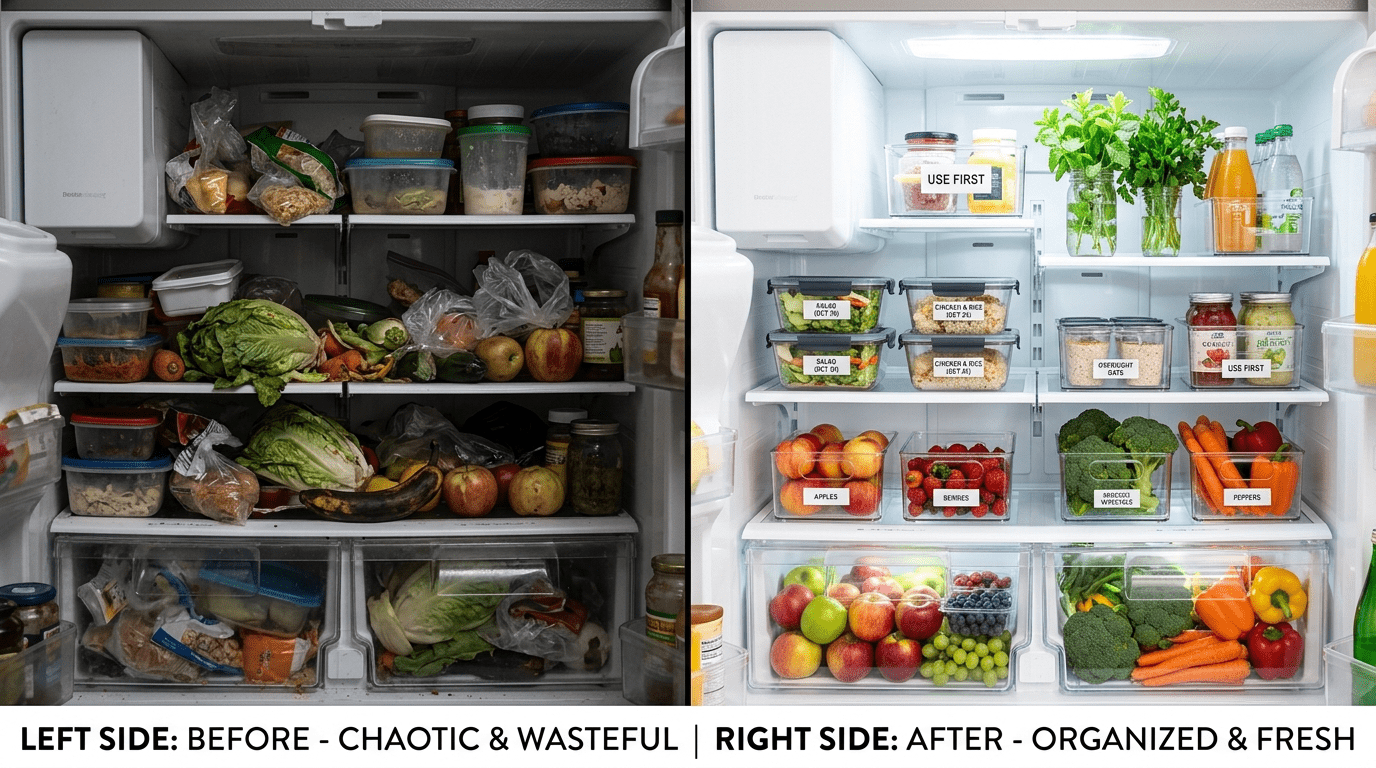
The "use first" shelf: Designate the eye-level shelf in your refrigerator as the use-first zone. Any ingredient nearing its use-by date goes here. Prepare meals from this shelf before opening anything new.
FIFO rotation (First In, First Out): When unpacking groceries, move older items forward and place new purchases behind them. This simple system prevents older items from being buried and forgotten.
Weekly fridge audit: Every Sunday (the Sunday Reset), spend 10 minutes assessing what is in your fridge, freezer, and pantry. Note what needs to be used this week and build 2-3 meals around those items before writing your shopping list.
Repurpose, don't discard: Many "waste" ingredients are functional:
- Wilting greens → blend into smoothies or soup.
- Overripe bananas → freeze for smoothies or bake into healthy banana bread.
- Stale bread → blend into breadcrumbs or cube for croutons.
- Vegetable off-cuts → simmer into stock and freeze.
Pairing smart grocery habits with sustainable weight loss strategies creates the nutritional foundation for your health goals — because eating well affordably removes the last remaining excuse for defaulting to processed convenience food.

TIP: When you are purchasing items on sale, and you have a set budget, such as $150 to spend, you’ll be surprised at how much you get just because that is the budget you have to stay within.
How Do You Save Money On Groceries Without Sacrificing Nutrition?
Saving money on groceries without compromising nutritional quality is achieved by redirecting spending from expensive, nutritionally poor options (processed packaged foods, premium beverages, meat-heavy every-day eating) toward the most nutritionally dense, affordable foods: dried legumes, eggs, frozen produce, whole grains, and seasonal vegetables.
The false belief that healthy eating is expensive is largely a product of comparing whole-food meals to ultra-processed convenience food by purchase price — without accounting for serving size, satiety, or nutritional value per pound. Dried lentils at $1.50 per pound deliver more protein, fibre, and micronutrients per dollar than any packaged "health food" product at five times the price.
The budget healthy eating hierarchy (most nutritious, least expensive):
- Dried legumes: Lentils, chickpeas, black beans, kidney beans — the highest nutrition-per-dollar foods available.
- Eggs: Complete protein, every essential micronutrient, $0.25-0.40 per egg.
- Frozen vegetables: Equal nutrition to fresh at 30-50% lower cost.
- Whole grains (bulk): Brown rice, oats, quinoa — fibre, B vitamins, sustained energy.
- Seasonal fresh produce: Maximum nutrition at minimum cost when bought in season.
- Canned fish: Tuna, sardines, salmon — omega-3s and protein at a fraction of the fresh fish price.
For women navigating the hormonal and metabolic dimensions of nutrition, understanding how nutrition supports hormonal balance makes it clear that the cheapest nutrient-dense whole foods are also the most hormonally supportive.

Your Next Step: Build The Body And The Budget You Deserve
You now have a complete grocery savings system — from meal planning fundamentals to bulk buying strategy to the apps that return money passively.
The next step: pair these food budgeting habits with the nutrition and fitness strategy that supports real, lasting transformation for women.
Join thousands of women in our free community and receive the Lean Body Formula Special Report — 10 research-backed actions that support permanent weight loss, written specifically for women's bodies and real lives.
No expensive health food required. No calorie counting. Just what the science supports — for real budgets and real results.
Related Articles
The Bottom Line
Grocery overspending is not a discipline problem or an income problem. It is a systems problem. The families and individuals who consistently spend less on groceries while eating better are not exercising more willpower — they are operating with better habits and better tools.
Meal plan before you shop. Set a budget and treat it as a boundary. Reduce expensive proteins two or three times a week. Choose frozen over fresh for cooking. Switch staples to store brands. Buy non-perishables in bulk. Eat with the seasons. Use the apps that passively return money on purchases you are already making. And stop paying for food you throw away.
Start with two or three strategies this week. Add one more the following week. Within a month, the savings will be visible — and the system will be automatic.
Your health goals and your financial goals are not competing. They are the same goal, approached with the same intelligence.
Embrace Inspiration:
Like What You Read? Be Sociable, Comment, And Share It! Thanks.
Glossary Of Key Terms
FAQ
The fastest-impact strategies for reducing your grocery bill immediately are: (1) writing a meal plan before shopping and buying only what the plan requires; (2) switching from name-brand to store-brand products for pantry staples — saving 25-30% per item; and (3) replacing fresh produce with frozen equivalents for cooking — saving 30-50% with no nutritional compromise. These three changes alone can reduce a typical household grocery bill by $50-100 in the first week.
The savings from switching from fresh to frozen vegetables for cooking are typically $5-15 per week for a household of 2-4 people, depending on current produce consumption. Over a year, that represents $260-780 in savings. The nutritional trade-off is effectively zero — research consistently shows frozen vegetables retain equivalent or superior micronutrient levels compared to fresh produce that has been transported and stored for several days.
Bulk buying delivers genuine savings only for non-perishable, regularly used items where you can consume the full quantity before expiry — dried grains, canned goods, cooking oils, nuts, and household staples. For perishables without a clear use plan or freezing strategy, bulk buying typically increases food waste and net cost. Always calculate the unit price (cost per ounce or gram) to verify that bulk pricing is actually lower than regular packaging.
Yes — and some of the most nutritionally complete foods are also the cheapest available. Dried lentils, canned chickpeas, eggs, frozen vegetables, oats, brown rice, and seasonal produce all deliver exceptional nutritional density at low cost. The perception that healthy eating is expensive comes from comparing whole-food cooking to ultra-processed convenience food — a comparison that ignores per-serving cost, satiety, and long-term health value.
Digital coupon apps (like the native supermarket app for your regular store) offer targeted discounts on specific products — activate them before shopping, not after. Cashback apps (like Ibotta and Fetch Rewards) return a percentage of your spend on qualifying items after purchase via receipt scan. Combined, these tools add $15-40 in monthly savings with minimal ongoing effort after the initial 15-20 minutes of setup. The key is using them for items already on your planned shopping list — not letting available coupons drive unplanned purchases.
Meal planning prevents food waste by ensuring every ingredient purchased has a specific planned use before it enters your basket. When you buy without a plan, ingredients are purchased speculatively — "I might use this" — and often spoil before a use materialises. A weekly meal plan, built around what you already have in your refrigerator and what is on sale, converts food purchasing from speculative to purposeful. Studies show that meal-planning households waste significantly less food and spend substantially less on groceries per week.
Join Our Mailing List
Join thousands of women inside our community and receive our free guide, 10 Actions That Support Permanent Weight Loss — the exact behavioural shifts that make the difference between a two-week attempt and a lasting transformation.
No restriction plans. No guilt. Just what actually works — for real women with real lives.